
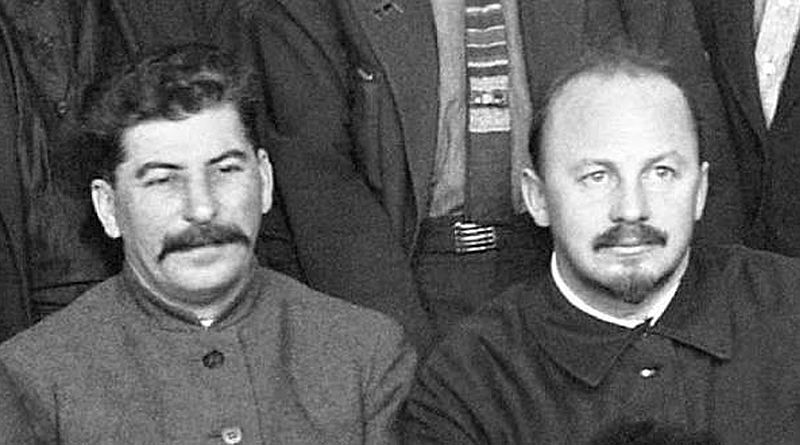
In my school years, I accidentally found a pre-war edition of the Small Soviet Encyclopedia in a friend’s library. I was interested in the fact that it contained biographies of Soviet leaders not mentioned in official sources. For some reason, I remembered the biography of a member of the Politburo of the Central Committee of the CPSU(b) Nikolai Bukharin – simply because it was written not in the bureaucratic language common in the last decades of the Soviet Union’s existence, but in normal human language. The author of the article in the encyclopedia called Bukharin the “party’s darling,” simple and accessible in everything – from philosophical discussions to playing “gorodki.”
The encyclopedia was published in that brief period when Stalin, with the help of his then-ally Bukharin, had already dealt with the so-called “left opposition” of Lenin’s associates Trotsky, Zinoviev, and Kamenev, but had not yet managed to remove Bukharin himself. Bukharin appeared as a supporter of a much more “humane” Bolshevism than his opponents – not surprisingly, he put forward the slogan “enrich yourselves!”, aimed primarily at the peasantry. However, ironically, Stalin used Bukharin to deal with supporters of orthodox socialist views only to later implement their political program – with industrialization, collectivization, and, consequently, repression and famine.
Against the backdrop of this policy and its terrible results, Bukharin, executed on March 15, 1938, at the Kommunarka site near Moscow, could seem like an appealing figure. Stalin himself recalled him all the years after the purge and affectionately called him “Bukharik,” as during their friendship and collaboration. However, apart from the encyclopedia article and texts from the perestroika period (some of which I think I wrote myself), I also had a small brochure with the transcript of the first and last day of the meetings of the Russian Constituent Assembly on January 15, 1918.
Bukharin was the leader of the Bolshevik faction, which was a minority in this parliament but did not intend to give up the power they had seized. “Let the ruling classes and their henchmen tremble before the communist revolution,” Bukharin exclaimed. The Bolsheviks left the assembly hall after his speech and dissolved the Constituent Assembly. The civil war began.
That is why the image of Bukharin – a wonderful person and reformer – no longer evoked any admiration in me, and his execution on March 15, 1938, seems to me a natural conclusion to his life path. When you start feeding the dragon, you must be prepared for that dragon to devour you. But throughout human history, unfortunately, the dragon feeders were confident it would eat someone else, not them. And they were almost always wrong.
The danger of the Bolshevik dictatorship was not only associated with the imposition of a bizarre ideology that abolished private property and denied individuals basic freedoms. It was primarily dangerous because it recognized no competition of ideas and demanded complete agreement from its citizens with the leader’s ideas. Even the “servants of the people” party – the Bolshevik Party – was built by Lenin on the principle of “democratic centralism,” requiring complete submission of rank-and-file members and local organizations to the central leadership’s decisions without any discussions or doubts. Therefore, the phrase about “wavering with the party line” was not a mocking definition of opportunism, but a survival strategy.
The paradox is that the people who created the Bolshevik Party were formed in different political conditions than those they wanted to impose on others. Therefore, they were ready to impose silence and obedience on others but not on themselves. Zinoviev, Kamenev, Bukharin, and others hoped to be heard even when a new leader emerged, and their task was simply to follow his orders. However, the party congress where all these people genuinely repented and praised Stalin (the 17th Congress of the CPSU(b) in 1934, the so-called “Congress of Victors”) was almost entirely executed by the leader later. Bukharin, in his speech with journalistic frankness, summed up this collective repentance of the dictator’s former opponents: “It is the duty of every party member to unite around Comrade Stalin as the personal embodiment of the mind and will of the party.”
Only 16 years had passed from his speech at the Constituent Assembly to his speech at the congress, and he transformed from a brilliant journalist and economist, a popular politician, and the “party’s darling” to a powerless slave who would soon be executed. But should I feel empathy for this bankrupt theorist of totalitarianism and his comrades among the other “servants of the people” of those times?
After all, all these people, victims of repression and terror, were preparing slavery and death for everyone else.
They wanted me to become an eternal slave.
