

Information on the current losses of the Russian Federation due to sanctions as of 12.07.2026.
1. On the night of July 12, drones attacked the Syzran Oil Refinery in the Samara region.
— Local residents reported explosions and a fire on the enterprise’s territory. The Syzran Oil Refinery belongs to “Rosneft” and is one of the key oil processing enterprises in the Volga region.
— The plant’s design capacity is about 8.9 million tons of oil per year. The enterprise produces gasoline, diesel fuel, aviation kerosene, and bitumen. This is not the first attack on the plant this year.
— In May 2026, after a drone strike, the Syzran Oil Refinery was forced to completely halt operations due to damage to the primary oil processing unit, and repairs were expected to last over a month.
2. Russia is earning less from the world’s largest diamond production.
— In 2025, the country mined 31.5 million carats of diamonds — 15.6% less than the previous year, but this was enough to maintain first place in the world with a 31.9% share.
— Meanwhile, the export of 29.8 million carats brought in only $2.54 billion in revenue, or about $85 per carat, indicating a significant price drop. Several factors are affecting the results. The global natural diamond market is experiencing a crisis due to the rapid spread of synthetic stones.
— Additional pressure on Russian producers comes from sanctions, complicating logistics and forcing sales at significant discounts.
— In particular, exports to India — the world’s largest cutting center — in monetary terms decreased by 40%. The situation is worsened by the structure of Russian exports. “Alrosa,” which accounts for about 90% of diamond mining in the country, primarily sells raw materials, whereas the main added value is formed abroad during the cutting and sale of finished diamonds.
— The company is already reducing production. In 2025, it decreased by 10% to 29.8 million carats, and in 2026 “Alrosa” expects another reduction to 25-26 million carats.
3. RZD wants to shift some costs to businesses due to the financial crisis.
– The Russian state company RZD, facing increasing debt, a decline in freight transportation, and expensive loans, is trying to shift some of its costs onto businesses.
– The monopoly is asking the government to change freight transport regulations to make shippers responsible for the technical condition of wagons and compensation for damages if they are damaged.
– Additionally, RZD is promoting the “ship or pay” principle, which would require clients to guarantee transport volumes or pay for them even in the event of a reduction in freight flow.
– Business representatives consider this a hidden tariff increase, transferring risks from the carrier to the clients. The worsening financial state of RZD reflects the broader issues of the Russian economy. In 2025, the company’s net profit fell 22-fold, financial expenses nearly doubled to about 500 billion rubles.
– In the first quarter of 2026, net profit fell almost fourfold again, and debt rose to approximately 3.8 trillion rubles. Due to a cash shortage, RZD has already cut its investment program by 20% after a 40% cut the previous year.
– This threatens delays in infrastructure projects vital for logistics and exports. According to company data, loading volumes are decreasing in almost all cargo categories, indicating further cooling of economic activity in Russia.
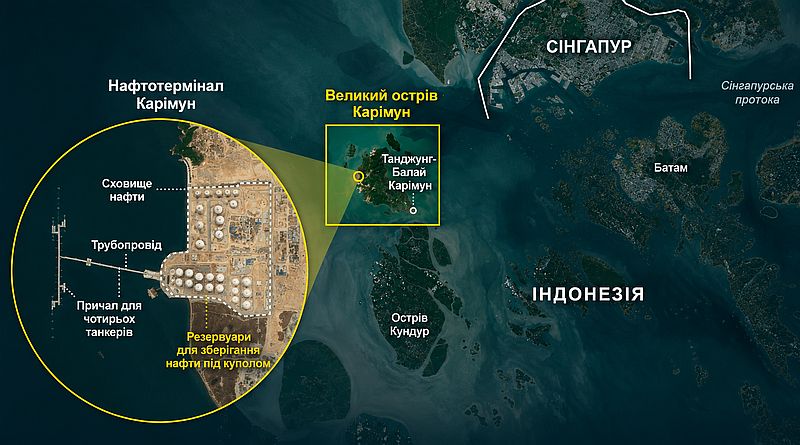
4. The small Indonesian island of Great Karimun has become one of the main Asian hubs for transshipment of Russian petroleum products.
– According to Indonesian customs data, from July 2024 to May 2026, at least $1.6 billion worth of Russian petroleum products were transshipped through the Karimun terminal from seven Russian ports, three of which are under EU sanctions.
– After a change of ownership in 2024, the terminal came under the control of Novus Middle East DMCC. According to the EU, it is linked to the network 2Rivers (formerly Coral Energy), which is under EU and UK sanctions for involvement in trading Russian oil.
– An investigation revealed that over 90% of around 5 million tons of petroleum products passing through Karimun after the ownership change were processed through dozens of intermediary companies. Most cargoes are delivered by a “shadow fleet.”
– After transshipment and mixing, the fuel is labeled as Indonesian in origin and legally shipped to Singapore, Australia, the Philippines, China, Malaysia, Myanmar, and other countries in the region.
– According to Bloomberg, Karimun has become a key node allowing Russian petroleum products to access Asian markets, bypassing Western sanctions and concealing their origin.
5. Russia’s “shadow fleet” finds it increasingly difficult to bypass sanctions.
– The Russian “shadow fleet” continues to adapt to sanctions, but maritime logistics are becoming increasingly expensive and risky.
– According to CREA estimates, by the end of June 2026, 45 ships involved in transporting Russian oil were operating under false flags of registration.
– For comparison, in October 2025, there were 101 such tankers. Despite the reduction in their number, the scheme to circumvent sanctions persists. Of the 45 ships, 13 transported both Russian and Iranian oil, six were last loaded with Iranian oil or oil products, and two with Venezuelan oil. This indicates the formation of a joint logistics network for Russia, Iran, and Venezuela.
– In June, nine tankers with false registration transported Russian oil and oil products amounting to 282 million euros — 28% less than in May.
– All three ships that loaded in Russia during the month departed from Black Sea ports. Additionally, in June, three tankers were detained and inspected — Tagor, Deliver, and Smyrtos.
– Although sanctions have not stopped Russian exports, they are gradually increasing their cost, complicating logistics, and raising risks for carriers.
6. Russia uses Japan to procure sanctioned technologies for the war against Ukraine.
– Following the mass expulsion of Russian spies from Western countries, Moscow has reoriented its activities towards Japan, taking advantage of its high-tech industry and weaker counterespionage legislation.
– A secret GRU unit — the 20th Directorate — plays a key role in the scheme, with officers operating under the guise of diplomats and business representatives to search for, purchase, and smuggle sanctioned dual-use components into Russia.
– An investigation by The New York Times claims that Russia uses Japanese logistics companies and third countries, including Sri Lanka, Uzbekistan, Vietnam, and China, to supply microchips, semiconductors, machine tools, and other equipment necessary for arms production.
– According to Ukrainian authorities, about 90% of Russian missiles and drones contain Japanese components. After an X-101 missile strike on Kyiv, Ukrainian specialists found Japanese-made electronics in its debris, the export of which to Russia is banned.
– Ukraine has repeatedly provided Tokyo with evidence of the use of Japanese technology in Russian weapons and warned about networks that help circumvent sanctions. Meanwhile, Japanese authorities have yet to effectively cut off these supply channels.
Map: Bloomberg, Google Earth
