
During the last work trip to Ukraine, members of the Czech delegation asked a Ukrainian officer when, in his opinion, this war would end. To which he replied with one word: NEVER! Czechs love dark humor. But he was not joking.
Our problem, the problem of that part of Europe that has not yet experienced kinetic war, is that we have not yet switched to WAR mode. We behave childishly when we hope that what began on February 20, 2014 (the date the Russians themselves marked on the medal for the “return” of Crimea) will end with a ceasefire.
We act irresponsibly when we think that a change of power in Russia will solve the issues of war and Russia’s internal policy. We hope to be spared and try to avoid discussions about the future.
Renowned Ukrainian historian Ivan Lysiak-Rudnytsky wrote in his well-known essays that the Ukrainian political nation died twice to be reborn three times. He meant the three state entities that Ukrainians consider exclusively theirs. The ones where Ukrainian territories and the Ukrainian elite were not part of any foreign empires. Where the Ukrainian people did not strengthen these empires intellectually and militarily. Human resources — this is precisely what Moscow is still seeking and fighting for in Ukraine. Not for black soil, not for minerals, but for human resources.
War is criminal, but not senseless.
We make a huge mistake when we say that this war is senseless, or that people like Vladimir Putin have gone insane. Russia did not start the war without reason. Criminally — yes, but not without reason. Moscow has said from the beginning that this war is existential for it. It will survive only if it wins. If Moscow loses this war, it is very likely that the Russian empire will collapse.
When we talk about the three revivals of Ukraine, it should be added that these revivals were always a product of internal strength. Ukrainians themselves, despite the hostility of their neighbors, both near and far, found the energy for new life, a new political entity on the territory where this people have formed over centuries.
And the Russian empire in the last century died several times and was able to resurrect, but usually thanks to external help. Help from those who, for some reason, needed to keep the Russian empire alive.
We last observed such processes in 1991, when U.S. President George Bush advised the Ukrainian parliament against proclaiming independence, speaking of “suicidal nationalism.” These efforts to preserve the empire and pressure on Ukraine ended with the so-called Budapest Memorandum, which no one needs to be reminded of. But the most interesting and important thing about it is not that it did not prevent war and guaranteed absolutely nothing. The main point is that it is yet another example of the West’s naivety and mindlessly trusting attitude towards Russia.
This war, like previous ones, will eventually end. But before it ends, we must ask ourselves whether we have developed our Eastern policy? Do we have an idea about the eastern borders of Europe? Do we have a strategy for our attitude towards Russia?
I will start with the last question: do we have a strategy for our attitude towards Russia?
The idea that a democratic Russia can be preserved within its current borders is as naive as efforts to preserve the USSR and the belief that it could be democratic. The last attempt to democratize Russia quickly ended with the shelling of the parliament and the Russo-Chechen war. We should not support the illusions of those Russians whom we consider the opposition or democratic opposition, and deceive ourselves into thinking that if Russia becomes democratic, it can exist within its current borders.
Democracy, even at its lowest level, will inevitably lead to the decentralization and collapse of what is currently held together by vertical power and violence. Russian democrats need to realize that they are enemies of the Kremlin not because they fight against government corruption, but because their efforts may weaken or even destroy the empire that the Kremlin is desperately trying to preserve.
The collapse of Russia frightens the Western world, but before the war ends, we must be prepared for such a scenario.
Do we have an idea of the eastern borders of Europe?
European politicians, those who feel responsible for the future, should not encourage their voters to hope that lines on maps will protect us. The eastern borders of Europe are being formed by Ukraine today. This process has been ongoing for centuries.
The prominent Ukrainian political and military geographer Stepan Lvivovych Rudnytsky — by the way, a professor and dean of the Ukrainian Higher Pedagogical Institute named after Drahomanov in Prague, who was later killed by the Soviet authorities in Sandarmokh along with many other Ukrainian intellectuals — emphasized the illogical establishment of borders, illogical unification into administrative units of territories that were not geographically, morphologically, climatically, and hence ethnically identical, which led to long-term disputes and wars, as was the case, for example, in Galicia. The Soviet Union intentionally formed borders in such a way as to provoke eternal tension between ethnic groups and be an eternal arbitrator among them.
We constantly raise the question of where the future border should lie and what territory Ukraine could cede to Russia. But the southern border of Ukraine cannot cross the Kherson and Zaporizhzhia regions. A more or less stable border can only be formed by the coasts of the Black and Azov Seas. There have been constant wars over these borders for centuries, and the essence of those wars remains the same today. It is not about mere centimeters, as our commentators often say. It is about ensuring that, in the future, the enemy does not have a favorable base for an offensive.
Politicians who in 2014 even considered the possibility that Crimea could be Russian not only chose the right of might over international law but also provoked a conflict by redrawing borders in the comfortable conditions of the European rear, which Europe had not seen for many decades. Crimea indeed became a base for the next attack. If Crimea remains in Russian hands, it will again become such a base for the next expansion.
Depopulation and forest burning in the past increased the area of the steppe and caused not only border shifts but also served as footholds for further and deeper raids. Today, we witness these processes firsthand. The depopulation and burning of cities not only shifts borders but also turns the rear into a battlefield. Therefore, it matters whether Kramatorsk and Sloviansk are under Ukraine’s control or not. If not, and these cities cease to be defensive points, then hundreds of kilometers of unprotected steppe will stop being our rear and will become a field for further conquest by Russian troops.
For twelve years, we have left the entire burden of struggle on the shoulders of Ukraine and Ukrainians. Central Europe has decided to parasitize on the EU and NATO and even parasitizes on the war in Ukraine. I feel embarrassed when I hear that we are helping Ukraine. Today, there are voices from Poland saying that Ukraine is fighting primarily for itself. No, Ukraine is fighting for itself and Europe. Ukraine is shaping its borders and Europe’s borders. This is a dual task.
We need to adapt to current conditions.
And we are not fulfilling our task and are not winning our fight in the rear. We are losing Central Europe by handing it over to marginal forces. To be frank, neither our politicians, nor our media, nor our academic circles managed to cope with the challenge we faced in the winter of 2014. But Ukraine has given us time. Now it would be appropriate to reject the opening of a western anti-Ukrainian front and clearly state that the anti-Ukrainian card, which wins elections across the entire belt of Central European countries, is criminal, and the EU and NATO are not historical clubs for certain member states to claim the right to open or close the doors of the EU and NATO based on their interpretation of history.
Ukraine must meet certain criteria if it wants to join the EU and NATO. And the European Union must change if it wants to survive and be viable not only economically and politically but also from a security standpoint.
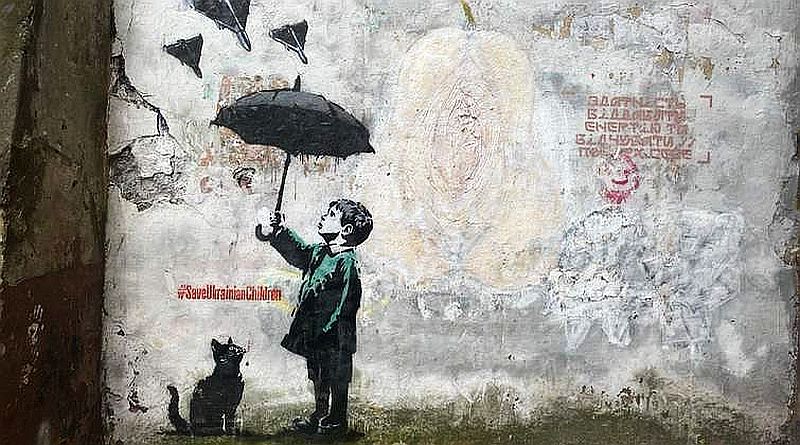
In the background: mural by Andriy Yarmolenko in Lviv. Photo: ZAXID.NET
