
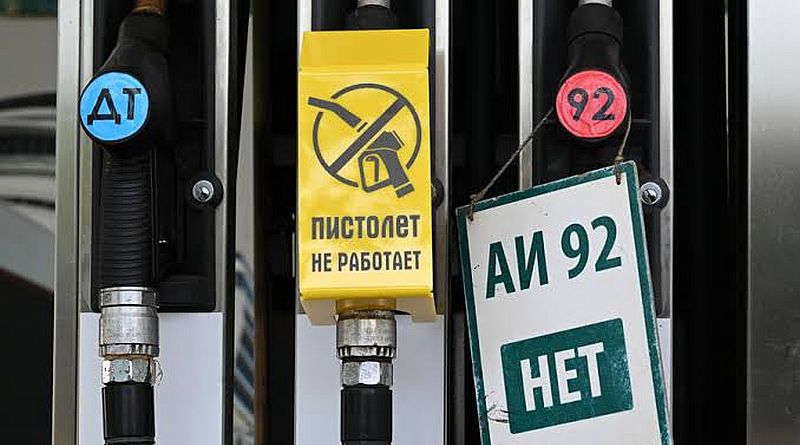
Let’s try to assess the depth of the fuel crisis in Russia and its real impact on the market. The Kremlin predictably classified stockpile statistics, but indirect data suggests that at least 30% of all operational fuel reserves in Russia have already been depleted.
In normal years, Russia accumulates in the spring and early summer about 2.5–3 million tons of operational maneuvering stock of light petroleum products in the reserves of Rosrezerv and commercial hubs of Transneft solely for the autumn peak. This is roughly the same ~30% of the country’s entire operational rear reserves meant to compensate for repairs and harvests. Since May, production has fallen (a gap of 25 thousand tons daily), so this accumulative buffer was not just created — it was used to maintain the current balance.
The fact that Russian officials are already seriously discussing a rollback to the “Euro-2” standards (i.e., to the cleaning norms of 13 years ago), frantically purchasing fuel from India by sea, and forcibly adding bioethanol and surrogate additives clearly proves: the country’s reserves are in very poor condition.
A gap of 25 thousand tons per day
The massive drone campaign in May-June 2026 collapsed gasoline production in Russia by at least 25%. Now all their oil refineries are producing about 85 thousand tons per day, while the actual summer need is 110 thousand tons. This daily 25 thousand-ton gap will systematically drain the remaining maneuverable fuel stock.

As of the end of June 2026, official fuel sales restrictions have already been introduced in 44 regions, and complaints about supply disruptions are recorded in 85 regions. The problems have scaled across the entire territory of Russia. In the Leningrad region and St. Petersburg, disruptions in food supplies have already been recorded, and queues at Rublyovka and most “Rosneft” gas stations have appeared in Moscow — which is an extremely telling marker.
Because in Russia of 2026, fuel is distributed according to a strict caste system of priorities:
— the army, the defense industry, and top-tier officials (since the USSR 2.0 won’t build itself);
— security forces, Russian Railways, and privileged agricultural holdings (at the level of Patrushev Jr.);
— million-plus cities (to avoid social unrest and a collapse of the service economy) and the rest of the agricultural sector.
All others are based on the residual principle.
If the shortage has reached gas stations in the elite suburbs of the capital, it means that the third-level priority (Moscow and the region) can no longer be consistently supplied. Fuel trucks are simply not able to deliver fuel from the surviving plants from beyond the Urals in time.

Pins Fell Down
The next clear marker is the large-scale collapse of transport companies. By the end of spring, 30,000 seized vehicles, including 15,000 long-haul trucks, were parked in leasing companies’ impound lots due to payment defaults.
Overall, around 90,000 trucks exited the market over the past year. Extreme accident rates (due to a lack of branded parts), inability to pay loans at the Central Bank’s outrageous interest rates, extortion from the “Platon” system, and a 22% increase in diesel prices have thinned the fleet of trucks.
About 25% of logistics companies (mainly small and medium-sized businesses) have not yet formally entered bankruptcy proceedings, but have declared “zero” profits, sent staff on unpaid leave, and are simply waiting for a miracle.
Prime Minister Mishustin’s decision to allow Euro-3 standard fuel circulation until the end of the year only adds fuel to the fire. A removed catalytic converter is half the trouble, but modern injectors and fuel systems will widely fail from such surrogate fuel. However, overhauling a truck engine doesn’t absolve anyone from monthly loan payments. The state doesn’t care that in six months thousands of leased Chinese trucks will require fuel system replacements, turbines, and cylinders costing millions of rubles. For the defense industry, they are expendable, just like the mobilized troops. Engine overhauls at one’s own expense, pay the lease or hand the truck over to the impound lot.
Facing the August Peak
The urgent import of 60,000 tons of fuel from India and at least 70,000 tons from Belarus is a cry for help. Nobody would burn scarce currency ($50–70 million for a large batch plus gold-tier logistics) if they could simply shut off the internal export tap. But the main test lies ahead — in August-September, when the vacation season, harvest collection, and active military operations coincide. The current import volumes are enough fuel for literally just a few days of peak consumption.
The internal diesel consumption then jumps from a baseline of 3.5 million to 4.2–4.5 million tons per month. Converted to daily terms, this is 135–150 thousand tons of diesel. Two factors overlap: a massive harvest campaign (farmers sweep up everything to the last drop) and the active phase of northern supply (urgent fuel delivery to Arctic regions before the ice sets in).
In neighboring Kazakhstan, a major refinery is under repair, but even if it were operational, they can’t cover a quarter of the Russian market. Creating an operational reserve, as done traditionally in spring, is physically impossible through imports. This summer fuel gap (minus 25 thousand tons daily) and the August diesel spike completely deplete the fuel base storages, as they were unable to build up reserves.
Moscow Transport Thrombus
Since the strategic refinery in Kstovo was burning again (with key AVT-6 primary processing units hit by drones), the Moscow Refinery completely fell out of the chain due to heavy repairs until early 2027, and after several waves of strikes on the Yaroslavl (“Slavneft-YANOS”), the entire Moscow fuel hub now critically depends on the railway.

And RZD itself is caught between:
— queues in Rublyovka;
— fuel stations in Saratov, Volgograd, and Krasnodar, where fuel is strictly distributed to officials and law enforcement certificates;
— a four-kilometer queue of 800 vehicles at gas stations in Zabaykalsky Krai, where tanker cars simply don’t arrive.
Simultaneously, hits on the Slavyansk Refinery in the Krasnodar Krai have exacerbated the local shortage in the south and in occupied Crimea to the limit — reports indicate Novorossiysk has dried out of fuel.
Novorossiysk is the largest export oil hub in southern Russia. If fuel disappears in this port city, where pipelines converge, it means the reservoirs of pumping stations and bulk terminal bases are drained to the bottom.
Civilian farmers there are openly refused diesel shipments because the entire railway and oil storage resources are allocated for the supply of the “Dnieper” occupation group and the remnants of the Black Sea Fleet.
Can the Russians restore the plants by autumn? Obviously not. Therefore, in August-September, the fuel hammer will strike them with maximum destructive force.
Minus $35 Billion
This is unfolding against the backdrop of a massive financial storm. The deficit of the Russian federal budget already doubles the liquid part of the National Wealth Fund (NWF) — and this does not yet fully account for the drop in the price of Urals to the level of $40–42.
Add to this the 5–7% drop in railway loads. Each percentage point means a net loss of 30–40 billion rubles in revenue for the RZD monopoly. Due to a logistical bottleneck, where civilian cargoes have been stuck in sidings for months, Russian metallurgists and coal miners have already lost about $2 billion in export revenue because they physically couldn’t deliver raw materials to ports.

When logistics become 20% more expensive, it automatically acts as a fuel tax on any product. A bottle of milk in notional St. Petersburg becomes more expensive not because the cow eats more, but because the truck with this milk spent three days collecting surrogate fuel at gas stations or standing in line. The Russian economy is being hit by a classic stagflation blow: a fuel shortage pushes prices up while real production falls due to downtime.
And the cherry on top — a banking liquidity crisis rapidly gaining momentum. The cash volume in the system has been anomalously rising for the fifth consecutive month (as of May, it was +18% year-on-year). Amid the panic, queues at gas stations, mobile internet outages, and even local shortages of basic products like milk, Russians are frantically withdrawing money from accounts. Within a week of such panic, up to a billion dollars’ equivalent is stashed under mattresses.
Overall Result
If we add up the direct budget losses from the drop in global oil prices, forgone gains from reduced export of petroleum products, critical increases in domestic logistics costs, and enormous expenses on emergency fuel imports — the total monetary equivalent of the fuel-energy crisis in Russia for the first half of 2026 confidently breaches the mark of $30–35 billion in net losses. This is effectively the annual budget for their entire defense-industrial development program.
In other words, Russia, by continuing the war, has burned an amount equivalent to what the Kremlin invests in tank and missile production plants annually within a few months.
The goal of the Armed Forces campaign was to force the enemy to deplete its operational rear reserves and drain storage capacities before the critical autumn peak. This stage is completed — the safety cushion has been burned. The stage is set, the gun in the first act is loaded. We await the shot in August.
Cover photo: Occupier media
