
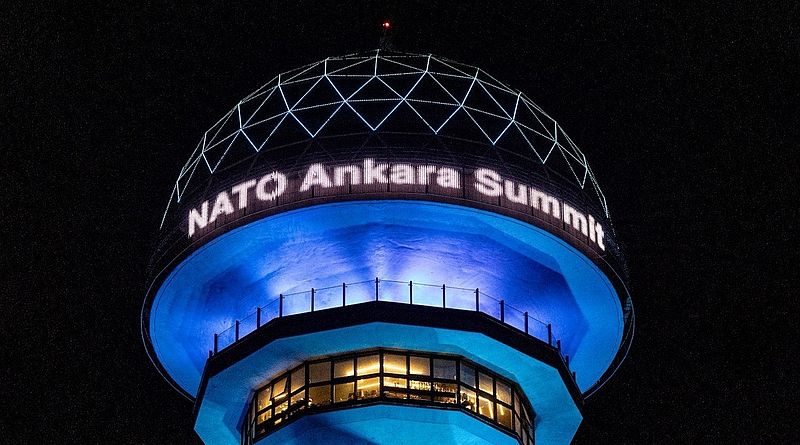

On July 7-8, a meeting of Alliance state leaders will take place in the capital of Turkey with the participation of the President of Ukraine.
Two months ago, this event seemed highly controversial and marginal. Trump was in conflict with European partners over Hormuz. Europe had its own discord. Therefore, there were no special hopes.
Now I would put it this way: there is potential, but in which direction it will be converted is currently unknown. That is why both Ukraine and – especially Russia have made additional efforts to create a favorable context.
1. Putin made these moves.
Firstly, on the night of July 1-2, Russia attacked Kyiv, killing 30 civilians just in the capital, simultaneously delivering openly terrorist strikes for several days on Sumy, Zaporizhzhia, Kharkiv, Dnipro, Kherson, and other frontline regions, not to mention the frontline Sloviansk and Kramatorsk.
Secondly, on July 3 (on the eve of the US anniversary and as a backdrop for conversation with Trump), Putin staged an outrageous performance with the “capture of Kostyantynivka.”
Thirdly, the next day the Kremlin sent Medvedev, a drunkard, to the funeral of Ayatollah Khamenei. Apparently, the sum of these actions was supposed to demonstrate Moscow’s strong position.
However, the effect seems to have been the opposite.
The symbol of the Russian Federation at this stage is the pathetic appearance of the ex-president of Russia, struggling with withdrawal symptoms. An armed aggressive drunkard can be dangerous, but the limits of his power are obvious.
Honestly, I doubted that Putin would strike again on the night of July 5/6. Judging by the comments of official forces and experts, I was not the only one doubtful; many expected a strike on July 6/7.
But, apparently, the results of massaging Trump and NATO leaders were deemed so unsatisfactory in Moscow that they decided to intensify the efforts.
Hypothetically: the Kremlin shifted the strike a day earlier because Ukraine refused to partake in the farce around Kostyantynivka.
The Russian Ministry of Defense publicly initiated several hours of a ceasefire on July 6, allegedly “for the exchange of bodies,” and offered Ukraine until 12:00 on July 5 to agree. When no agreement followed, they launched missile attacks on Kyiv to overshadow this story.
Because it clearly proves: Putin “took” Kostyantynivka in advance, although the situation there is very severe. That is why the Russian Federation wanted to bring its troops into the city within a few hours to hasten the process.
It didn’t work out.
As a result, Russia killed at least 19 more civilians in Kyiv and wounded about 61 people, also 7 people were killed by Russia and 26 wounded formally in the Kyiv region (Vyshneve, essentially – Kyiv).
The photo of a deceased family in a destroyed high-rise building will be a clear demonstration of what Russia is currently strong in: organizing war crimes.
This is an extremely clear signal: without ballistic interceptors, Kyiv becomes a shooting range for Russians, just like all other cities in the north, east, and south of Ukraine. NATO leaders need to take a position.
Besides the timely transfer of missile defense systems to Ukraine and increasing their production, there are at least two more options – the enforcement of already approved sanctions (as Russian missiles are full of Western components) and assistance in scaling long-range means (so that every night by autumn, 1000 deep strikes of all kinds fly into Russia).
There is a possibility that Putin did not scare anyone but rather pushed for the right decisions. We will see soon.
2. What has Ukraine done?
On the night of July 5/6, Ukrainian Defense Forces demonstrated a wide range of impressive results, which can be grouped into the “oil” and “Crimea” blocks.
In the “oil” block, the Security Service of Ukraine, together with colleagues from other agencies, made a successful visit to the Yaroslavl region, where they once again reached the facilities of the Yaroslavl oil refinery, and also covered the associated Yaroslavl oil pumping station (a Service specialty).
All this is part of the dismantling of a major node of oil/oil product production and transportation for export through the Baltic Sea, as well as to the Moscow region. Additionally, there are reports of damage to facilities at the ports of Ust-Luga and Vysotsk.
Furthermore, the Security Service of Ukraine reported (and NASA’s fire map confirmed) a visit to “First Plant LLC” (Kaluga region, landmark – Polotnyany Zavod). This is a medium-sized refinery processing 1.2 million tons of oil, producing gasoline, diesel, kerosene, motor oil, fuel oil, etc. Its advantage is that it is one of the few refineries in close proximity to Moscow (140 km) and in the west of Russia as a whole.
The delay at this plant temporarily reduces the maneuvering capability of fuel both in the interests of the invader grouping on our northern border and in the interests of the Russian capital.
And finally, the highlight of the week (if not the month) – the first successful attack on the monstrous Omsk oil refinery. Special Forces drones covered a distance of about 3000 km (2500 km in a straight line) and temporarily took out at least one critically important installation with a processing capacity of 8.5 million tons. There was a reconnaissance visit recently, from which correct conclusions were drawn, visible on the faces of dear Russians.
The Omsk oil refinery has been discussed so much recently that there’s no point in repeating it. Just a small clarification: besides the cyclopean capacity (about 22 million tons per year, 1st-2nd place in Russia, key plant east of the Urals), the Omsk plant produces around 1000 types of various products, making it a very modern, versatile petrochemical complex in the structure of “Gazprom Neft.” This means a potential slowdown not only in gasoline/diesel/kerosene but also a chain reaction at other enterprises linked to Omsk’s specialized products.
In summary, regarding “oil” on the eve of the NATO summit, Ukraine:
• Reaches Russia’s largest oil refinery for the first time at a distance of 2500+ km;
• Once again targets a major hub in Yaroslavl (for which it’s necessary to bypass Moscow);
• Harasses a refinery in the Kaluga region (again nibbling at the flow near Moscow);
• Keeps Baltic ports on alert (Ust-Luga, Vysotsk, and earlier St. Petersburg).
Additional touch: the S-400 launch system was destroyed in the Bryansk region.
Working range – as shown in the picture: from the Baltics to Siberia. Previously, the scale was continental, now it’s officially intercontinental.

3. The “Crimea” block is no less illustrative.
Firstly, from the point of view of clearing Russian air defense elements:
• The Security Service continued its destruction of hangars at the military airfield in Hvardiiske.
• It also struck a Pantsir-S2 SAM and a mobile fire group near Simferopol.
• The SBS hit an S-400 launcher near Kerch.
• The SBS attacked the Nebo-U radar (Kerch area).
Secondly, aiming to disconnect the Russian occupational group in Crimea from fuel, the Security Service and SBS attacked the oil terminal and oil depot “TEC-1” in Kerch. The SBS also reached two tankers transporting fuel from Taganrog to Crimea.
Thirdly, to reduce the combat capabilities of the occupiers on the peninsula, the SBS attacked another substation. In total, the targeting of energy facilities led to blackouts of varying durations across Crimea and the occupied part of the Kherson region…
* * *
Against this backdrop, NATO country leaders will gather in Ankara. By the morning of July 7, the “summary” will surely be “updated.”
Does this mean that unpleasant surprises are ruled out? Not at all. For example, yesterday’s statement by the Polish defense minister regarding the disclosure of information about all aid to Ukraine since 2022 points to this.

The NATO Summit in Ankara: the consolidation of the Alliance against Russian expansion.
The summit of the North Atlantic Alliance currently being held in the Turkish capital showcases the expected shattering of the Kremlin’s inflated hopes for a strategic split in the West, as key agenda points indicate unprecedented consolidation of allies in the face of Russian aggression.
The main topic of discussion among the leaders of thirty-two states is a significant increase in defense spending, during which European members of the organization and Canada report swift movement toward the target of five percent of the gross domestic product by 2035.
Since current European investments have already exceeded previous expectations, the military-industrial potential of Western countries is transitioning to long-term planning, depriving Moscow of the advantage in a prolonged war of attrition.
The extensive package of military assistance to Ukraine poses a particular threat to Russian geopolitical ambitions. It provides for the allocation of seventy billion euros for defensive equipment and the training of military personnel. The creation of a stable financing mechanism, intended to be secured for the following years, ensures the continuous supply of the Ukrainian army with the latest types of weapons, completely nullifying Russian calculations on the cessation of Western support.
Simultaneously, a large-scale defense industry forum is being held on the sidelines of the summit, aimed at concluding contracts worth tens of billions of dollars, leading to the final technological separation of the West from the isolated Russian economy.
The choice of Ankara as the meeting place highlights the failure of Russia’s attempts to use Turkey as a weak link in the Alliance structure. Turkey’s leadership’s desire to showcase its own defense industry and strengthen the southern flank indicates that Ankara fully shares the long-term strategy of containing the Kremlin, reinforcing the concept of comprehensive security.
The inclusion of partners from the Indo-Pacific region in discussions, including Japan and South Korea, points to the globalization of the anti-Russian framework, which ultimately narrows Moscow’s opportunities for maneuvering on the international stage.
The decisions made in the Turkish capital create insurmountable barriers to Russian expansion, as NATO’s institutional strengthening turns the isolation of Russia into an irreversible historical process.
