
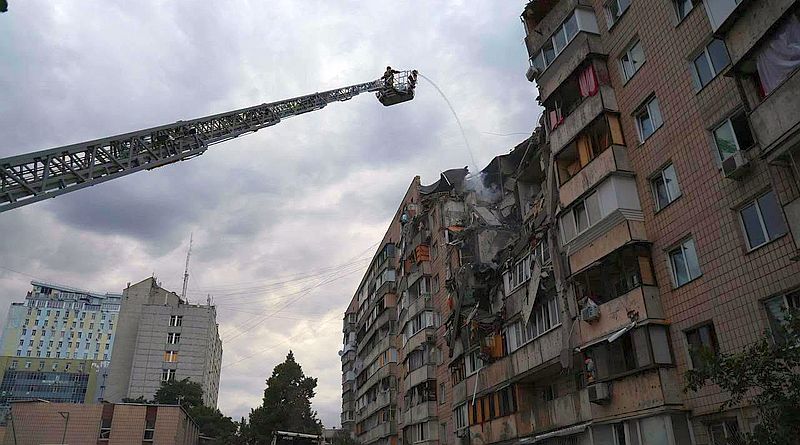

It is difficult to write this post, there are many casualties and hits, we have an anti-record, but analysis is still needed…
I did not spend this night with the people of Kyiv (as I was in Bila Tserkva), but I understand all the pain and anger at the country-waste. No analysis will bring back people or rebuild buildings, but there are a few points that still need to be highlighted.
I probably made mistakes in previous analyses regarding the missile brigade and the 12 launchers for Iskanders.
This night we have an anti-record – for the first time we did not shoot down ANY ballistic missile or Zircon. During the last attack, I was in Kyiv and clearly heard how many interceptors we had for the Patriots. Today I didn’t hear and cannot state about new Iskander algorithms. And most likely, we are running out of PAC-3 missiles to shoot down Iskanders.
In past analyses, I constantly said that the main goal of a large number of ballistic missiles was to exhaust our reserves, not to hit targets. Last night we saw that their tactic worked. It’s hard to argue with mathematics, hence today’s anti-record.
But now to the essence. Where exactly was I wrong? And this is precisely a positive moment 🙂. This mistake can be called the “mistake of a Western observer.” An analogue of the mistake of a shot-down pilot. I assessed the Russian command and army by Western standards. Well, if Zabolochye makes a large ballistic volley, it means that the entire missile brigade must be used. Especially since they have plenty of them. But no. Even when the volley consisted of 24 Iskanders, that is, 12 launchers of the missile brigade were counted, there were not only Iskanders, but also some missiles from the S-300/400 air defense complex. In the case of Kyiv – only S-400 with the 48n6DM missile. For Dnipro, Kharkiv, and Zaporizhzhia, smaller missiles from the S-300 will suffice.
How did I realize this? In two stages: analysis of the landing sites with characteristic missile debris and conversations with knowledgeable people.
Yes, I was mistaken about the “greatness” of the roosters, who have very large resources and missile potential. And when I said in previous analyses that I could not understand why the missile brigade deployed 5-7 launchers (because there were characteristic reload timings of 30-40 minutes), spread them across two regions (Kursk and Bryansk), I might have suspected, but did not believe it could be so simple. They do not have the resources to make a full MILITARY VOLLEY OF 12 LAUNCHERS AT ONCE! Although they claimed to produce 40-50 Iskander-M per month, they cannot make a volley of 24 missiles!
They initially added fewer, now more missiles from the S-400. Plus Zircons. Simple math showed them that if volleys were made purely from Iskanders, our PRO would not be overloaded, and the replenishment of PAC-3 missiles would allow each attack of 12-16 Iskanders to be shot down 90%, as we do (and also did today) with all Cruise missiles (Kh-101, Kalibr, and Iskander-K) and Shaheds. And about Shaheds at the end, there is also a point today. I just want to add a point about North Korean KN-23s, which were often added to volleys in winter. Now they are not there, you see that too. The country with rice rations for the population cannot produce them enough to supply the roosters on a permanent basis.
My conclusion. Until autumn, Yansur Anaboy will not be able to maintain constant volleys of 30 ballistic missiles per attack every 7-10 days. Today’s attack was very quick, it hadn’t even been a week since July 2, they hadn’t even gathered 600 Shaheds, it happened due to the NATO summit on July 8. And so I assumed the attack would be today. But they hurried the date of the strike on Kyiv.
The next attack will not be sooner than a week later. Gathering resources, performing maintenance on aircraft, launchers, programming cruise missiles – it takes at least a week. Several ballistics at night, two per week – that’s how they’ve been doing it in recent weeks. But a massive and combined attack requires much more time and preparation.
And about the 48n6DM missiles from the S-400. That is why it seems that the missile brigade is spread over two regions. Because the range of these missiles when working on the ground just reaches 250 km, to fly from the Bryansk region to Kyiv. But without any accuracy, which we see in civilian buildings…
And now the final point. On July 2, when I accompanied the entire attack with many of you in Telegram and described the attack, there was a moment at 00:45 when all the channels wrote about four ballistics heading to Kyiv, but nothing arrived. My version is that the S-400 missiles were launched in the Bryansk region, and they were shooting down ours, not flying as ballistics to Kyiv. Because batteries are located there for these two tasks. Supplementing the ballistic volley and shooting down our missiles like Flamingoes.
And here’s another option on how we can get through the next attacks more easily. Not to wait for partners to supply us with PAC-3 missiles from warehouses, but to launch more Flamingoes and our soon-to-be ballistic missiles, to reduce the potential of the 48n6DM missiles, which constantly supplement the volley to Kyiv. Firstly, something will definitely reach the target, and secondly, we will definitely reduce the volley on the capital.
This is an analysis of our ballistic anti-record. My condolences to all the victims of today’s grief. And for the first time, I will use video not of strikes on the swamps, but of the strikes on Kyiv. The world must also see how the swamps want peace…
