
Andriy Harasym, Volodymyr Lytvynov, Nikita Holovinsky / Texty
In over four years of full-scale war, Russian missiles, drones, and shells have left marks in all districts of Kyiv. Texty.org.ua has updated its database on strikes in the city, adding previously unaccounted incidents of damage from hits and falling debris up to June 15, 2026. This includes only cases reported by official sources or media. But even this data is enough to see how the air terror against the capital has changed.
Russia targets the same locations for years

Looking at the map of shellings in the Ukrainian capital, it may seem that the attacks are randomly distributed. However, when all recorded strikes are layered over each other, a different picture emerges. Russia repeatedly targets the same city zones.
The densest cluster of strikes formed on the right bank— from Lukyanivka through Shuliavka to Solom’yanka. Here, over four years of war, the largest number of recorded hits and debris falls have accumulated. The second major cluster formed on the left bank around the Darnytsia industrial hub. These two zones stand out most clearly on the map when looking not through administrative district boundaries, but through the density of attacks.
Such distribution is unlikely to be coincidental. It is largely explained by the location of major industrial enterprises and infrastructure objects. The Artem plant, other defense industry enterprises, major production sites, logistics complexes, and energy facilities remain among the targets that Russians consider priorities. A separate category is energy facilities, which have repeatedly come under attack during campaigns to destroy Ukrainian energy infrastructure.
At the same time, the geography of attacks changes depending on the nature of military actions. In 2022, a significant portion of the strikes was related to battles on the outskirts of Kyiv. In subsequent years, another pattern became increasingly clear: Russian strikes concentrated around several persistent nodes mentioned earlier. Consequently, Kyiv districts—”record holders” for the number of hits—also changed.

At the beginning of the invasion, the Shevchenkivskyi, Sviatoshynskyi, and Podilskyi districts were among the most affected, but in the last two years, there has been a sharp increase in strikes on the Darnytskyi and Solomianskyi districts. This is most evident in the case of Darnytsia. In 2022, only 8 strikes were recorded here, but in 2025 there were already 51, the highest among all the city’s districts.
At the same time, the map shows that over time, the geography of attacks has become significantly broader. Damage is regularly recorded almost throughout the city, and the number of neighborhoods that have been hit at least once is constantly increasing.
How the air war over Kyiv has changed

Overall, since the start of Russia’s full-scale invasion, the tactics of strikes on the Ukrainian capital have changed several times.
The mentions on the infographic of shells and mortar mines relate to the first days of the war when the enemy approached the capital.
In 2023, the main threat became massive missile attacks, when dozens of cruise and ballistic missiles could be launched at the city in one night.

In 2025, the air campaign entered a new phase. It was then that the number of strike drones sharply increased, becoming the main means of attack. While in previous years, the number of missile and drone strikes was comparable, in 2025 the number of recorded drone strikes exceeded missile strikes several times over. July 2025 became a turning point — after this, massive drone attacks were no longer an exception but became almost a constant occurrence.
The year 2026 showed another change. If in 2025 the main tool of enemy attacks were numerous drones, then in the first half of 2026 Russia sharply increased the use of ballistic missiles. In just six months, Kyiv recorded almost as many missile strikes as in the entire year of 2025.
The Russians shifted to a tactic of combined strikes, a new attack model. Throughout the night, the city is exhausted by waves of drones, forcing air defenses to constantly respond to new threats. Following this, or concurrently, strikes are launched with ballistic and cruise missiles. The calculation is simple: to overload the air defense system as much as possible and increase the probability of some means of attack breaching to the target.
The combination of massive drone attacks with concentrated ballistic missile strikes became a key feature of the campaign against Kyiv this year.
Terror and more terror
Although the map showed a concentration of strikes in areas where industry is located, an analysis of the types of objects suffering from Russian attacks reveals that residential areas, by a large margin, top the list.

Over four years of war, 290 residential buildings have been damaged — at least twice as many as any other category of objects. For comparison: in second place are non-residential premises and objects that could not be accurately identified (122 cases). This is followed by cars, roads, transport infrastructure, and gas stations (111).
This pattern became particularly noticeable in 2025-2026, when the number of massive attacks sharply increased.
If during 2022-2024, residential construction in Kyiv suffered about 30 hits annually, 2025 saw a sharp turning point. The number of strikes on residential buildings jumped to 130 — more than in the previous three years combined. And in the first six months of 2026 alone, Russia added another 72 such hits. This is not a gradual increase but a dramatic change in the scale of aerial terror against the city.
Allegedly, the main targets for the Russians are Kyiv’s industrial zones and factories, which occupy vast areas. However, enemy rockets and drones consistently hit residential buildings, leading to numerous casualties.
If it were about one or two hits, it might be appropriate to talk about some error, especially since the accuracy of Russian missiles at the beginning of the full-scale invasion was quite low. But strikes on peaceful buildings not only did not stop over time but became even more extensive. After hundreds of strikes on Kyiv, Russia can no longer hide behind talks of “mistakes” or “inaccuracy” of weapons. If missiles and drones repeatedly hit residential areas, this means it was precisely planned by the Russian command. Terror against the peaceful Ukrainian population has become one of the methods of conducting this war.
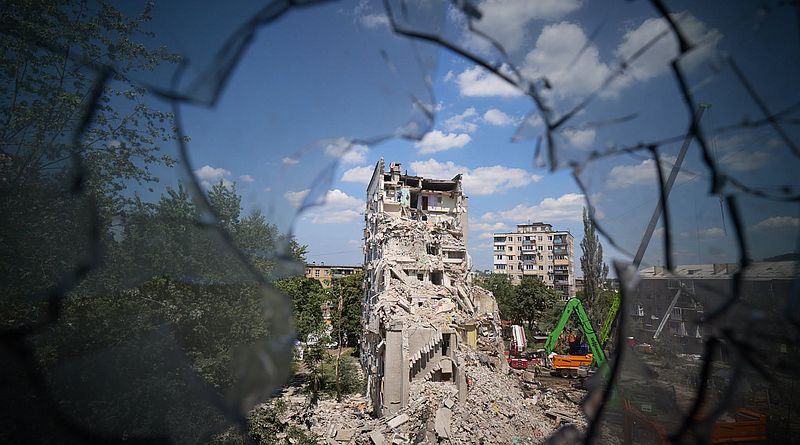
In the cover photo: Consequences of the shelling of Kyiv on 07/02/2026. Photo: State Emergency Service of Ukraine
