
The “special military operation” that Vladimir Putin planned to complete in a few days has turned into a grueling war, lasting longer than the USSR’s involvement in World War II. The Russian army is suffering huge losses, the economy is on the verge of systemic collapse, and there is rapidly growing discontent within the country and among the elites.
This is written in an article by Peter Frankopan, professor of world history at the University of Oxford, for Foreign Policy.
As the author notes, as the Kremlin’s capabilities narrow, the Russian dictator is increasingly succumbing to the “drowning syndrome,” making his behavior and decisions dangerous both for his inner circle and for the external world.
Colossal Human Losses
According to the article, Russian forces have long ceased to achieve significant success on the battlefield, and in April and May even lost some previously occupied territories. The Oxford professor cites data from the UK’s Government Communications Headquarters, which estimates that the number of Russian military personnel killed is approaching half a million, while the overall Russian losses in terms of wounded and dead, according to Western assessments, significantly exceed 1 million. The rate of depletion of human resources is staggering: Russia loses eight soldiers killed or seriously wounded for every one Ukrainian military lost.
The article emphasizes that with average monthly losses of over 30,000 people, the Kremlin is struggling to find fresh reserves. To attract new soldiers, the authorities are forced to offer one-time payments of up to $80,000 and write off debts of up to $140,000. However, as Russian military bloggers write, new recruits face a catastrophic reality. Due to the radical change in technology and the mass use of drones, the average lifespan of a recruit from arriving at the training ground to death is from 10 days to three weeks, and directly on the battlefield, Russian fighters live on average from 20 to 35 minutes.
Economy on the Verge of Shock
As noted in the article, the strikes by Ukrainian long-range drones on oil refineries and energy infrastructure have already brought the war directly to Russian territory. Massive attacks have significantly reduced Russia’s refining capacity, causing a fuel shortage within the country. More than half of Russian regions and occupied Crimea have already introduced rationing or completely stopped selling fuel to the population.
The economic pain is exacerbated by unprecedented pressure on the budget. The author emphasizes that Moscow’s military spending currently consumes half of Russia’s entire state budget, which significantly exceeds the figures officially recognized by the Kremlin. Central Bank Governor Elvira Nabiullina openly warns about the constant deterioration of the situation and a chronic labor shortage caused by the massive death of men on the front.
According to European intelligence estimates cited by the Oxford professor, the Russian economy now has only two paths: long-term decline or sudden shock, each of which will inevitably end in financial catastrophe.
The Role of Nicholas II
Against the backdrop of military failures and financial difficulties in Russia, the former consensus on supporting the invasion is rapidly collapsing. As Peter Frankopan writes, among the Russian business elite and military bloggers, there is serious dissatisfaction with the Kremlin’s management decisions, increasingly described as senseless and self-destructive. Russian ultra-patriotic influencers openly warn about the approaching dramatic events and compare the current situation to 1917 – on the eve of the collapse of the Russian Empire.
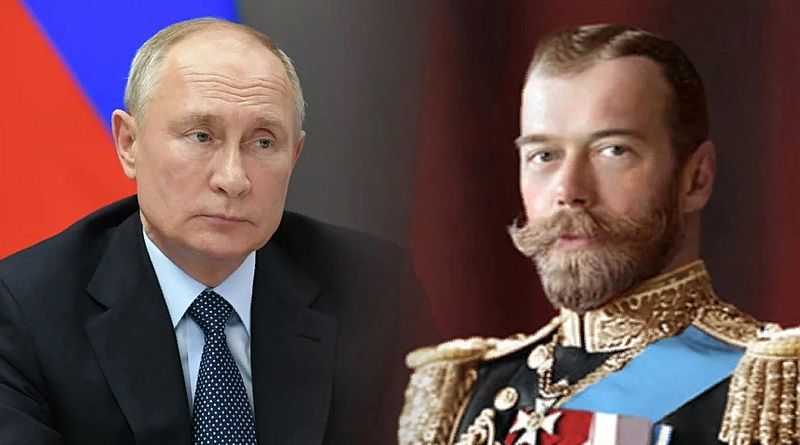
Instead of demonstrating strategic vision, Vladimir Putin is essentially repeating the mistakes of Tsar Nicholas II during World War I. According to the author’s observations, the dictator is excessively delving into the micromanagement of military actions, disappearing from the public arena for long periods due to paranoid fears for his own safety, and his rare appearances seem completely detached from reality.
In Professor Frankopan’s view, Putin is caught in a political trap, as any reduction in military spending or attempt to negotiate with Ukraine will lead to the immediate contraction of an economy that currently relies solely on defense orders. In these conditions, a cornered Kremlin will try to expand the battlefield through hybrid attacks, subversions, and nuclear blackmail of the West.
