
As a result of the record-intensive combined attack by the Defense Forces in Volgograd, the workshop of an important defense plant “Titan-Barikady” was destroyed, the work of strategic refineries in Ufa and Yaroslavl was paralyzed, and occupied Crimea was left without electricity and satellite communication.

Three Flamingo rockets struck the workshops of the “Titan-Barikady” plant in Volgograd on the night of June 27, 2026. The impact of the heavy warhead means months of downtime. This is easy to verify since “Kremniy EL” plant is still in the process of dismantling debris with cranes and repairing the roof, while Storm Shadow with much weaker warheads hit there. Things are also bleak for the aggressor in Volgograd — one workshop simply ceased to exist. Judging by the casualties, it is not fashionable in the Russian Federation to respond to alarms. And this is good: sometimes it’s faster to buy machines than to train staff.
“Titan-Barikady” is one of the few enterprises in all of Russia (together with Yekaterinburg’s Plant No. 9) that has the equipment and competencies for a highly complex metallurgical process: casting, forging, autofrettage, and deep drilling of large-caliber gun barrels.
Here, in addition to Iskanders, they make the artillery part for the 152 mm self-propelled artillery “Msta-S” and their latest “Coalition-SV”. “Titan-Barikady” also modernizes and produces barrels for heavy artillery of the Supreme Commander’s Reserve — 203 mm self-propelled gun 2S7M “Malka” (modernized “Pion”) and 130 mm coastal complexes A-222 “Bereg.” The barrel for the “Msta” lasts about 2000–2500 shots, after which it needs to be replaced, otherwise, the shells scatter not according to the certificate or explode in the breech. The destruction of production lines, unique turning-carousel machines, forging presses, and the electroplating workshop hits the Russian Federation harder than the loss of a couple of ammunition depots.

The Defense Forces hit two out of three refineries in Ufa on June 25 — “Bashneft-Ufaneftekhim” and “Bashneft-Novoil.” Ufa is 1800 km away by air, just to note. Local residents reported thick black smoke and several fire sources in the industrial zone. Crude oil refining installations were knocked out — both refineries lost up to half of their capacity. Considering they produced up to 6% of Russia’s fuel, the crisis will only deepen. If the Moscow Refinery is “urgently” repaired in half a year, they have hit the bottom in terms of spare parts and contractors (I don’t think there were many ELOU-AVT repair crews).
Simultaneously, a critical logistics hub was targeted — the “Vtorovo” oil pumping station in the Vladimir region. This is the largest oil product loading station in Europe, pumping fuel directly to Moscow and supplying the Moscow aviation hub. A drone hit the distribution system, effectively cutting off one of the main fuel arteries to the capital of Russia, creating a cascading disruption in the supply of light oil products.

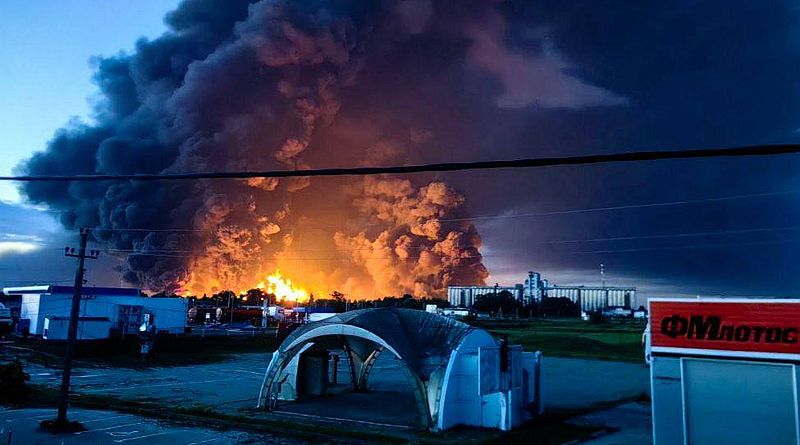
On Ukraine’s Constitution Day, June 28, a double hit on refineries was arranged. The first was the Slavyansk Refinery in the Krasnodar region. This is a key plant in Russia’s southern cluster, supplying troops in Ukraine. A swarm of drones broke through local air defense, causing a large fire through fragments and direct hits. The district administration confirmed damage to technological gas pipes and main power lines. The plant was partially shut down, and emergency teams were urgently dispatched to Kuban. We are drying up the south, which traditionally spends a lot on irrigation and supplies Crimea.
The second refinery hit on June 28 was the Yaroslavl Refinery (“Slavneft-YANOS”). This plant is located about 700 km from the Ukrainian border. It is a strategic enterprise supplying fuel to Russia’s central regions and the northern fleet. Strikes on the tank farm and vacuum units caused such chaos that security forces had to completely block the federal highway on the exit from Yaroslavl towards Moscow for almost an hour, while the Ministry of Emergency Situations tried to localize the fire.
These are not just local fires at refineries. We are deliberately launching a cascading crisis: disrupting production beyond the Urals while simultaneously cutting distribution pipes right near Moscow. The logistical distance increases, there are not enough tank cars, and the aviation hub of Russia’s capital starts to draw fuel from reserves. The target is, of course, the economy — transport companies go bankrupt due to Chinese trucks in loans, farmers, delivery, and taxis suffer.
Occupied Crimea is being hit non-stop. On the night of June 28, the Saky Thermal Power Plant was targeted. Locals reported more than 16 explosions in an hour: a swarm of drones methodically destroyed the station’s infrastructure. NASA FIRMS satellites recorded powerful thermal anomalies in the area of the fuel tanks and transformer substations of the power plant. The station, with a capacity of nearly 150 MW, powered key military facilities of the occupiers in the western part of the peninsula, including an airfield in Novofedorivka. The result — strict blackout schedules were implemented in Simferopol and Sevastopol (from two to five hours), traffic lights in cities stopped working, and the occupation administration announced “emergency repair work.”

Apart from the energy sector, we are systematically burning their military space, not only in Crimea but also right under Sobyanin’s nose.
In Crimea, the Space Communication Center in the Vitino area near Yevpatoria was hit hard. This is a unique long-distance space communication facility used by the Russians to coordinate the work of their military-scientific satellite group and guide precision weapons. It was targeted in 2024, with at least three ballistic missile hits recorded, destroying expensive radar equipment and antenna complexes. Now, it has been checked by drones.
In recent days, the Defense Forces have twice dismantled the Dubna Space Communication Center in the Moscow region. This is the largest Russian ground complex through which the Russian Ministry of Defense manages its satellites, conducts reconnaissance, and coordinates troops. It is a huge area with vulnerable radiotelescopes, phased antenna arrays, and highly sensitive receiving equipment that ensures communication with the Russian satellite group (including the GLONASS system and the Liana electronic intelligence satellites). The first strike occurred on the night of June 22: according to the General Staff, drones destroyed the 32-meter MARK-IV antenna hardware-module complex and a nearby technical building with control servers. However, the Russians found this insufficient, so today, on the morning of June 30, a new swarm of UAVs flew into Dubna.
Two of six such complexes were hit — the losses in long-range aviation, space communication centers, and fuel production are such that they could be pouring Avdiivka with gold right in Russia, but the pensioners in the Kremlin wanted to make history.
In southern Russia, military logistics came under attack. In the Rostov region, a drone swarm attacked a logistics hub in the area of the “Sambek Heights” complex, used as a transit base for equipment and personnel before dispatch to Donbas—at least 12 service personnel were injured, and several units of transport equipment were destroyed. The occupiers tried to hide the fact of the attack, but the stream of ambulances towards Taganrog could not be concealed. The bridge to Novoazovsk was completely destroyed—the land corridor to Crimea continues to dry up.

To understand the scale of the operation: the intensity of the raids these days is a record for the entire year of 2026. The Russian Ministry of Defense officially stated that only on the night of June 25, their air defense “intercepted” 269 Ukrainian UAVs over 11 regions. On the night of June 27, they reported the “downing” of another 213 drones over 12 regions. This means that the Ukrainian Unmanned Systems Forces are deliberately launching massive decoy swarms that overload the channels and deplete the ammunition of Russian Pantsir and Tor air defense systems, after which heavy strike drones and missiles fly into the empty zones, taking out targets for months of repair.
Will the grandfathers in the Kremlin return to reality? Not sure. Judging by the fact that Putin is already ten kilometers from Sumy, surrounding the Armed Forces of Ukraine near Stary Oskol, took Kupyansk in the winter, and is now standing on the western outskirts, and Russia has certain problems with fuel, he is fighting on Mars. And bringing him back from Mars to Earth is not a very simple task. But we are working, because their army refuels, receives guns, and directs missiles here on Earth.
In the cover image: Fire after the attack on the Slovyansk oil refinery in the Krasnodar region of Russia. Photo: Exilenova+
