
Novoooleksandrivsk direction.
The Russian command in the zone of its 36th Combined Arms Army (CAA) of the “Vostok” group of forces seeks to prevent the further advance of the forward units of the Armed Forces of Ukraine (AFU) towards the Huliaipole – Velyka Novosilka road, and if possible, to restore the position of its troops that existed prior to the beginning of the AFU counterattacks in this direction a few months ago.
At present, the enemy (Russian troops) has evidently managed to accomplish the first task — it has stabilized the situation in the tactical zone, as the advance of AFU’s forward units and infantry groups in this direction has virtually stopped. However, the enemy has not been able to cope with the second task — restoring the previous position of its forward units.
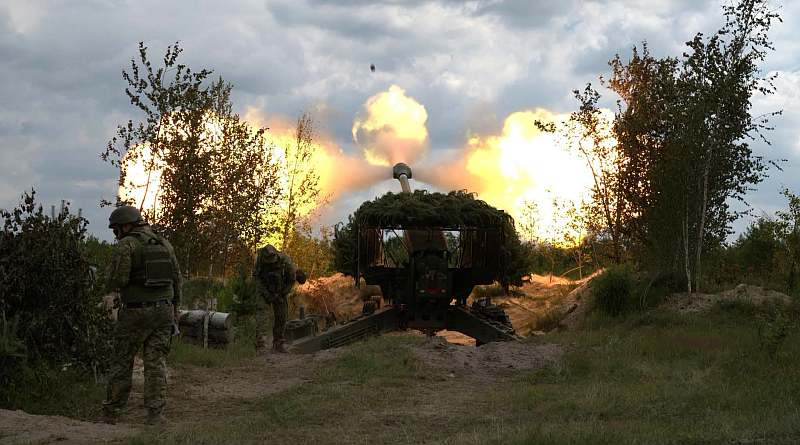
Throughout the zone of the Russian 36th CAA, fierce counter-battles continue, primarily between small infantry groups of both sides with mutual intense use of tactical UAVs, artillery, and other means of combat.
1. Besides the forces and means of the 36th CAA itself, including the 5th Separate Tank Brigade (STB), the 37th Separate Motorized Rifle Brigade (SMRB), and the 30th Separate Artillery Brigade (SAB), the enemy command has actively used additional reinforcement means in its zone, in particular:
– Units of the 69th Separate Covering Brigade (SCB) from the 35th CAA of the “Vostok” group were recorded in its zone;
– As well as part of the forces of the 120th Marine Division (MD).
During the period of repelling Ukrainian counterattacks in the past and at the beginning of this month, separate formations of “territorial forces” (TF) and “mobilization reserve” (MR) were recorded in the zone of the 36th CAA. At least two such formations at the level of a “separate motorized rifle/infantry regiment/battalion” (SMRR/SR – SMB/SIB) were present in the zone of the 36th CAA.
To stabilize the situation in the zone of its 36th CAA, the command of the Russian “Vostok” group could also involve part of the forces from its operational reserve (38th SMRB of the 35th CAA). Though its units were primarily recorded and are still being recorded in the zone of the 5th CAA of the “Vostok,” which is currently advancing in the Huliaipole direction.
At the moment, it is evident that the Russian command (likely at the UVO level) is still considering the possibility of using some of the forces and resources concentrated and deployed in the 36th Army’s sector in other directions, as, evidently, they believe they have already accomplished their main task (stabilizing the situation in this army’s tactical zone). However, based on a more realistic and adequate assessment of the situation, I would call this stabilization rather precarious, as in several areas of this direction, battles in the tactical zone continue to be quite stubborn and intense.
2. Current situation on the Novooleksandrivka direction is characterized by a very clear desire of both sides to achieve significant results, primarily regarding the tactical improvement of their own forward units and subdivisions, specifically:
– The Armed Forces of Ukraine, which as a result of previous rather active and intensive counterattacking actions, managed not only to stop the enemy’s advance in the northwestern direction but also to push it back in the entire band of the 36th Army from the Vovcha River to the south, are now trying to consolidate their achieved positions and lines, maintaining the possibility of continuing offensive actions in the general southeast direction.
– In turn, the Russian command seeks to eliminate several Ukrainian incursions into its defense system at the tactical level and simultaneously restore the advance of its forward units along both banks of the Yanchur River in the northwestern direction, as well as in the general direction of Zaporizhzhia — Verbove.
As a result of these “mutually exclusive” aspirations, in the tactical zone almost throughout the entire band of the Russian 36th Army, “sticky” and fierce encounters continue with varying success, specifically:
– It is evident that the forward units and infantry groups of the Ukrainian Armed Forces managed to liberate most of Berezove with a short attack and even moved slightly further southeast of the village. However, the enemy likely still managed to retain several small infantry groups on the southwestern outskirts of Berezove and even to the northwest of it.
– In the areas of Novomykhailivka and Kalynivske, fierce battles are underway. Russian assault groups operating from the direction of Zaporizhzhia are constantly trying to break through the flank of Ukrainian units holding the southeastern part of the village and the territory to the south of it, and also constantly attacking Kalynivske itself from the east. So far, the Ukrainian Armed Forces are holding their positions, but small infantry groups (from 2 to 4 service members) of Russian troops have already been recorded in Novomykhailivka and on the northern outskirts of Kalynivske. It is evident that the purpose of all these actions by the enemy is their desire to completely eliminate the Ukrainian incursion in the Novomykhailivka area and push them north.
The problem for the forward Russian units attempting to accomplish this task is that the local (tactical) command of the Ukrainian Armed Forces is quite aware of the enemy’s intentions. The successful attack on Berezove and regular local attacking actions by the Ukrainian Armed Forces in the southern direction around Ternove quite eloquently testify to this. After all, if they become effective, Ukrainian units themselves will be able to reach the rear of Russian units attacking Novomykhailivka and Kalynivske.
– The same situation is happening around another Ukrainian incursion in the Novohryhorivka area, where the enemy is also trying to “bypass” the forward positions of the Ukrainian Armed Forces from the east and northeast, effectively acting along the administrative border of the Dnipropetrovsk and Zaporizhzhia regions of Ukraine.
The result of these actions is still unimpressive. Apart from a few small advances “through plantings” to the north and northeast of the village by a few hundred meters, the enemy has not achieved more.
It should be noted, however, that in the area between Novohryhorivka and Novomykolaivka, the enemy has a few “small and very small” blocked infantry groups in the tactical rear of Ukrainian units (approximately up to 4), which apparently managed to infiltrate there through the infamous “inter-positional space (areas).”
For example, to the west of Kalynivske, several Russian “infiltrates” continue to hold an “orchard” surrounded by 800 meters. The northernmost of these groups is still recorded even in the Verbove area (over 6 km from the front Russian positions northeast of Novohryhorivka).
—In the directions of Rybne — Zahoda, as well as Pryvilne — Krasnohirsk (on both banks of the Yanchur River), quite active battles are also taking place in the tactical zone. Russian troops clearly seek to push the advanced units of the Armed Forces of Ukraine as far north as possible from the Uspenivka and Novovasylivske areas to at least partially unblock the important road for them (Huliaipole — Velyka Novosilka) at the point it crosses the aforementioned river.
However, after the Armed Forces of Ukraine withdrew from Rybne, and Russian infantry groups were able to occupy part of Krasnohirsk (the actual result of intensive “penetrative” actions by Russian troops over the month has been their advance on both banks of the Yanchur by 1 km), further Russian counterattacks in this direction, in essence, stalled.
But in the area between Zahoda and Dobropillya, the enemy succeeded again in “infiltrating” another batch of their assault “infiltrates” (up to 6 such groups recorded). The largest of them (5-6 bodies, possibly up to 10) are apparently nestled in various “forest plantations” and impromptu shelters in the area of Dobropillya, Novi Zaporizhzhia, and northwest of Solodke.
Thus, it can be stated that the situation on the entire Novooleksandrivka direction, from a formal point of view, currently looks quite stable. Obviously, in this sense, both sides are mainly engaged in “tactical improvements” of the positions of their forward parts and units.
3. However, regarding general (operational-tactical) prospects, this stability, so to speak, appears somewhat fragile. It is evident that in the case of any significant “tactical improvement” achieved by one of the parties, it will clearly attempt to immediately develop it to the operational level.
At least the Russian command currently demonstrates such readiness, having concentrated up to 4 brigades (including a tank brigade) in the 36th CAA strip and having brought in part of the forces of the 120th Naval Infantry Division (from its strategic reserves). And it should be noted that, FOR NOW, even part of these forces and means have NOT been regrouped to other directions. Although they might do so, considering (of course, only “temporarily”) the current stabilization in this direction as an “acceptable” result for themselves.
I believe that the decisive factor in this issue and specifically in this case for the Russian command will be the assessment of further plans and intentions of the Ukrainian troop group’s command operating in this direction.
It is evident that the command of the Eastern Military District is not eager for several fresh Ukrainian brigades to “fall” behind the right flank and into the rear of Russia’s 5th Army Corps at the most inconvenient moment (for example, during the “hypothetical triumphant approach” to the Slovyansk-Kramatorsk agglomeration). This is especially true in the context of the sizeable “impact” of the Armed Forces of Ukraine with strike drones on the operational rear of the Eastern Military District and “Dnipro,” affecting the entire Southern operational zone.
The chain of events here is quite logical. Summer — heat — water (which, due to a fuel shortage, will be very difficult or even impossible to deliver TIMELY and in the necessary quantities), followed by a gradual decline in troop combat effectiveness. I am not even mentioning all types of food, spare parts, ammunition, etc., in conditions of “disruptive” supply routes (including the operational level). The more intensively the troops of both groupings engage in combat operations, the more actively they lose this combat effectiveness under such conditions. Therefore, it should be remembered that the command of BOTH Russian troop groupings, including the Eastern Military District, will do everything possible to prevent such a development of the situation.
Photo: General Staff of the Armed Forces of Ukraine
