

The Russian leader, speaking at a gathering of military academy graduates, “exposed himself like a sub-officer’s widow,” claiming at the latest meeting of a new group of officers, potential victims of his criminal policy, that they are “fulfilling tasks during the [special military operation] – liberating our historical lands…”.
So once again, they talk about “historical lands.” Not about states, not about international law, but pseudo-legal nonsense aimed at justifying an act of aggression and attempts to annex the territory of sovereign Ukraine.
Why is this complete nonsense from a legal standpoint?
In modern international law, the concept of “historical lands” is not recognized. Borders and sovereignty are based on the norms of the UN Charter, principles of inviolability of borders, and self-determination of peoples, and any attempts at forceful revision under the slogans of “restoration of historical justice” are considered aggression and a violation of international law. Thus, the Russian rhetoric about “returning historical lands” is legally null and void and has no legal force.
The Russian invasion of Ukraine is a direct and blatant violation of the fundamental norms of the modern world order.
Why references to “historical lands” are illegal.
Firstly, it violates the UN Charter. Article 2 (4) of the UN Charter strictly prohibits the threat or use of force against the territorial integrity or political independence of any state. No historical myths or claims can overturn this norm.
Secondly, it denies the principle of inviolability of borders. The Helsinki Accords of 1975 and international law are based on the recognition of existing, officially established borders. Ukraine and Russia officially delimited their common border in the 2003 Treaty on the Ukrainian-Russian State Border, which the Russian Federation ratified and committed to respecting.
Thirdly, it openly disregards the prohibition of annexation. International law categorically prohibits the acquisition of territories by force. The occupation and attempt to annex Ukrainian regions under the guise of “historical rights” are qualified by the UN General Assembly as acts of aggression.
Fourthly, it is an attempt to use the historical affiliation of certain lands to various states to disguise the intent to rewrite modern rules and norms. The modern legal order prioritizes the will of the people currently living on the territory, not who owned the land centuries ago. In 1991, the people of Ukraine (including Crimea and Donbas) in a legally organized all-Ukrainian referendum chose independence by an absolute majority, officially recognized by the world community and by Russia itself.
Fifthly, the International Court of Justice (the highest judicial authority in the world) issued an order in March 2022 obligating Russia to immediately cease military operations. The UN General Assembly in numerous resolutions (including ES-11/1 and ES-11/4) clearly condemned the actions of the Russian Federation, recognized them as aggression, confirmed Ukraine’s sovereignty within its internationally recognized 1991 borders, and deemed the Russian arguments completely unfounded.
So save your stories about “historical lands” for when you try not to lose Kaliningrad (Königsberg in East Prussia), which, according to the logic of the Russian leader, are the historical lands of Germany.
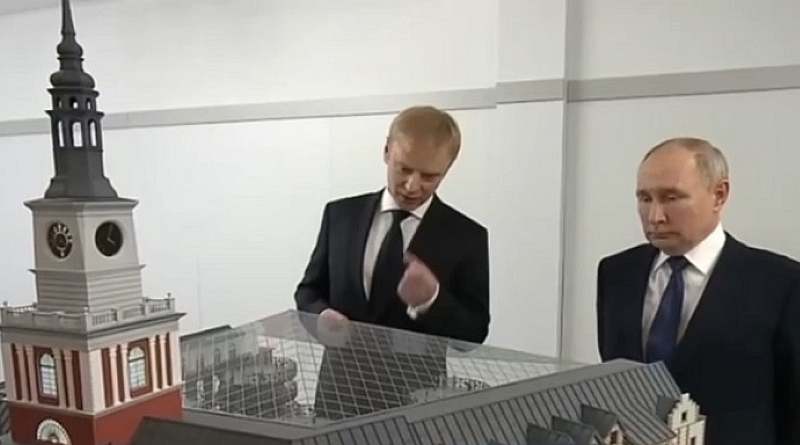
In the thumbnail: Rector of the Baltic Federal University named after Immanuel Kant, Alexander Fedorov, shows Vladimir Putin a model of the new BFU building, January 25, 2024. Photo: Occupier media
