
Today — Sloviansk direction.
1. The enemy (“RF Armed Forces”), with the forces of its “South” group of troops, continues trying to break through from the east to the nearest approaches to the city of Sloviansk, as well as to occupy the key area for logistics support of the Lyman bridgehead of the Armed Forces of Ukraine, south of the Siverskyi Donets River.
The basis of the enemy group advancing on Sloviansk from the east is the troops (forces) of the 3rd Combined Army (ZVA), formerly known as the “2nd Army Corps (AC) of the people’s militia of the L/DPR”. In particular, the forces and assets directly concentrated, deployed, and participating in offensive actions in this army’s sector consist of:
– 6th Separate Motorized Rifle Brigade (omsbr);
– 85th omsbr;
– 88th omsbr;
– 123rd omsbr;
– 127th omsbr.
In addition, in the same direction, a larger part of the so-called “Russian volunteer assault corps” (DSK) operates, as well as a number of formations (up to 5) at the level of “separate motorized rifle/rifle regiment/battalion” (omspr/osp, omsb/osb) of the “mobilization reserve” (MR) category and territorial troops (TrV). They either are part of the brigade staff of the 3rd ZVA, acting in this direction, or are assigned to them in operational subordination as reinforcement means.
In fact, on the Sloviansk direction, the Russian 3rd ZVA operates with almost its full complement of troops (except for the 4th omsbr, which probably operates its main forces in the Kostyantynivka direction).
In all forward parts and subdivisions of the 3rd ZVA, including the MR and TrV categories, consolidated assault groups and units have been formed, which are widely and quite intensively used by the Russian command in combat operations.
Currently, the 3rd ZVA, leading an offensive on the city of Sloviansk, is the most powerful in terms of combat and numerical composition (BChS) in the entire “South” group (apart from it, this group includes the 8th ZVA and the 3rd AC, which are currently fighting for the Kostyantynivka defense area of the Armed Forces of Ukraine).
In fact, the command of the “South” group concentrated the entire 3rd ZVA exclusively on the Sloviansk direction, replacing its forces and assets in the Chasiv Yar area with the 70th Motorized Rifle Division (msd) of the 18th ZVA, previously regrouped here from the Southern operational zone (“Dnieper” group).
2. Currently, the command of the 3rd ZVA is concentrating its main efforts on the flanks of its offensive sector. Namely:
– South of the Siverskyi Donets River in the general direction of Siversk – Kalenyky – Mykolaivka;
– And on both sides of the Sloviansk-Bakhmut road, trying to reach the line of Orihuwatka-Zapovidne.
From the end of April to May, the enemy managed to achieve numerous tactical penetrations in the offensive zone of its 3rd Combined Arms Army, creating a real possibility in the near future to bring its main forces of forward units to the outskirts of both Sloviansk and Kramatorsk. Specifically:
– The enemy advanced from Zakytne to the area south of Kryva Luka with its forward assault groups, initiating battles for the latter. Simultaneously, advancing towards Riznykivka — Kalenyky, they also managed to secure positions in Kalenyky.
– Notably, the enemy progressed from Kalenyky towards Lypivka. Although the Armed Forces of Ukraine continue to hold some positions south of Kalenyky and Riznykivka, the enemy managed to advance a number of its assault groups, using a ravine along the Sukhaya river, effectively penetrating between these positions and Rai-Oleksandrivka. Moreover, this advancement seems quite deep (approximately up to 5 km).
Although the Armed Forces of Ukraine managed to repel several “focused” enemy attempts to “cling to” Rai-Oleksandrivka with significant forces, the threat of encirclement and blocking of several Armed Forces positions, located south of Kalenyky and Riznykivka (to the east of Rai-Oleksandrivka), is quite evident.
The enemy (in the form of several small infantry groups) managed to hold the outskirts of Rai-Oleksandrivka (south of the “Ukrposhta” branch), and the distance from this area to their comrades operating north of the Sloviansk-Bakhmut road is only 2.6-2.7 km.
– North of the Sloviansk-Bakhmut road, the enemy managed to occupy Lypivka again, advancing towards Nykyforivka — Lypivka, and reaching the line Dibrova — Fedorivka Druha.
– South of this road, the enemy, operating in directions Privillia — Malynivka and Minkivka — Tykhonivka, reached the “Siverskyi Donets — Donbass” canal with the main forces of their forward units. They even advanced with separate assault groups towards Malynivka and Tykhonivka respectively beyond the canal.
Although the Armed Forces of Ukraine continue to hold both Malynivka and Tykhonivka, the situation south of the road is clearly developing quite negatively for the Armed Forces of Ukraine. As the enemy attempts to attack not only across the canal but also along it from Novomarkove, it is evident they are striving to completely “collapse” the defense of the Armed Forces of Ukraine along the canal.
Thus, it can be asserted that the situation in the Sloviansk direction appears quite threatening for the Armed Forces of Ukraine. Despite significantly reducing the pace and dynamics of the offensive of the forward units and subdivisions of the Russian 3rd Combined Arms Army over the past week through a series of counterattacks, limiting them in the tactical zone to minimal levels, they have not yet been able to fully stabilize it. The forward units of this Russian army continue to advance towards Sloviansk, albeit quite slowly.
Realizing this, the enemy continues active and quite intensive attacking/assault actions predominantly with small infantry (assault) groups in almost all of the aforementioned directions. At the same time, they strive to fully exploit the presence of significant gaps in the combat formations of the forward units of the Armed Forces of Ukraine (modestly referred to in reports as “inter-positional spaces/gaps”) for active and as deep a penetration as possible and subsequent entrenchment there.
3. However, despite the apparent tactical successes achieved by the Russian 3rd Army in the previous month, its further operational-tactical prospects seem less clear.
Mainly due to the minimal advancement rate demonstrated by its leading units and formations over the last week and a half. Evidently, their combat capability has started to gradually decrease. This is not to mention the fact that during the battles for Rai-Oleksandrivka, which the 3rd Army command will likely attempt to “capture at any cost,” it will decrease even further.
In addition, the 3rd Army command is again demonstrating its “signature style,” aiming to attack almost along its entire front line, both immediately and simultaneously. In this way, it effectively dissipates its own offensive efforts and capabilities. Even though, from a formal point of view, one can still highlight the flank sectors of the 3rd Army’s line (where its command has quite obvious tactical successes), in practice, it constantly “strays” from concentrated efforts on them, persistently reverting to a sort of “total onslaught,” trying to attack (and, accordingly, advance) across almost the entire width of its line (from Zakytne to Novomarkove).
If this is such a “brilliant” plan to “confuse” the Ukrainian command, it might seem, let’s say, quite strange. After all, it actually leads to a general acceleration of the decline in combat capability of the 3rd Army’s leading units and formations. At least faster than in the leading units and divisions of the Ukrainian Armed Forces, which are defending.
By the way, such “behavioral reactions” are very characteristic of the two Russian armies — the 3rd and 51st Armies. Yes, precisely those that “grew” from the so-called “army corps of the Donbas people’s militias.” Frankly, I still haven’t determined what kind of “birth trauma” contributed to the subconscious desire of their command to “always attack everywhere,” without paying attention to questions such as “how to attack?” and “where exactly to attack?”, and most importantly “why attack?”.
However, it should be recognized that such “offensive frenzy” sometimes does yield results, occasionally quite quickly and significantly, at least tactically. But, as a rule, it does not last long and leads to clear and swift “over-expenditure” of manpower and resources. Let’s recall the “first” breakthrough of the 51st Army on the Dobropillia-Kramatorsk highway, which resulted in the virtual “slaughter” of the assault units of at least two of this army’s flank brigades. Or the price that the 3rd Army had to pay for its offensive battles in the areas of Bilohorivka, Verkhniokamenske, and south of Chasiv Yar, which stood out even from the term “significant.”
I believe that due to this “over-aggressive style” of combat command, the Russian 3rd Army command now risks failing to accomplish (in other words, “missing”) both of its operational-tactical tasks, which it likely previously “sketched” in its “plans and dreams” in this direction — reaching the approaches to Sloviansk (read, occupying the dominant heights east of the city) and “cutting off” the logistics of the Ukrainian Armed Forces’ Lyman bridgehead (by reaching the areas of Mykolaivka and Slovianskaya TPP). And all because it attempted to achieve both of these goals simultaneously at one time. That is, to attack simultaneously here and there…
And what does it have now in this sense?
It also reflects the fact that over the past week, its advanced units and divisions have experienced a noticeable slowdown in their own advancement (offensive), without achieving the “desired” operational-tactical objectives in the Sloviansk direction.
Yes, I acknowledge that considering the importance of this direction for the entire summer-autumn campaign of the Russian troops in Ukraine, the 3rd Army Corps may still be reinforced, replenished, and “comprehensively regrouped,” and then attempt to move on Sloviansk again, so to speak, with renewed forces. However, several important elements are now needed for all these “restorative procedures” — resources and manpower, in “commercial” quantities, ADDITIONAL forces and means (read, reserves), and most importantly — time.
Currently, from the nearest advanced positions of the Russian troops to Sloviansk (more precisely, to the lines and areas from which it will be possible to start the “mass infiltration” of Russian stormtroopers into the city by a well-practiced methodology, that is, to actually begin the assault on the city itself), it is approximately 15-15.5 km. Not very far, to say the least.
However:
– The Lyman bridgehead of the Armed Forces of Ukraine is still holding,
– Rai-Oleksandrivka is as well,
– And BEYOND the “Siverskyi Donets — Donbas” canal, the Russian troops are evidently expecting not “tea and hospitality” from the Armed Forces of Ukraine, but something clearly very opposite.
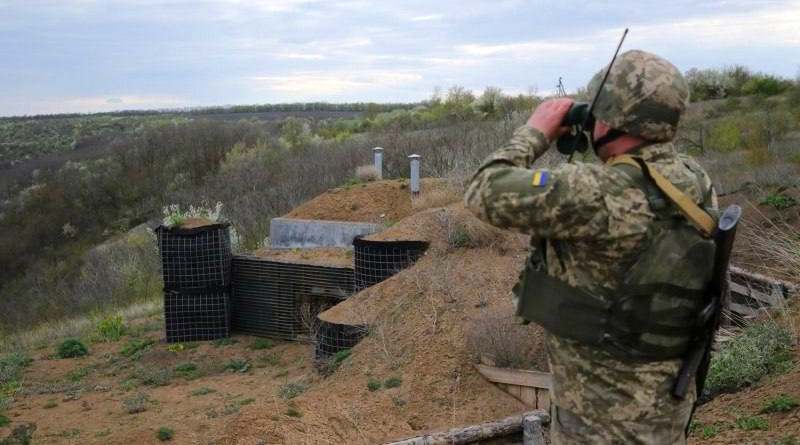
Photo: General Staff of the Armed Forces of Ukraine
