

I told you yesterday, that on the day of “poryebryk” we would launch a very interesting attack 😆.
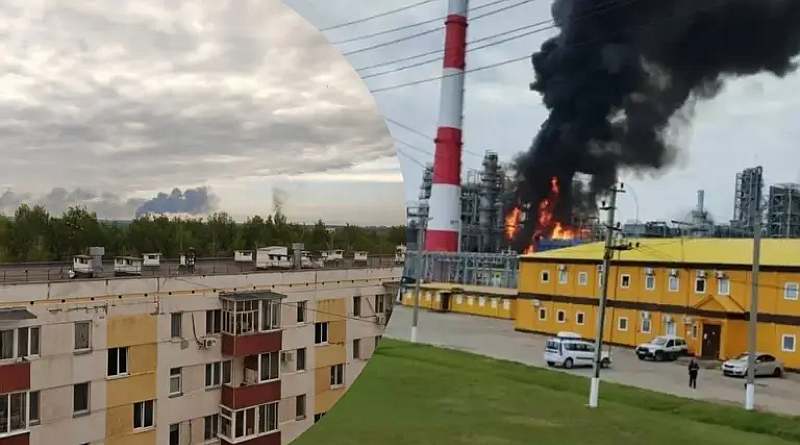
And here we have it. Last night’s attack on targets in Tatarstan and Samara region is not just a random set of hits on three different plants, as it might seem at first glance.
Our guys worked as systematically as possible and beautifully cut through a single production node! Strikes on the petroleum giants TANECO and TAIF-NK in Nizhnekamsk, simultaneously with the hit on the Tolyattikauchuk chemical plant, is a coordinated destruction of the single technological ring of the Tatneft company that directly feeds the Russian war machine.
Let’s look at the numbers and real connections, because that’s where all the beauty of the plan lies.
TANECO and TAIF-NK together process over 23 million tons of oil per year and produce millions of tons of gasoline. However, straight-run gasoline after primary oil distillation has an octane number of only about 50-60 units.
To make it into fuel of normal standard AI-92 or AI-95, high-octane components are needed (a familiar word for everyone: additives). And here, the main donor for the entire region is Tolyattikauchuk, which has facilities with a capacity of 335,000 tons of MTBE per year (methyl tert-butyl ether).
Their own additive lines in Nizhnekamsk are negligible, so the plants in Tatarstan are critically dependent on railway tanks from Tolyatti. By hitting the refineries and the additive synthesis lines simultaneously, we can stop this conveyor from both sides. The occupiers will be left with a heap of low-octane raw materials, with no means to upgrade them to working fuel conditions.
A little information about these two plants:
TANECO (Nizhnekamsk). A powerful oil refining complex of the Tatneft group that processes over 16 million tons of oil per year. For gasoline production, isomerization units (420 thousand tons/year) and catalytic reforming (714 thousand tons/year) are used. This allows for the production of 1.7–3 million tons of automotive fuel annually.
TAIF-NK (Nizhnekamsk). The neighboring refinery is geared up for processing 7.3 million tons of heavy oil and 1 million tons of gas condensate per year. The plant covers up to 88% of all gasoline production in Tatarstan.
But the fuel trap is only half of the matter and logic of today’s attack.
The second and much more painful dimension of this strike is the direct undermining of the base for the production of Russian explosives and rocket fuel. For the synthesis of classical TNT and RDX mixtures, the chemical industry needs liquid aromatics, namely benzene and toluene.
TANECO hosts a powerful aromatic hydrocarbons complex, producing up to 60 thousand tons of pure benzene per year and huge amounts of industrial toluene. This chemistry is transported by tankers directly to the special chemistry factories of the military-industrial complex, with the Sverdlov plant in Dzerzhinsk first on the list. It is a monopoly that equips Russian aerial bombs and missile warheads. Without toluene from Nizhnekamsk, munitions factories will face a hard stop.
Simultaneously, Tolyattikauchuk addresses the physical casing for weapons systems. Modern solid rocket fuel for Grad, Uragan, or Smerch MLRS systems, as well as for the Iskander ballistic missile complexes, cannot be created without a polymer binding material. Simply put, a special rubber adhesive is needed, which holds the oxidizer powder and metal fuel in a stable state inside the rocket body, prevents the mixture from cracking during storage, and ensures even combustion at launch. Tolyatti produces exactly these special types of rubber. Without them, not only is missile engine production halted, but the manufacture of Russian plastic explosives PVV-5A, their equivalent of western C-4, also ceases.
This is how a proper systematic approach to the Russian military-industrial complex looks. We’ve not just damaged a few technological installations. With our strikes, the defense forces have halted the entire industrial chain, where Nizhnekamsk provided the basic chemical energy and toluene for TNT, and Tolyatti secured the fuel logistics and polymer matrix for missiles. This is a powerful, synchronized depletion of the Russian offensive and their missile potential, not just a reduction in gasoline at gas stations. The lack of gasoline, of course, forces the public to record all these hundreds of videos and view the authorities with skepticism. But reducing the “explosive potential” is even better for us.
Collage: 24 channel
