
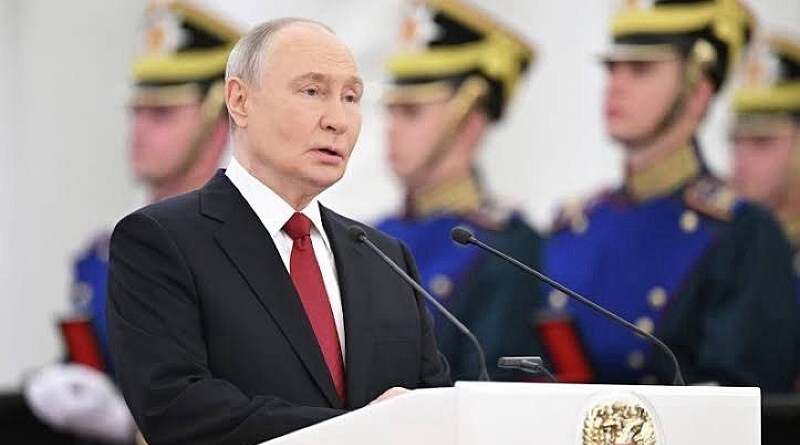

Today’s official celebrations for Russia Day once again demonstrated the deep ideological transformation of this holiday. Originally conceived as a day of civic sovereignty and building a new, open country, it has today definitively turned into a day of broadcasting President Putin’s intensified militaristic fervor.
Instead of dialogue about internal development, economy, or citizens’ living standards, the key events of the day were meetings with military veterans, loyal media structures, and war correspondents, as well as the awarding of state honors at the Kremlin, accompanied by another wave of aggressive rhetoric towards Ukraine and the West.
The central theme of Putin’s speeches to the military was the official promise to increase the intensity of strikes on Ukrainian territory. Commenting on the increased Ukrainian drone strikes on Russian oil refineries and border regions, Putin openly announced plans for large-scale attacks on Ukrainian critical infrastructure under the pretext of protecting its own civilian facilities.
Here lies a cynical substitution of concepts: by calling Ukrainian strikes on legitimate economic and military targets, which fuel the Russian army, “attacks on civilian objects,” the Kremlin attempts to legitimize its longstanding campaign to destroy Ukraine’s energy system.
The very necessity to make such statements on a national holiday betrays the Kremlin’s growing nervousness about the war increasingly moving onto Russia’s own territory, shattering the remnants of the “complete security” myth.
In his official speech in the Kremlin’s St. George’s Hall, Putin linked modern aggression with historical legacy, calling all stages of the country’s history “one unified whole” and emphasizing that “unity and patriotism” are the main values helping to “defeat enemies.”
For participants of the “special military operation,” this rhetoric is presented as a reliable spiritual support. However, behind the facade of grandiose phrases lies an attempt to forcibly blur the responsibility for the unleashed war onto the entire Russian population, making citizens accomplices in imperial expansionism. Using history as a justification for aggression means effectively refusing to recognize the sovereignty of neighboring states, whose territories the Kremlin considers its “historical lands.”
The current rhetoric underscores Moscow’s long-term strategy—a demonstration of readiness for endless war. International analysts note that Putin’s theses on Russia Day aimed to intimidate European and American leaders to restrict military aid to Kyiv, particularly permission to use Western long-range weapons on targets deep within Russia.
Amid formal congratulations from the few remaining Kremlin partners, an attempt is made to show that international isolation has failed and the regime feels confident. By focusing attention on the “damage from Ukrainian drones,” Russian diplomacy tries to promote the narrative in the West about the need to stop support for Ukraine to stabilize the region.
Russia Day 2026 appears to have completely cemented the Kremlin’s abandonment of civic agenda. The main content of the holiday was not a day of independence and creation but a cult of war. Putin’s threats to increase strikes on Ukrainian cities, made under champagne toasts at the Kremlin, confirm: Moscow is not seeking real peace but uses any internal platforms to escalate violence and blackmail the international community.
