
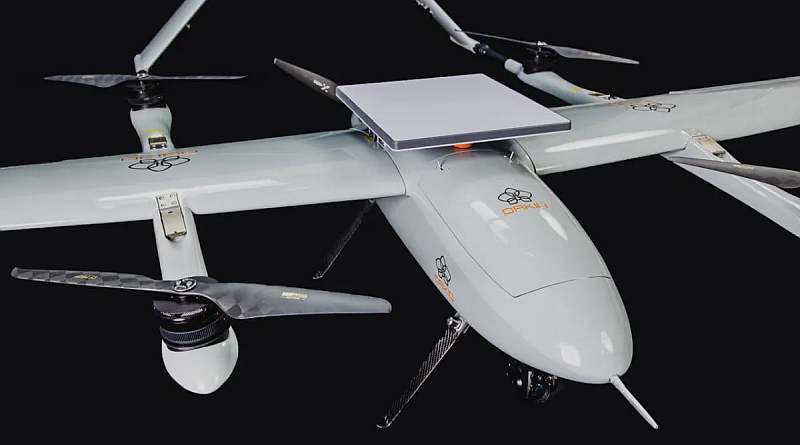

Recently, we talked with some R&D folks and discussed an interesting topic – the dependence on Starlink and its impact on the present (and the future).
And it turned into quite an interesting topic to think about.
Starlink has become a game-changer for our front- and mid-strike UAVs. Mainly because its capabilities greatly enhance the capabilities of drones, and it contains functionality that requires fairly technological solutions to replicate in a drone.
But, as one pilot said, manufacturers created drones that are technological and not so technological, but Mr. Starlink leveled them all (a reworking of the saying about God, people, and Colonel Colt).
Here’s the deal.
A modern front-, mid-strike drone must have a number of fairly technological solutions to successfully perform its job.
You must have a stable connection over long distances (the cost of such a Western communication module ranges from $7,000 to $15,000. Ukrainian modules of this class have not yet been developed, and judging by everything, they won’t be developed in this paradigm).
To cover long distances in an automated mode, you must have a neural network that guides you by visual landmarks according to the loaded map, and an onboard mini-computer that will compute it all.
The target acquisition system must have algorithms for any case, entering the target in difficult weather conditions, in any wind direction, and when the target is moving.
To avoid showing up on Electronic Warfare, you must have algorithms that allow you to pass sectors in a radio silence mode.
To have communication at low altitude above the ground, you need a relay on a reconnaissance wing. And generally, adaptation with a reconnaissance wing.
This is all complex.
Starlink solves many of these issues.
You don’t have a neural network tracking the drone according to the loaded map? Well, Starlink itself gives you the terminal position according to the satellite constellation.
You don’t want to invest in integrating costly Electronic Warfare-resistant communication? Well, a mini Starlink for 400-500 bucks, a tunnel or R2D2, and you’re off to any distances for a thousand bucks. Your relay can also be put where you put the expensive communication module before.
Your target acquisition system only works on the range, and in real combat conditions, it can’t attack moving targets, or “captured pixels” constantly fall off when the board approaches the target? No problem, the operator will guide the board manually in target mode, entering on the most gentle trajectory, and will manually adjust the drone to the target at the last moment.
This all leads to lowered requirements for the drone; you can create a fairly simple and low-tech drone because later you’ll install Starlink on it, and thanks to that, it will fly excellently. Moreover, it will be significantly cheaper than a more automated drone with those functions on board.
– But there is the Hornet, – you might say.
Yes, of course. And it’s an excellent drone. But even the basic communication version, on which a Starlink is placed, does not cost the $5,000 that Eric Schmidt sells them for. All drone enthusiasts understand that this is a discounted price for Ukraine because Eric is a great friend of Ukraine, and his developments are the result of Ukrainian combat experience. Therefore, Eric sells these drones to us at a symbolic price, thanking us for these developments.
Breaking down his drone by components, the components alone are several times more expensive than its cost, even without accounting for the valuable software (the development of which was incredibly costly).
But Eric can afford it, he tests his drones in Ukraine and moves towards complete system automation.
But can Ukrainian manufacturers afford the same?
Not really. This leads to an interesting situation because, for the first time in years of war, the state has begun to focus on purchasing less technological means. Why?
Because they are cheaper, and the budget is not limitless, money needs to be saved, and the cost of hitting one target needs to be reduced. Literally, it is the opportunity to destroy the enemy for less money.
But this also carries some risks.
Firstly, it sabotages future system automation.
All the elements mentioned above are steps toward full drone automation, which will be controlled by military systems with minimal human influence on the tactical process. Abandoning the development of such processes means returning to systems reliant on humans. And here, we hurt our competitiveness in the future because Western companies are preparing for war with automated systems, and their drones are developing in that direction.
We, on the other hand, are returning to, essentially, “FPV drones with Starlink,” manually operated because it’s cheaper. And this is after we stumbled with this concept when we came to sell our interceptors, only to find unexpectedly that there was no possibility to quickly set up pilot training schools, there weren’t thousands of pilots who had flown on various platforms for years, and the Arabs directly said “either install remote control because there’s no one to train for this, and no time to spend six months training a pilot, or you fly your interceptors yourselves, because otherwise, we don’t need this.”
And this was a sign that process automation was needed, and the level of drones that the world requires. But somehow, on interceptors, these markers showed where to move, but on strike drones, these markers didn’t influence someone’s opinion.
Secondly, we are becoming increasingly dependent on politically influenced communication types. Well, okay, we’ll fill the warehouses with means that fly well solely on Starlink. But what if it’s turned off?
We already have a massive dependence on Starlink at the front and, despite all the risks, have done nothing in case of it being turned off.
Having seen how it worked for the enemy, we’re boldly moving forward, confident that only Russians step on the same rake repeatedly, and we’re sure to avoid it, just as we did before.
But there’s a point. I recently started thinking about the purpose of the information operations (IO) being pushed by Russia. Like when they buried girls in Starobilsk in wedding dresses, or retaliated against attacks on “civilian casualties” who somehow happened to be at the Rubicon base and drone pilot training school “Warrior.” Then there’s news about a strike on a bus, saying many civilians died (though the bus was on a military route, civilian bodies were not shown, and the bus numbers were immediately removed).
And now Russian military are also starting to switch to civilian transport on a large scale. If they’ve already started warming up the narrative that “Ukrainians are killing civilians with Starlink drones,” what do you think the goal of this information operation is?
That’s what I think too. Let me remind you, Musk once disconnected Starlink on naval drones and officially stated “Starlink is a peaceful communication.”
Okay, even if they don’t block Starlink along those lines, what stops them from just not renewing those Starshield accounts, which allow drones to fly?
Yesterday I read that Bulgaria refused to sell us weapons because “it escalates the conflict.”
Damn, missiles and drones over Kyiv and the deaths of children don’t escalate the conflict, but selling weapons to the defending side does. It’s crazy. But somehow Russia managed to push this position in Bulgaria, to the detriment of state drone sellers.
But the question is different; there’s Pete Hegseth, who is somewhat of a supporter of Ukraine, there’s Elon Musk (no comments), and is there any guarantee that they aren’t already being fed the line that “Starshield escalates the conflict, and Putin would have agreed to some terms, but can’t because the Russian armed forces are getting beaten, and he can’t end the war in such a situation or he will lose face?”
And we continue to rely on Starlink.
So what’s the right approach?
The right approach is to have alternatives in case Starlink is disconnected. We need drones and technologies that can cover 70-150 without Starlink, using autonomous technologies and quality radio communication, and we need cheap mass-produced drones where we can attach mini Starlinks.
The truth is, this is already creating a shortage of mini Starlinks in Ukraine, and I am increasingly being asked by different units to arrange for at least a few “minis.” By the way, my unit has the same problems, if you wish to help with mini Starlinks, the details are below; we also want to unleash more fire from the skies😉.
But I digress.
So, there needs to be a government system that will separate these directions and purchase more technological drones to stimulate their development and have solutions in case of a Starshield shutdown, and also purchase cheaper, mass-produced tools for Starlink, understanding how much of what needs to be bought, because these are quite different in cost and class.
This also motivates manufacturers of cheaper and less technological drones to develop their technologies and create more advanced tools, independent of Starlink.
Is this being done? But somehow I think not.
If the state wants to save money, there are other opportunities, for example, not pouring billions of hryvnias into stillborn brigades, which already have thousands of substandard members, constantly changing officer ranks because it’s just chaos, but nobody cares, we come from a wealthy family, we can afford it. But more technological drones – we cannot. There are other directions too, but let’s stop here.
Anyway, we need to find a balance here because the last thing I want from this post is to repost it in a few months with the phrase “I told you so!!!” Like it happened with the drone interceptors.
Right now, we are balancing close to forming the “status quo” on the front line, and I really wouldn’t want this status to depend on the whims of Hegseth and Musk. We need an alternative, at least in my opinion.
Something like that.
Photo: Airdroper
