
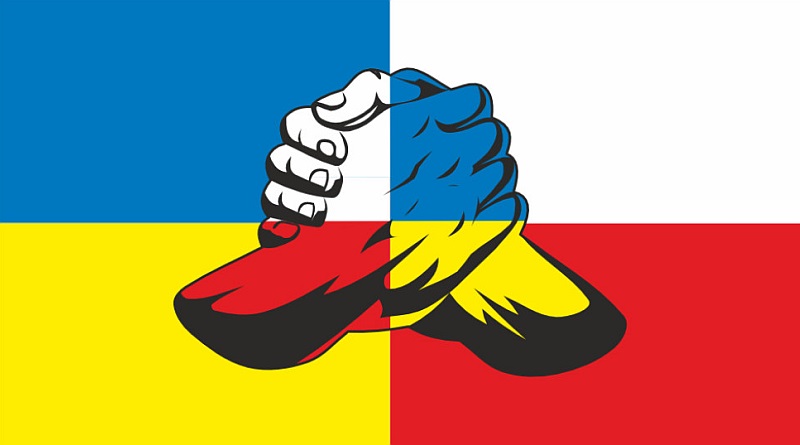

When I follow the new escalation of the Polish-Ukrainian historical conflict, which again threatens to worsen relations not only between our countries but also between our peoples, I feel a huge temptation to look at this situation not from the position of a Ukrainian journalist who believes in his country and its future, nor from the position of a sincere friend of Poland.
I am tempted to look at this situation from the position of a victim. Yes, a victim. Because in the reality that everyone loves to ignore, I belong to a people millions of whose members lived for centuries on the lands of modern Poland and modern Ukraine. They lived, by the way, before the Poles realized they were Poles and the Ukrainians that they were Ukrainians.
They lived—and now they don’t. Where did they go, I wonder? You know where. The vast majority were simply killed, including my closest relatives. Many were simply expelled. And it’s not only about the Middle Ages with its bloody excesses. It’s about the 20th century. About the Holocaust, yes. But also about everything that was before and after the Holocaust. About pogroms in Ukraine. About Jedwabne, about Kielce. About expulsion from communist Poland. About wild Soviet anti-Semitism. Both Ukrainians and Poles should just understand that no one has forgotten about this. And will not forget—just as Ukrainians and Poles will remember the victims of Volhynia.
Moreover, no common explanations regarding religious or economic motives for persecution work in the real world. Explanations that the entire atmosphere was created by insidious hostile empires, Russians, do not work. Explanations that “people’s avengers” were responding to communist crimes, because there were many Jews among the members of this bandit party, do not work. It must always be remembered: the response to all these “motives” was the killing of women and children. That perhaps your grandfather—Ukrainian or Polish—killed a Jewish child, and your grandmother—Ukrainian or Polish—betrayed a Jewish child, and it was sent to death.
What do I feel when only one handshake separates me from my murdered relatives—and from those who might have killed them? I do not feel a desire for revenge. I do not feel a desire to reproach and explain which monuments to dismantle and how to name streets.
I want to see the Polish and Ukrainian peoples as citizens of strong states, confident in their own future. I know that any violence against the weaker comes from a national inferiority complex—from insecurity, from the inability to protect oneself and from the desire to vent anger, to demonstrate one’s strength on someone who cannot defend themselves.
And I am absolutely certain that the road to a sense of dignity lies through respect for those who have fought for their own sovereignty and statehood. However, such a struggle by oppressed nations has never in history been devoid of crimes, a division between moderate politicians and radicals, between murderers and righteous people. Humans are not robots. I would like to write “unfortunately,” but I will not, because otherwise, we would not witness these miracles of self-sacrifice, where alongside those who killed and betrayed, there were always those who saved—at the cost of their own lives. I always remember this when I see the Avenue of the Righteous at Yad Vashem in Jerusalem: how many Ukrainians and Poles are there! And it saddens me that we have not yet duly honored those Poles who saved Ukrainians from their compatriots, and those Ukrainians who saved Poles. These people are true heroes.
Many people, respected in the Ukrainian and Polish pantheons, evoke not only disgust in me but also sheer fear. Yes, fear. The fear of a victim, because I remember well all that these people did, wrote, and said. But I am convinced that nations should have the opportunity to honor their heroes on their path to state-building. Especially since no monument is eternal. We have seen this repeatedly in many countries—from the United States to France or Germany. And I am certain that many people, honored in Poland or Ukraine, will eventually disappear from their pedestals as history progresses. However, it is the Ukrainians and Poles themselves who should decide this, not Ukrainians for Poles or Poles for Ukrainians.
Today, any conflict on historical grounds results in victory for only one state. A state that has always aimed to dictate its own vision of historical memory to everyone. A state that has never acknowledged any of its own crimes and always declared everyone around as criminals.
Any discord between the Polish and Ukrainian nations will inevitably lead to the triumph of Russia. If it defeats Ukraine, it will destroy Poland as well, no matter what illusions about their own security in European structures or NATO the average Pole tries to rely on. Ultimately, it should be noted that the world has once again changed, and no one has any security guarantees anymore. We can only save ourselves together. Or perish together.

Demonization of Ukraine in the Polish information space.
In recent weeks, there has been an intense demonization of Ukraine in the Polish information space, catalyzed by the well-known populist and Ukrainophobic party “Law and Justice,” which was behind the farmers’ protests and the blockade of freight flow from Ukraine to Poland in the past.
An extremely interesting study by “Press Club Polska” is crucial for understanding current trends and highly negative consequences for Poland. It reveals that since late May, Poland has experienced the most unprecedented informational attack on Ukraine.
Specifically, the number of mentions about Ukraine on Polish social networks increased to 247,329, and the number of interactions rose from 873,883 to 4,355,208 (+398%, almost fivefold).
The average daily rate increased from 11.0k to 35.3k mentions, peaking at 90k mentions and 2.0 million interactions on May 29.
The main theme was the awarding by Ukrainian President Volodymyr Zelensky on May 27 of the honorary title of “Heroes of the UPA” to the Separate Center for Special Operations “North,” which in Polish historical memory is associated with the “Volhynia massacre.”
On May 29, President Karol Nawrocki, who previously stated that every nation has the right to historical memory, now imposing the Polish position on Ukraine, took the lead in the informational attack on Ukraine.
In a very short time, the share of negative mentions of Ukraine in the Polish information space rose to 19.8% compared to 17.3% in the previous period, while the share of directly positive mentions fell almost to zero (0.1%).
Importantly, even slogans that seem pro-European or pro-solidarity at first glance, such as “Glory to Ukraine,” “Bravo Ukraine,” are now voiced almost exclusively in a mocking or hostile tone this week. The mass of neutral messages (80.1%) mainly consists of informational reports about the dispute itself, rather than indifferent sympathy.
The strongest emotional signal of the week is the structure of reactions on Facebook. Their total sum rose to 1,460,830 (from 306,157 the week before).
Noteworthy is the shift in focus from the usual debate for populists
“how much Poland pays for the war in Ukraine” to “how Ukrainians behave in Poland,” emphasizing fundamental fields – memory, dignity, and symbols.
Polish populists of the PIS party, quite predictably against the backdrop of internal problems, especially economic ones, and after effectively losing the elections, have resorted to a frontal attack in an attempt to unite their supporters and opponents on the theme of national memory, which is often used by Polish politicians to justify or distract attention from their domestic political failures.
A significant trend from the PIS-catalyzed anti-Ukrainian sentiments is the growing process of Ukrainians leaving Poland. The first noticeable effect is that employers in Poland are increasingly forced to hire workers from Colombia, the Philippines, India, and Nepal.
The influx of refugees from Ukraine to Poland in 2022 not only presented a challenge for Warsaw but also solved the problem of a severe labor shortage. Ukrainians have, over the past four years, addressed the economic problem of the rapidly developing country by filling the gap of labor shortage, contributing to the stabilization of the economic situation amid turbulence.
Now, the PIS party and its most outspoken advocate today, President Karol Nawrocki, are creating another precedent for the deterioration of bilateral relations and the exodus of Ukrainians from Poland. Well, if culturally, historically, based on language criteria and mentality, Colombians, Filipinos, Indians, and Nepalese are closer to Poles who fiercely criticize Ukrainians, then that’s the direction things are heading.
And finally, the most important thing.
The Poles and Ukrainians have always had one common enemy, and this enemy has always tried to pit us against each other. When it succeeded, we lost, and it danced on the bones of our ancestors; when it did not, it lost, and together we set the Kremlin ablaze as one torch.
