
In Didostopol, the Russian ship Ivan Khurs has been completely destroyed. It was hiding in the Oil Bay.
Ocean-class reconnaissance ship. 45 days of autonomy, 8,000 miles sailing range, a 100-meter-long fool.
Detected and caught right near its own shore. It never managed to complete a single mission it was intended for.
This once again confirms that the steppe civilization of savages is a priori unsuitable for having a naval (especially oceanic) fleet.
Why?
It’s very simple. Backward tribes do not understand why all these trendy bang-bangs are needed. For them, it’s a matter of prestige and show-off. So they make stupid decisions, such as:
a) having a big fleet at all in the puddle of the Black Sea;
b) clashing in the Black Sea basin with an opponent with a great history of victories precisely in the Black Sea.
What could be dumber?
The Black Sea is unsuitable for maintaining a large fleet here.
The ancestors of Ukrainians in all times — from the Scythians of Skilurus to today, of course, used the fleet in naval wars. And very successfully.
But maritime strategy in the Black Sea has a number of nuances that the steppe savages did not understand.
The only exit from the base into the ocean zone — the straits from the Black Sea into the Mediterranean — is controlled not by you, but by the opponent. That’s it. You won’t be able to break through the Bosphorus with your oceanic fleet a priori (if the opponent wishes so).
At this point, you can put an end to the desire to have an oceanic fleet in the Black Sea — it is a senseless desire.
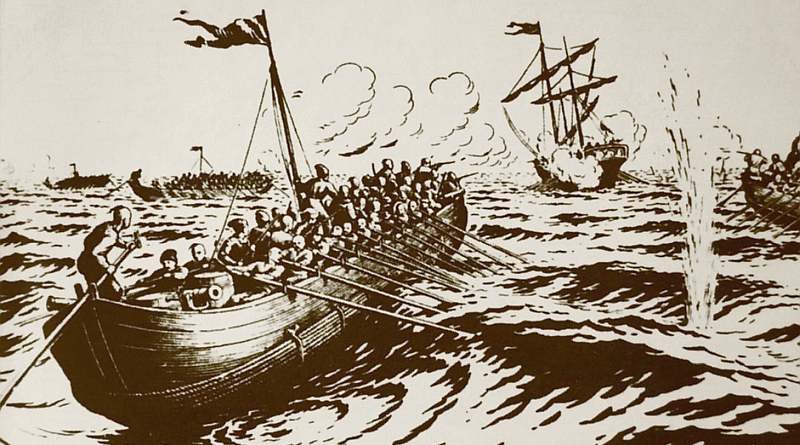
Of course, there is an option to attack the owner of the Bosphorus. And that’s what the inhabitants of Ukraine’s territory did, starting 2,000 years ago. In the 3rd century AD — during the “Scythian wars”. In the 7th century — during the siege of Constantinople by the alliance where the Antes acted on monoxylous boats. In the first half of the 8th century (even before the emergence of Rus), when, according to the Life of George of Amastris, the Rus were already partying in Anatolia, and then (according to the Bavarian Geographer) imposed peace treaties on Constantinople. Then in the times of the Rus’ princes. And then in the times of the Cossacks — already against the Ottoman Empire, which replaced Constantinople with Istanbul.
But from the point of view of military strategy, times do not change here. The attacks of the Antes on monoxylous boats, the attacks of the Cossacks on chaikas in the 17th century, and the raids of Magur and Sea Baby in the 21st century do not differ from each other in any way. These are raid actions — a sudden exit from rear rivers to the sea and a raid on coastal fortresses. Without landings and long sieges. Yes, in rare cases, it was possible to break through even to the Mediterranean region. But mostly they were limited to the capital of the state that held the exit from the Black Sea (Tsargrad, Golden Horn).
Why?
The calculation is simple and far-sighted.
You attack the heart of the empire — the capital of the sultan/emperor, and he immediately faces political problems under his throne. Like Putin, when our drones hit Moscow. Subordinates see you as weak. Some sultans were even executed. The sultan gets angry, upset, and might even send troops to our lands in retaliation (for example, the Khotyn War of 1620 — a classic revenge for Sagaydachny’s naval wars), but in the end, the sultan realizes the impossibility of countering such a Ukrainian strategy purely due to geographical reasons. Eventually, he goes to negotiations (Chmelnytsky’s treaty with the sultan in 1648 or the treaties of Igor/Oleg with the emperors of the 10th century).
Whoever the enemy of the inhabitants of the Northern Black Sea region might be at a particular historical period, they will inevitably suffer. Because geography is on our side.
At the same time, geography dictates limitations for Ukrainian naval commanders.
The main limitation: the impossibility of maintaining large ships here. There is simply no place to accommodate and protect them. During the Cossack era, the Cossacks repeatedly brought captured Turkish galleys from their campaigns into the Dnipro, but the galley fleet never took root among the Cossacks. A galley fleet in the 17th century was a fleet of the Mediterranean basin: longer distances, greater autonomy, and seaworthiness were needed. And in the waters of the Dnipro or Don, large ships were an easy target for enemies who would suddenly attack, and hello there. An example from modern history: the need to scuttle the frigate Sagaidachny.
The only reason the Northern Black Sea civilization might need large ships is to project power. For example, like Hetman Sagaidachny, who carried out a mission in the Gulf of Aden against Somali pirates. This is the sole and unique use of a large ship for a country from the Black Sea basin.
In practice, the conditions where a state of the Northern Black Sea region would want and be able to “project power” against any state of the Mediterranean region are incapable of arising. Even against the Barbary pirates of the 16th century, the Cossack fleet could not have achieved anything. Not to mention the fleets of Venice or Spain.
As soon as a state that controlled the Northern Black Sea area became aggressive enough and started infringing on the interests of the Mediterranean states, they simply formed a coalition and overwhelmed this state. There are many examples in history:
• The Muscovites were defeated in the Crimean War of 1854 (the panorama of which was bombed by our drones);
• The Turks were defeated at Lepanto in 1571 by a coalition of the Holy League.
All of this was realized by our ancestors 2000 years ago, and they concluded a simple and timeless truth: it is cheaper to be friends with neighbors.
* * *
The Russians reached the Black Sea only in the 18th century and decided: “it’s something special”! We need gigantism! We will launch aircraft carriers in the Black Sea!
Due to this stupidity, the very first naval fleet of the orcs sank. Literally, the “fleet of the great sea” was destroyed by a storm and rotted at the base even before the war with the Turks in 1788. Because of this, the Russian Empire was forced to humiliatingly restore Ukrainian statehood, enter into a military alliance with the “Black Sea Cossacks”, and pay off the Ukrainians with Kuban, because they needed their fleet. It was the Ukrainian fleet under the command of Sidor Bely, Zakhar Chepiga, Anton Golovaty, and John Paul Jones that saved both the Russian commander Suvorov at Kinburn and the entire Russian Empire in the war with the Ottomans.
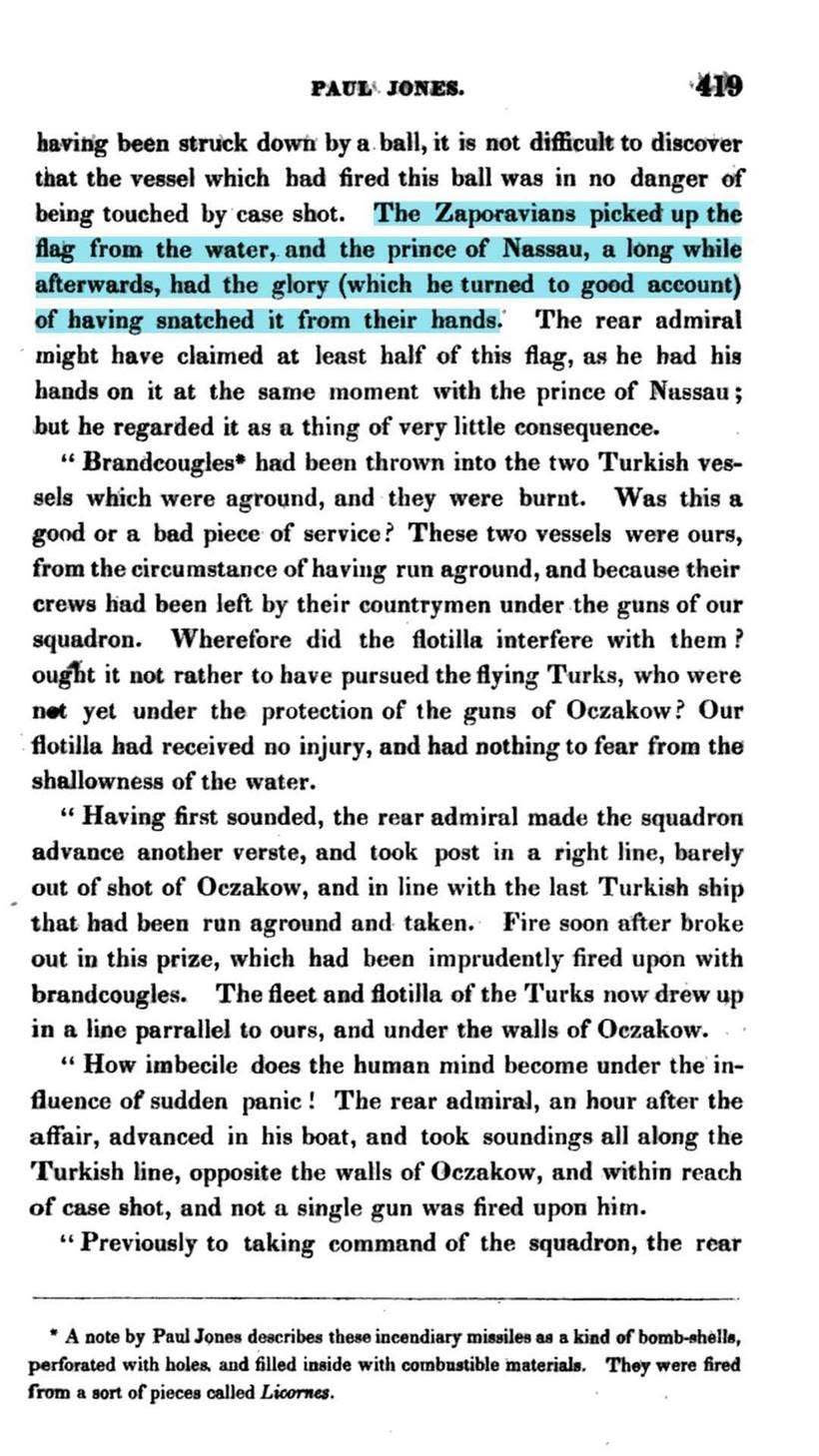
There still exist the memoirs of American Admiral John Paul Jones (founder of the American fleet), who wrote that it was indeed the Cossack fleet that captured the admiral’s galley and even the flag of the Turkish Kapudan Pasha (rank of admiral) in the grand naval battle. However, the Russian commander Karl Nassau-Siegen was dull (as he writes), doing only one thing in the whole war: “snatched that flag from the hands of the Cossacks” (*see screenshot from the memoirs below).
The sinking of the Russian fleet without a battle was a karmic signal from the universe. But the Horde’s strategists clearly did not catch that signal 250 years ago.
Now their fleet is sunk again without a battle. Serves them right.