
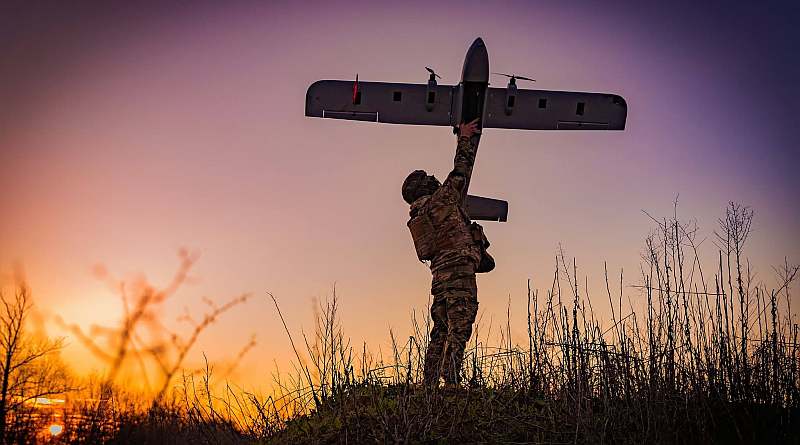
Oleksandr Kovalenko / Obozrevatel
The failure of Russian forces during the spring offensive campaign and the clear exhaustion of Russian armed forces in the fifth year of the war, as well as the successful implementation of a logistical lockdown in the mid-rear areas of temporarily occupied territories (especially in the south) and the escalation of strikes within Russia itself, has led many experts to talk again about the prospects of liberating the southern regions and directly the Crimean Peninsula.
Statements and predictions of varying degrees of boldness are heard. Some predict a landing on the peninsula, while others openly state that the battle for the peninsula will be decisive in the war.
But how realistic are these predictions, is it appropriate to discuss them now, and when will the Kerch Bridge be destroyed – we will try to figure this out today.
Koschei’s Needle
Could a lost battle for Crimea force Russia to capitulate, and how difficult would it be to liberate the peninsula? The answer to this question may simultaneously disappoint and inspire a rather large part of the audience. Indeed, the accessibility of liberating Crimea follows that of the Kherson and Zaporizhia regions, if one follows not emotional statements, but basic military science. In turn, the most complex and problematic in this matter are the Luhansk and especially Donetsk regions.
Currently, we can observe how Ukraine’s Defense Forces are cutting Russian logistics in the mid-rear zone in the south – on the left bank of Kherson and the southern part of the Zaporizhia region. Ukrainian drones are already targeting not only sections of the M-14 highway (Mariupol-Berdyansk-Melitopol-Dzhankoy) and N-08 (Mariupol-Orikhiv), N-30 (Berdyansk-Tokmak), but also R-57 (Hola Prystan-Skadovsk), M-17 (Oleshky-Armyansk), R-47 (Kakhovka-Novooleksiivka), and several lateral roads.
Essentially, Russian logistics in southern Ukraine (by pressing it against the Black Sea and Azov Sea coast, eliminating any maneuverability) can simply be destroyed. And dead logistics mean the inability not only to advance but also to defend. And if the Russian occupation forces fail to adapt to the evolving situation, then the collapse of the entire southern defense for the enemy is only a matter of time – as is the advance of Ukraine’s Defense Forces to the administrative borders of Crimea.
And here is the most important part. The operation to liberate Crimea will gain significantly accelerated and obvious momentum only when Ukrainian forces stand near the administrative border of the peninsula. In other words, after the liberation of Kherson and Zaporizhzhia regions, but not before that.
I don’t even consider the version with a landing operation, unless we’re talking about situational diversionary and reconnaissance operations, which, by the way, have occurred before. But there is no talk of any large-scale landing operation to liberate the peninsula. Considering potential losses even before the start of the operation and what we discussed earlier about ROV themselves – the difficulties of supplying a landing group on the peninsula during active combat engagements.
In turn, if the scenario with the liberated Zaporizhzhia and Kherson regions is realized, Crimea finds itself in isolation. Ukrainian forces control the Black Sea, establish control over the Azov Sea – ferry and VDK connections, and other maritime options are immediately cut off.
The length of the peninsula from north to south is about 200 km, which allows for full control of both low and mid-altitude airspace over Crimea and the deployment of systematic, round-the-clock hunting of the occupiers.
And here the question of the Kerch (Crimean) Bridge arises.
Today, when the land corridor to Crimea is just starting to suffer from Ukrainian drone strikes (and this is not even the peak capabilities of the Armed Forces in exerting this pressure), Russian propagandists openly admit that the bridge does not provide the freight flow needed for the peninsula, which was carried out via M-14.
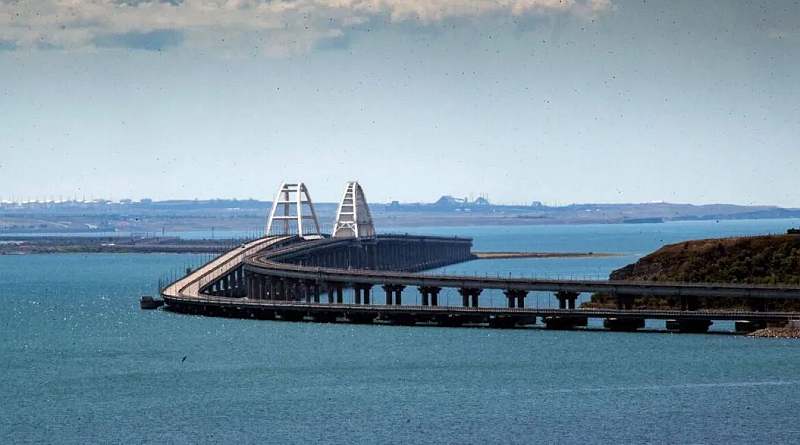
And it would seem that by striking the Kerch Bridge, we would completely cut off Crimea from supply and accelerate its liberation process. But that’s only at first glance. Because destroying the bridge will lead to the redistribution of cargoes intended for Crimea to other directions and more likely being delivered to other locations – the same Donetsk and Luhansk regions. In turn, a functioning Kerch Bridge, located 150 km from Berdyansk, Kyrylivka, or Prymorske, could become a road to hell for ROV.
The only route from Russia to Crimea and back will allow the depletion of the minor resources sent there – just as the peninsula has now become a zone of depletion for Russian air defense. Therefore, the idea of destroying the Kerch Bridge (before liberating Crimea), considering that we can take it under full fire control and turn it into a road to hell, is much less promising.
But will the liberation or even isolation of Crimea become the “death needle” for Putin? I think not.
The Last Battle – Donetsk
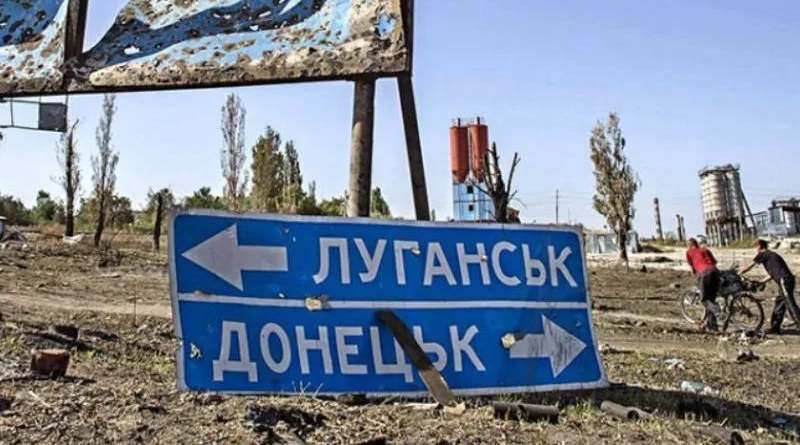
The most difficult battlefields are the Donetsk and Luhansk regions. Moreover, Luhansk has a simpler scenario for liberation compared to the heavily fortified and logistically developed Donetsk.
The freedom of maneuver related to the border with Russia will also play an important role, as will the ability to adapt logistics considering this circumstance.
If the Russian Armed Forces flee from the mainland south of Ukraine and lose Crimea, Putin will place his last bets on the Donetsk and Luhansk regions, turning the so-called “DNR” and “LNR” into the last bastions of spirituality, cohesion, resilience, and other ephemeral narratives of the regime.
The most striking historical example is World War II. When it was obvious to everyone that Berlin would not hold out and would fall, Hitler did not capitulate or surrender. Such behavior is typical of many dictators and military leaders, heads of state, conspirators, and others who lose wars. Why should Putin differ drastically from them and admit defeat after losing Crimea?
No, he will cling to his presence in Ukraine in the form of occupied territory until the very end.
Therefore, the last and hardest battle for the borders of 1991 will be precisely the Donetsk region.
Conclusions
I see no reason to believe that the war will end once Crimea is liberated. In my view, the liberation of the peninsula, although possible in the “second phase” after the Kherson and Zaporizhzhia regions, will occur in a much simplified manner compared to the battles for Donetsk and Luhansk regions.
Regarding the Kerch Bridge, I also see no need to destroy it into atoms right now, if in the future it can be turned into a means of regularly exhausting the enemy. Turning the bridge into a future road of death is a more promising solution than turning it into ruins. There will always be time for ruins, but it should be used as a tool for exhaustion while there is such an opportunity.
It is precisely exhaustion and weakening that will help us liberate our territories, though not as quickly as many would like, but certainly. And today it is even more evident than in 2022.
The material is published as part of a joint project between OBOZ.UA and the group “Information Resistance”.
Cover photo: 22nd Separate Mechanized Brigade
