
Carlos Lozada, New York Times / Translation iPress
The End of the Role America Played for Decades
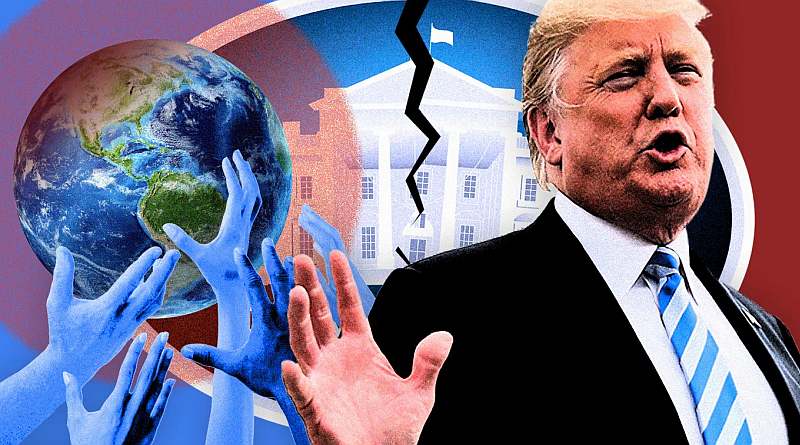
We had a good run – about eight decades or so, but now it’s clear that the US has ceased to be the leader of the free world. No successor has been appointed to this position, and it is unlikely that the European Union, NATO, or anything that now constitutes the “West” will nominate one of their own. This position might even be completely eliminated – another staff reduction, carried out by the grace of President Trump, Carlos Lozada notes wryly in the New York Times.
According to him, instead of leading the free world, the US strides across the planet seemingly unrestrained by constraints, foresight, or strategy, wielding its power simply because it can. Within months, the Trump administration captured the President of Venezuela and threw him into prison in Brooklyn and dealt a devastating blow to Iran’s theocratic leadership in a war whose echoes spread across the Middle East and unsettle the global economy. Now the President says he would be honored to take on Cuba next. Trump during his second term is Michael Corleone from “The Godfather,” settling all family business.
Nearly two decades ago, international affairs columnist Fareed Zakaria published a bestseller titled “The Post-American World,” predicting the relative decline of the United States compared to other rapidly rising economic countries.
As Lozada notes, Barack Obama was seen with this book during his first presidential campaign, indicating its influence on elites. The US would still remain a leading military and economic power, Zakaria asserted, but might assume a new political role – something akin to the chairman of the board of the planet, relying on “consultation, cooperation, and even compromise.”
Trump and the Dismantling of the “Free World” Concept
Under Trump, highlights Carlos Lozada, the perception of US leadership has truly shifted, but from authority to domination, from persuasion to intimidation, from nurturing alliances to dismantling them. “We need no one,” a frustrated Trump said last week when European leaders initially refused to help with opening the Strait of Hormuz. “We are the strongest country in the world. We undeniably have the strongest military in the world. We don’t need them.”
Starting a war with only one ally and then expecting everyone else to fall in line is the perfect example of the tension inherent in America’s new approach. The US wants the advantages of hegemony, but without accepting the associated responsibilities—ensuring collective security, promoting economic openness, supporting vital alliances. Trump is not interested in being a superpower; he simply enjoys wielding superpower authorities. He wants to act in the world constrained only by “his own morality” and “his own mind,” as he recently said to The Times.
What does this mean for America’s role and purpose in the post-Cold War world? It means that what was once known as Pax Americana—a US-led system of alliances and institutions that advanced American interests and values and helped prevent major conflicts in the decades after World War II—has irreversibly vanished. Instead of Pax Americana, we see something akin to Lax Americana, a world in which a careless, unrestrained, and not-too-curious American superpower roams the chessboard, threatening old friends and accommodating long-standing rivals, seeking short-term gains despite the dangers it creates for itself and the world.
This is a historical anomaly: a superpower voluntarily relinquishing its leadership role because it has concluded that leadership is for fools; that no longer promotes its values, having decided that those values were false all along; that abandons the rules and institutions it so long built, assuming they are no longer worth the trouble.
Allies Without a Center of Gravity
If Washington somehow still considers itself the leader of the free world, it is only because it is reimagining who belongs to this world and because it is downplaying the very meaning of leadership.
To better understand how this new America operates, Carlos Lozada refers to the last great transition—when the world shifted from the Cold War stalemate to a period of unquestioned US supremacy. He advises looking at several influential books and essays that have tried to peer into the future. A notable place among them is held by “The Rise and Fall of the Great Powers” by Yale historian Paul Kennedy, published in 1987, which quickly became one of the sacred texts of American decline.
In the usual course of history, Kennedy wrote, great powers typically relinquish global leadership reluctantly, losing a major conflict to a new rival, failing to keep up with some transformative technological innovation, often in the military sphere, or becoming economically exhausted to the point where the burden of hegemony becomes too heavy. Kennedy warned against what he called “imperial overstretch,” arguing that “the sum total of America’s global interests and obligations today vastly exceeds the country’s ability to defend them all simultaneously.”
A superpower, if it wants to maintain its status, usually has to accomplish three challenging tasks, Kennedy believed, and all three simultaneously. First, ensure and finance military security for itself and its allies; second, meet the economic needs of its population, not to mention its desires; and third, ensure sufficient long-term economic growth to continue having both guns and butter.
“Achieving all three of these goals over a prolonged period will be very difficult,” Kennedy wrote. “However, achieving the first two or even one of them without the third will inevitably lead to relative decline in the longer term.” This was the fate of great states of the past, such as Imperial Spain, Napoleonic France, and the British Empire, when after World War II it gave way to the United States.
Trump’s obsession with how the rest of the world is “ripping off” America – whether through trade deficits, loss of manufacturing capabilities, or insufficient military spending by NATO countries – is not just the mantra of a developer obsessed with a better deal. It’s also the resentment that dominant states always feel towards weaker ones, as Robert Gilpin, a theorist of international relations, explained in his classic 1981 work “War and Change in World Politics,” dedicated to why hegemons come and go.
The Athenians wanted their allies to provide more resources for defense against the Persians; the British wanted their rebellious American colonists to chip in for wars against the Indians and the French (although excessive taxes on the colonies ultimately backfired on the British Empire); both the Soviet Union and the United States wanted their respective client states to share the costs of the Cold War. “Since the dominant state will protect the status quo in its own interests,” Gilpin wrote, “smaller states have little incentive to pay their ‘fair’ share of these defense costs.”
For Trump, the problem of leadership in the free world is that the free world is freeloading.
By the 1980s, both Kennedy and Gilpin were already warning of America’s relative decline. And who could blame them after all the crises of the 1970s? But then Washington got a reprieve, and quite a significant one. “History is on our side. We will bury you!” Soviet leader Nikita Khrushchev once assured. But only a few years after Ronald Reagan declared morning in America, the USSR found itself buried. It seemed history was on America’s side, and for some, it even ended.
As Carlos Lozada notes, in the 19th and early 20th centuries, many great powers fought among themselves. In the latter half of the 20th century, it was only two nations watching each other from behind their warheads. Eventually, instead of East-West rivalry, commentators envisioned a “unipolar moment” of US supremacy. George H.W. Bush proclaimed a “new world order” of markets and democracy; Bill Clinton envisioned a “bridge to the 21st century”.
But others, as the NY Times columnist emphasizes, saw a darker turn ahead. Samuel Huntington envisioned a “clash of civilizations”, based on culture and belief. In “The Coming Anarchy,” foreign correspondent Robert Kaplan predicted ecological disasters and battles over race and tribe. Particularly insightful was his commentary on the United States, foreseeing polarization, fragmentation, and political dysfunction; electronic media that would “embrace the desires of the crowd”; and a military-technological complex that could prove as dangerous as its military-industrial predecessor.
“There is no ultimate victory of reason,” Kaplan wrote grimly.
Instead, he worried that in such an environment, “superficial leaders and advisors, due to a lack of wisdom and experience, might eventually make that terrible miscalculation leading to general war.” Just as European leaders, “lacking a tragic sense of the past,” blundered into World War I, so too could the USA enter its own modern fiasco.
Why the West is Losing Common Ground
The tragedy of September 11 and the haughty American response seemed to justify those who proposed these bleak visions. Following the terrorist attacks, Washington intervened in Iraq and is perhaps now doing this with its “foray” into Iran. It’s not necessary, notes Carlos Lozada, to believe that the year 2026 will unfold exactly like 2003, or that Trump’s “I think the war is generally over” is a clumsy version of Bush’s “Mission Accomplished” banner, to realize the dangers of a reluctance to think things through, to ask simple but crucial questions like “what if” and “what next.”
In the book “The End of the American Era,” published during George W. Bush’s first term, Charles Kupchan lamented that the US, intoxicated by the triumphalism of the “end of history,” failed to reconsider its purpose and the means to achieve it, or in expert parlance, its “grand strategy” during the years between the fall of the Berlin Wall and the destruction of the World Trade Center. America was a “great power without direction,” overlooking the growing influence of the European Union, indifferent to Russia’s fury over NATO expansion, and hesitant about adapting to the future rise of China.
Georgetown University Professor Kupchan, who worked in the Clinton and Obama administrations, argued that the Bush administration overestimated the long-term terrorist threat compared to the “more dangerous challenge ahead: the return of rivalry between the world’s major centers of power.”
The Trump administration, notes the NY Times columnist, seems to recognize this renewed rivalry and appears to have come to terms with it. After all, what is the “Donro doctrine” if not a confirmation of spheres of influence of great powers, acknowledging to Beijing and Moscow that if we can do our thing in the Western Hemisphere, they are free to do the same in their respective regions?
Much is said about the apparent contradiction between Trump’s interventionist inclinations and his campaign promises to avoid foreign wars. After all, engaging in regime change in the Middle East, if that’s what we’re doing, doesn’t quite align with “America First.” This tension creates electoral risks for the president’s party, and strategically, it’s all convoluted: the desire to topple a regime may only push its leaders further toward acquiring nuclear weapons as a means of security and survival. It also signals to other leaders desiring nuclear weapons that acquiring such weapons is the best way to ensure their own political longevity.
However, in terms of attitude, the author notes, there is a lot of consistency in Trump’s maneuvers. “Isolationism and macho militarism on the surface are very different,” wrote Immanuel Wallerstein in “The Decline of American Power,” published in 2003. “But they share the same fundamental attitude towards the rest of the world, toward ‘others’: fear and disdain combined with the assumption that our way of life is pure and should not be tainted by interference in the miserable squabbles of others, unless we are able to impose our way of life on them,” Wallerstein wrote. He suggests that it is easy for nationalist leaders to swing between isolationist and interventionist impulses.
Wallerstein, who was a sociologist and critic of global capitalism, wrote about the George W. Bush administration, but his analysis fits the Trump team surprisingly well. If you want to see “macho militarism” in human form, advises Carlos Lozada, just look at Pete Hegseth. In his 2024 book “The War Against the Warriors,” Hegseth laments that “an unholy alliance of political ideologues and Pentagon wimps has left our warriors without true defenders in Washington,” and his cultural references jump from “Top Gun” to “Die Hard” and “Team America: World Police.” In television appearances, Hegseth’s favorite medium, he promises “maximum lethality, not tepid legality,” mocks “stupid rules of engagement,” vows “no indulgence, no mercy” for the “rats” of the Iranian regime, boasts of the “brutal efficiency” of the US army, which rains “death and destruction” down from the skies all day long, and laments the lack of a truly “patriotic press” in America, dictating alternative headlines himself.
There is no triumph of reason here, Lozada emphasizes, only the logic of triumphalism.
The point is that being the “leader of the free world” means that the very nature of this role depends on how you understand leadership and how you define this world. As often happens, notes a NY Times columnist, the Trump administration is redefining terms, discarding principles.
When NATO was established in 1949, the treaty declared that its members would “safeguard the freedom, common heritage, and civilization of their peoples, founded on the principles of democracy, individual liberty, and the rule of law.” Speaking last month at the Munich Security Conference, Secretary of State Marco Rubio similarly referred to the common “heritage” of the Western world, but directly linked it to Christian faith, culture, language, and origin. “We are part of one civilization – Western civilization,” he stated, clarifying that Washington prefers “allies who are proud of their culture and heritage, who understand that we are heirs to one great and noble civilization.”
This is the “civilizational West,” not the “geopolitical West,” as Stuart Patrick, who worked in the State Department under George W. Bush, wrote last year. “The liberal notions underpinning the geopolitical West were essentially universal; in contrast, the nationalist ones elevating the civilizational West focus on defending borders and fearing others,” he noted.
In this context, Losada remarks, the United States can still remain the leader of the free world, but only if this free world is reimagined as a cultural realm, even hereditary, rather than as one based on adherence to political principles, or “abstractions,” as Rubio and Vice President J.D. Vance often dismissively call them.
What Remains of the Old International Order
After the multipolar world of the 19th century, the bipolar 20th century, and the unipolar post-Cold War era – what’s next? Will it be a clash of civilizations, a return of many great powers, a one-on-one duel with China – or will the American century still prevail?
This is difficult to predict, summarizes the publication’s columnist, but a certain sign of a superpower trying to maintain its position is when the word “renewal” is increasingly heard. In “The Rise and Fall of the Great Powers,” Kennedy dryly notes that pessimists speak of decline, while patriots dream of renewal. In his Munich speech, Rubio stated that the Trump administration “will take on the task of renewal and restoration.” He said that America does not want to sever ties with Europe but seeks to “revitalize an ancient friendship and renew the greatest civilization in human history,” which has been struck by a “malady of hopelessness and complacency.”
Trump, of course, first came to power almost ten years ago, claiming that America was already in decline, pointing to trade imbalances, porous borders, a weakened industrial base, and endless foreign wars. He was not wrong in saying that the old order was shaken, that the benefits of globalization were greatly exaggerated, and that Americans’ anxiety over high immigration was real and politically potent. But Trump’s second coming to the White House brought harmful tariffs, a net loss of industrial jobs last year, stricter border control at the cost of fatal zeal in immigration law enforcement, and now risky military interventions on two continents.
The irony, notes Losada, is that the path to renewal and revival might be the very path this administration is refusing to take—not in Tehran or Caracas, but at home. In the “Post-American World,” Zakaria called the U.S. the “first universal nation,” a country where people from all over the world can “share a common dream and a common destiny.” He called immigration America’s “secret weapon” because it provides a drive and energy rare for a mature, wealthy country. Higher education is “the best industry” in the country, he added, as it attracts the brightest minds to our schools and shores, helping the U.S. stay “at the forefront of the next revolutions in science, technology, and industry.”
It is this forefront that America must stay on, to fulfill the superpower survival imperatives that Kennedy outlined in “The Rise and Fall of the Great Powers”—to ensure sufficient long-term economic growth to support our military might and meet the growing needs of the people. Yet immigration, research, and higher education have all been under Trump’s attack. Last year, Vance warned participants of the Munich conference that the most serious challenge for the continent is the “threat from within, Europe retreating from some of its most fundamental values.” Much the same can be said today for the United States.
In recent decades, the author notes, there have been many episodes that seemingly foretold the end of U.S. dominance. The launch of “Sputnik” in the late 1950s sparked early Cold War paranoia that the U.S. was falling behind Soviet forces. In the 1970s—with Vietnam, Watergate, oil embargoes, stagflation, and the hostage crisis in Iran—the country was going through a “crisis of confidence,” as President Jimmy Carter put it. A decade later, it was said that Japan Inc. would outperform the U.S. Then 9/11 shattered the American sense of physical invulnerability. The Great Recession challenged the premise and promise of American capitalism; and the Capitol riots on January 6 exposed the fragility of the democratic model we have long sought to export.
Perhaps today’s lamentations are just another “Sputnik moment,” another instance where pessimists worry that America has gone off track. But it is also possible, as argued by Daniel Drezner, academic dean of the Fletcher School at Tufts University, that this is not just “another hymn of the Church of Perpetual Anxiety,” and that this time it truly is different.
Earlier, America’s isolationist, interventionist, and multilateralist tendencies balanced each other over time due to competing visions of national security embedded in the entire American political system. But when foreign policy powers concentrated in the hands of the executive branch, and Congress shrugged off its role in global affairs, America became vulnerable to the rise of an impulsive and reckless president. “The very steps that empowered the president to create foreign policy,” noted Drezner, “allowed Trump to destroy what his predecessors had cultivated for decades.”
Part of what they had tried to preserve for decades was a vital resource: international legitimacy. In “The End of the American Era,” Kupchan called it America’s “most valuable asset” and warned that the Bush administration was squandering it in Iraq by greatly overestimating the “autonomy that comes with military supremacy.” This warning is relevant to our time, as the Trump administration similarly squanders American legitimacy and misjudges the freedom of action that supposedly stems from having the strongest military and, as Trump boasts, “the best equipment.”
This very legitimacy was part of what made Pax Americana possible. Lax Americana, on the other hand, not only squanders the country’s legitimacy; it barely acknowledges its value.
When Joe Biden became president, he was eager to tell the world that America had returned, ready to lead again and work with its allies. But one question persisted: “For how long?” This distrust of America’s ability to stay the course was confirmed with Trump’s return to the White House. Canadian Prime Minister Mark Carney stated in Davos this year that the long-standing US-led rules-based system is cracking, and that middle powers like Canada must diversify their partnerships to survive. “The old order will not return,” he declared. “We should not mourn it. Nostalgia is not a strategy.”
The World After American Leadership
For long-time allies, the emerging new order, Carlos Lozada notes, depends too heavily on American whim and unpredictability. Trump’s obsession with purchasing Greenland, for example, although it became a subject of late-night jokes in the US, was taken so seriously in Europe that Denmark prepared military plans in case of an American invasion. Even now, when Western allies seemed inclined to assist in the opening of the Strait of Hormuz, their joint statement last week emphasized adherence to international law rather than support for Washington. As German Defense Minister Boris Pistorius expressed when the US first called for allied naval support: “This is not our war; we did not start it.”
This is what happens, observes the NY Times columnist, when you govern as if global support and democratic approval are secondary concerns. The Trump administration failed to justify the war with Iran—not only to Congress and foreign allies but also to its own citizens. This general indifference is actually a natural outcome of American domestic policy: if the administration doesn’t feel the need to explain itself to a reliably compliant Congress, and the president assumes that any action taken in office has legitimate approval and limited oversight, then what need has he to explain himself to the American people, let alone those beyond our borders? Domestic policy, Losada emphasizes, doesn’t restrain adventurism abroad; rather, it enables it.
The United States is once again becoming a “dangerous nation,” as in the title of Robert Kagan’s 2006 history of U.S. foreign policy—from colonial times to the 19th century. Kagan, now a senior fellow at the Brookings Institution, described a young rising state propelled by expansionist impulses and revolutionary ideas toward interventions and occupations. His description of America as dangerous was partly intriguing. But today’s dangerous America is an aging superpower driven by disdain for the established global order—an order Washington helped create—and a purely transactional approach to the world.
While American leaders once vehemently denied that their military interventions abroad were motivated by a desire to secure oil supplies, Trump readily admits it. “We will extract a tremendous wealth from the ground,” he declared after American forces seized Nicolás Maduro, the president of oil-rich Venezuela. And if war is about capturing resources, so is peace: countries wanting to become permanent members of the new Trump Peace Council must cough up $1 billion each.
If Pax Americana meant nurturing a long-standing American peace, then Lax Americana means America wants its share of the spoils. The world policeman, Carlos Losada emphasizes, is on the take.
“American power, which has supported the world order for the past 80 years, will now be used to destroy it,” warned Kagan in January, two decades after publishing “Dangerous Nation.” The modern equivalent of the 19th-century multipolar world, he writes, is “a world where China, Russia, the United States, Germany, Japan, and other major powers would conflict in one combination or another at least once a decade—redrawing national borders, displacing populations, disrupting international trade, and risking global conflict on a devastating scale.” And he wrote this, the columnist notes, just weeks before America and Israel began bombing Iran.
Carlos Losada is convinced that we are not entering a post-American world, where the United States is stepping off the stage or ceases to exercise its military might. Not at all. But perhaps, he notes, we are entering a world after America—a world where the very meaning of America, the principles and values long embodied by this country, sometimes in reality, sometimes in aspiration, are dimming. And the loss of this America may prove to be as damaging and far more enduring than any harm caused by Donald Trump’s ventures, concludes Carlos Losada in the article.
Carlos Lozada is an American journalist and writer, a columnist at The New York Times, and a Pulitzer Prize laureate. He is the author of “What We Thought: A Brief Intellectual History of the Trump Era” and co-host of the weekly podcast “The Matter of Opinion.” Previously, he was a book critic and senior editor at The Washington Post, as well as editor-in-chief of Foreign Policy magazine. Lozada was a Knight-Bagehot fellow at Columbia University and a professor of political journalism at the University of Notre Dame.
