
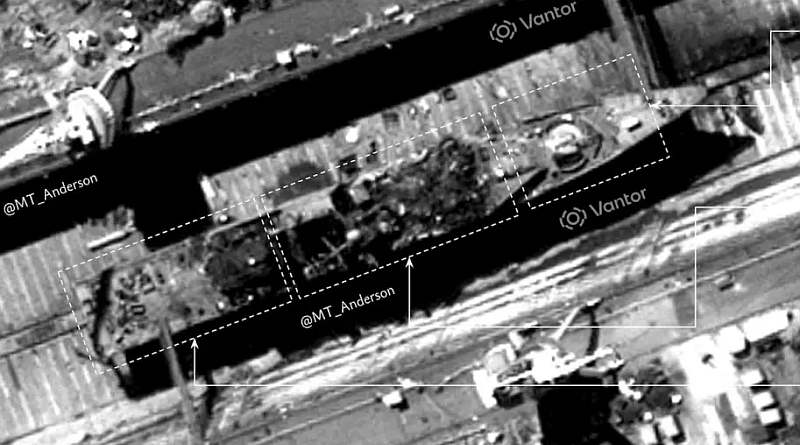
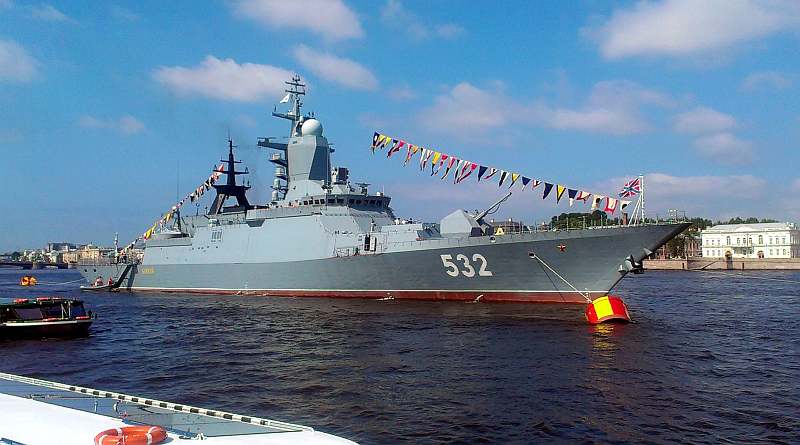
Fresh satellite images of the corvette “Boykiy” (project 20380) at the Veleshchinsky dock of the Kronstadt Marine Plant have just arrived. It seems we’ve hit a massive strike.
If we dismiss the Russian propaganda’s claims about “minor damage,” the reality is evident in full burnout, destroying a combat unit worth over a quarter of a billion dollars.
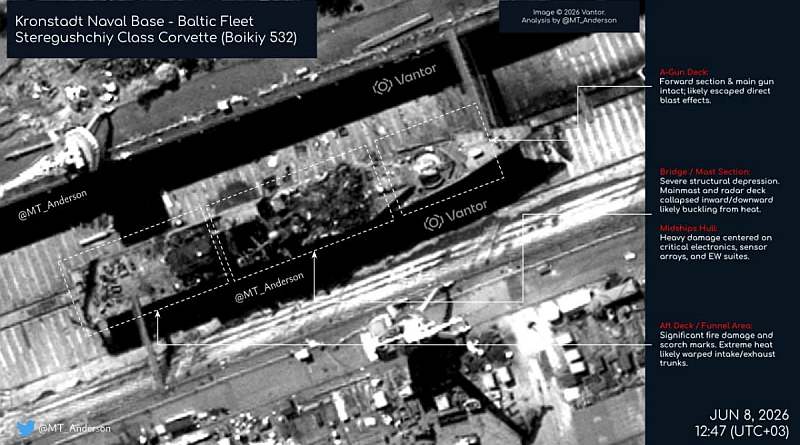
Ash instead of steel
The superstructure of these project 20380 corvettes is not classic ship steel. For a stealth effect and weight reduction, it is made from multilayer fiberglass and radar-absorbing composites (baked at the Middle Nevsky Shipyard). The point is that at extreme temperatures (over 800-1000 °C), this material doesn’t bend like metal. It simply burns out, crumbles into dust, and releases highly toxic gas with phenols.
Therefore, in the image, instead of the multi-tiered superstructure and mast, there is simply a “black hole” of over 150 square meters without any remnants of the structural framework. The composite couldn’t withstand the large-scale fire and literally collapsed inside the hull. It is impossible to weld or repair this — the remnants need to be cut away, and a new superstructure ordered, with a production cycle taking from 1.5 to 2 years.
Minus the “brains” and total blindness
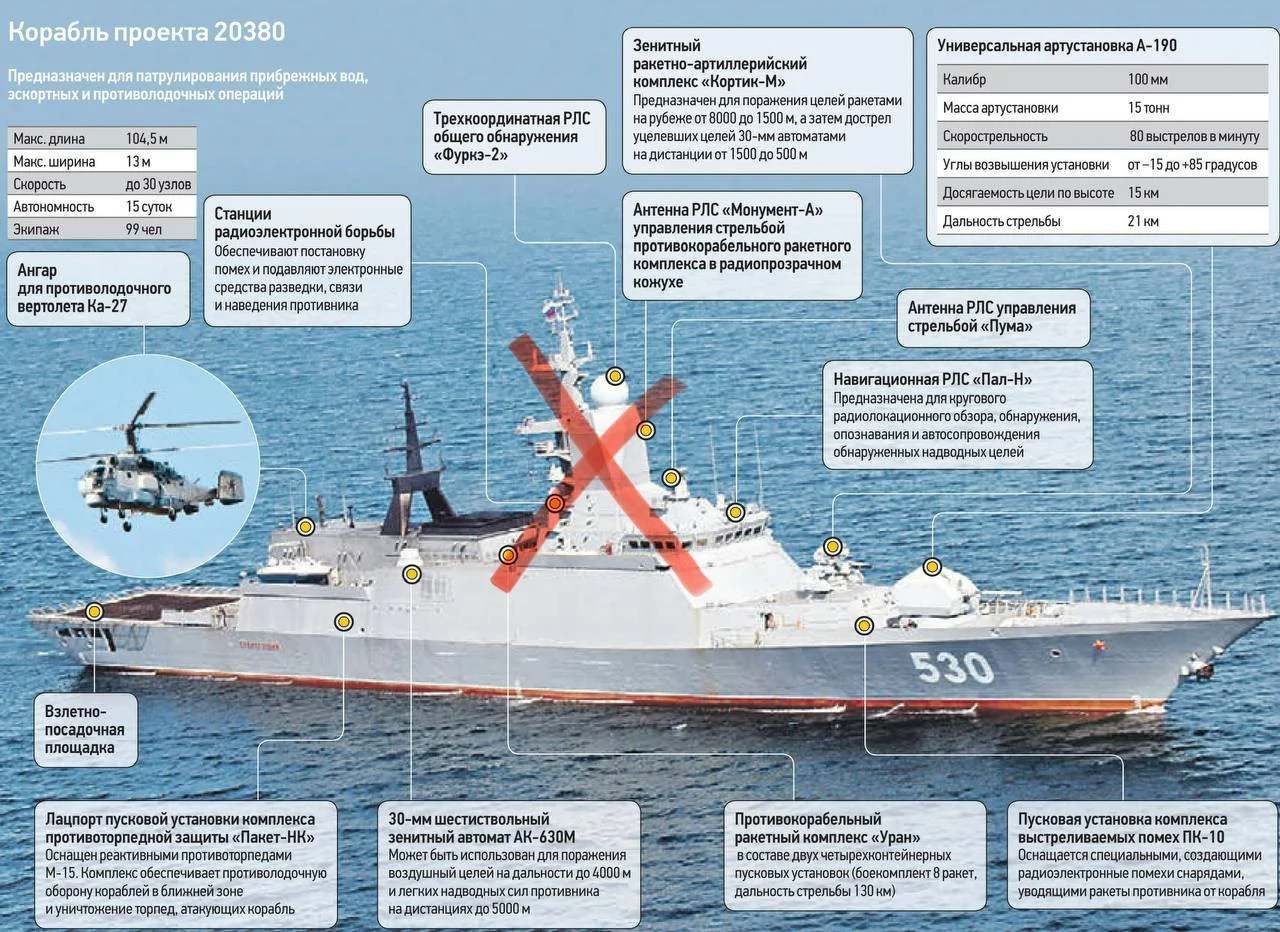
Along with this plastic structure, the electronic brain and the entire nervous system of the vessel burned to ashes. These corvettes have a huge radio-transparent mast containing the main target detection radar “Furke-2” (range up to 150 km) and targeting systems “Monument-A”. The mast is simply gone. It didn’t fall overboard; it collapsed inside due to critically weakened burnt-out bulkheads and decks.
There was also the TK-25-2 electronic warfare complex, secure communication equipment rooms (ZAS), and Centaur-NM satellite communication antennas. All navigator posts, control panels, navigation displays, and the “Sigma-20380” CIUS servers (combat information control system – essentially the ship’s “Windows”) were destroyed.
The ship is completely blind, deaf, and has lost its air defense control. CIUS and radars were built on Western element bases (Xilinx, Altera, Intel chips), access to which is now blocked by sanctions.
Blast Furnace and Toxic Pool
The entire central part—from the operating bridge to the helicopter hangar—is a torn black spot with twisted geometry. There are gas ducts, ventilation shafts, and the main engine room. The blackness and lack of contours scream of a massive internal fire. The ship worked like a blast furnace.
The heart of project 20380 consists of two diesel units DDA12000 (two 16-cylinder diesel engines 16D49 from Kolomna Plant and reverse-reduction gears from Zvezda plant). The Kolomna Plant is currently overwhelmed with locomotive repairs, getting new ship diesels from them out of turn is a mission that would take several years.
And now the water factor. The hull is closed in a dry dock. To quell such hell, fire crews were forced to pour thousands of tons of water with foam. All this boiling mixture of the salty water of the Gulf of Finland, melted cables, plastic, and oil poured down to the very hold. What the fire did not consume (lower tier machines, pumps, tens of kilometers of copper and fiber optic lines) was thoroughly destroyed by flooding and the aggressive chemicals of melted composites.
Threat of Breaking the Backbone
The ship stands not on water (where the load is distributed evenly along the contours according to Archimedes’ law), but in a dry dock on rigid point supports—keel blocks. An extremely high temperature raged in the center. Ship steel grade AK-235, when heated above 600°C, loses up to 60% of its yield strength, making load-bearing frames soft.
When hundreds of tons of water splashed into this red-hot box, the physics of material resistance worked as it should. The enormous mass of liquid in the thermally weakened center of the hull on rigid point supports causes bottom sagging (known as sagging) and deforms the structural set.
Even if all this is pumped out and cleaned, the distorted geometry puts an end to seaworthiness—the hull may crack along the weld seams in the first serious Baltic wave.
Missile Paralysis
Launchers of the Uran-V complex (eight containers for X-35 anti-ship missiles with a launch weight of 620 kg each) stand across the deck right at the epicenter. Even if the missiles themselves were removed before being placed in the dock, the titanium frames, hydraulics, and power cables of the launchers were melted to zero.
The vertical launch shafts of the “Redut” air defense system (12 cells for 9M96 anti-aircraft missiles) in the bow section appear visually intact. However, the heat exchange through the steel deck from a fire of this scale would have surely caused temperature deformations of the metal around the cells. The tolerances there are minimal. If the guides are off by even two or three millimeters, the missile will jam at launch or burn right in the shaft. The entire UKSK block (universal ship missile system) will have to be cut out and replaced.
A Check for Grandeur
In the final analysis, this is not just a “hit.” It’s effectively a write-off. Welding a new steel hull amounts to 15-20% of the ship’s cost, and is done quickly and cheaply. But manufacturing anew, laying out, and calibrating all that highly complex electronics under strict Western sanctions on chips means years of work and over 100 million dollars on equipment alone. The ship has lost 80% of its actual combat value. Restoring this piece of scrap metal will take longer and cost more than laying a new one.
The Baltic Fleet officially continues its descent. The export value of a similar corvette is about $250 million. This figure is confidently added to the general bill for a systematic raid by the SOU on the Leningrad region.
Just consider the scale: the Baltic Sea has finally turned into an internal NATO lake (following the accession of Sweden and Finland to the Alliance), and the Russian fleet cannot protect its ships even deep in the rear, 800 kilometers from the Ukrainian border.
Add to this strike on the “Boykiy” the recent detonation of 5,000 tons of scarce mine-torpedo munitions at the 15th Navy arsenal, the damage to unique test stands of the “Mortepotechniki” research institute (the main torpedo developer), six burned fuel tanks in the Coal Harbour, two oil terminals, and the FSB icebreaker, which sadly tilted to the side right at the quay.
These are no longer coincidences or isolated drone stings. This is a systematic, methodical destruction of the logistical, fuel, and naval infrastructure of an entire region. The check for grandeur has been issued, and the Russians are paying it with a fleet that burns down without even making it to the sea.
