
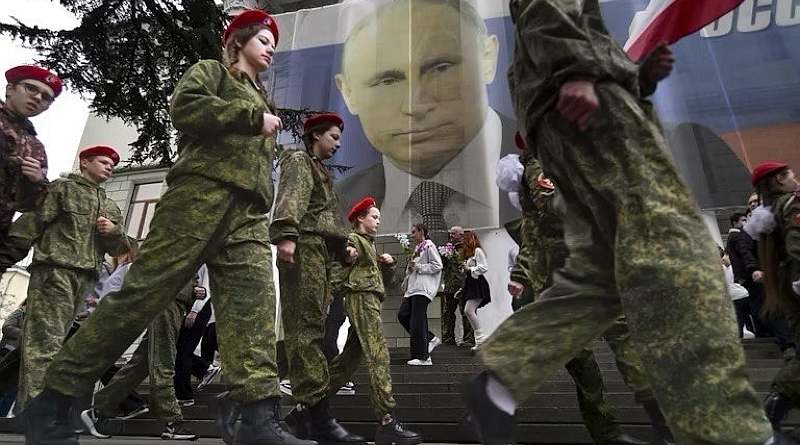

The militarization of Putin’s Russia’s economy in 2026 has reached truly critical proportions. The almost complete reorientation of the economic system to serve military needs is masked as “ensuring sovereignty,” but in reality, it is leading the country to a systemic crisis. By sacrificing the civilian sector for the military-industrial complex, the Kremlin is burning resources that could ensure long-term development.
According to European analysts, in the first quarter of 2026, Russia’s military spending reached a record 5.9 trillion rubles. This means that the war machine consumes about 65 billion rubles a day. For the first time in modern history, the share of military allocations in the federal budget has soared to 46%, turning the budget into a tool for financing military actions. This imbalance causes catastrophic consequences in all key spheres.
The absorption of nearly half of budget funds by the military department destroys the stability of state finances. Despite high global energy prices, the federal budget deficit in the first months of 2026 has already exceeded the planned annual figures. The Ministry of Finance of the Russian Federation is forced to take emergency measures: freezing civilian expenditure items and cutting funding for national projects. The liquid part of the National Welfare Fund is being depleted, depriving the country of a financial safety cushion.
The infusion of trillions of unsupported rubles into defense factories provokes a strong macroeconomic overheating. The injection of money into the defense sector accelerates internal demand, which is not backed by the production of consumer goods. As a result, we have chronic inflationary pressure. The Central Bank is forced to maintain an extremely high key rate to cool the market, which practically paralyzes market lending. The development of commercial, non-state-related business under such conditions becomes economically unviable.
The military economy exacerbates the acute labor shortage. Mobilization, the emigration of hundreds of thousands of highly qualified specialists, and the outflow of labor to defense factories have bled the civilian sector. Machinery, construction, transport, and services face a labor shortage. Meanwhile, the military-industrial complex produces “single-use” products that are destroyed on the battlefield and create no added value for the economy. Technological degradation is occurring: import substitution stagnates, and dependence on gray schemes for component supplies only grows.
While statistics record a formal increase in nominal wages due to payments to military personnel and defense workers, the real standard of living for citizens is rapidly declining. The country pays for militarization with a “hidden tax”: inflation devalues savings; the quality of medicine and education falls due to underfunding; housing and communal infrastructure deteriorate without major repairs, leading to large-scale accidents in regions.
Social spending is cut in favor of arms procurement. Late-Putin’s Russia has fallen into a classic historical trap: the bloated military sector squeezes all the juices out of the economy. Sooner or later, this financial pyramid will face inevitable collapse, for which not the elites, but the people, will have to pay for decades.
Photo: Occupier Media
