
Oksana Bedratenko, “Voice of America” / Radio Svoboda
Drones have become the deadliest force during Russia’s full-scale war against Ukraine. Four out of five successful strikes against Russian forces are carried out by drones, stated Ukraine’s President Volodymyr Zelenskyy. The recognition of the advantages of Ukrainian drone technologies on the international stage is only now emerging after several years of full-scale war, says Kateryna Bondar, a researcher at the American Center for Strategic and International Studies (CSIS). After the war in Iran began, “U.S. military saw how effective drones are and what they can do in practice,” she notes. This topic is addressed by “Voice of America”.
The U.S. is developing cooperation with Ukraine in this field, and some specific projects have already been announced. In June, the American company UDD, representing Ukraine’s F-Drones, won a Pentagon competition and plans to open production in Ohio, USA.
The competition took place as part of the Pentagon’s “Drone Dominance” program, which provides $1 billion for the development of an industrial base to scale up drone production.
In July, the British-Ukrainian company UFORCE announced signing an agreement with the American company ReconCraft in Oregon to produce MAGURA USVs combat drones in the U.S.

The Pentagon noted the success of Ukrainian technologies that “did not exist a year ago”
There is currently an “explosion of interest” in small Ukrainian drones in the US, noted Kateryna in an interview with the Ukrainian service of “Voice of America”.
These are FPV drones, controlled through special goggles that display real-time video directly from the onboard camera. Drones like “Baba Yaga,” including the Vampire UAV, are also widely used; they hunt at night and usually have thermal sensors, capable of carrying up to 15 kg of explosives and flying 35–50 kilometers.

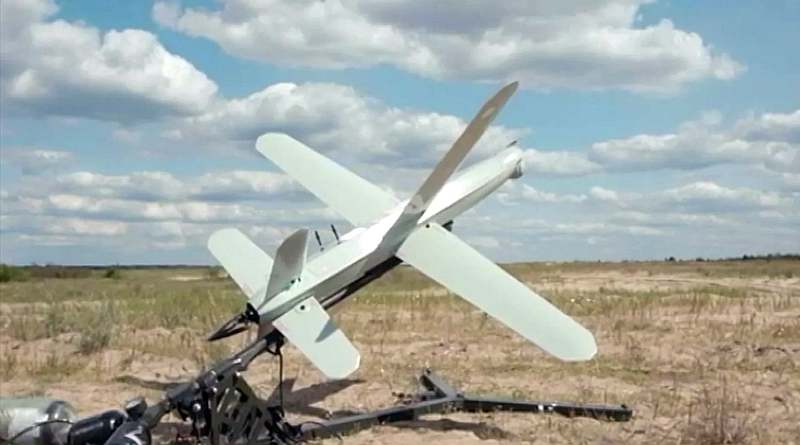
The Deputy Director of the Pentagon’s Defense Innovation Unit, Travis Metts, in an interview with the podcast “School of War” particularly noted Ukrainian fixed-wing drones.
“These medium-range drones, flying 100-150 km, combine technologies that allow them to operate without GNSS and GPS connections and signal jamming,” said Metts.
He highlighted the successful use of such drones to disrupt logistics in the so-called land corridor to Crimea. “These developments are relatively recent, and they are quite cheap. They can fly 100 km and hit practically anything that moves – tanks, trucks, people,” says Metts.
“This is a new capability that did not exist anywhere a year ago, and it has scaled up in recent months. So when we see oil refineries burning near St. Petersburg or east of the Urals, when strikes are made on depots, it’s them,” he adds.
The Pentagon values the fact that Ukrainian drone technologies have been battle-tested, and this is not empty talk. “Battle-tested in the case of Ukrainian companies means that millions of their systems have been used in real operations. The equipment, software, and especially the communication systems have been tested,” says Bondar.

Autonomous Drones in Combat
Autonomous operation is the future of drone technology, some analysts believe. Real combat conditions show that, for example, Russia usually has electronic protection around important objects, so it is expected that such communication will be lost at the final stage of an attack, says Metz. He noted that the ability to hit a target when communication with the drone is cut off is still a challenge for the US.
The experience of Ukraine in conducting attacks when communication with the drone is lost is gradually reaching the United States and other countries, notes Michael Horowitz, director of the national security program at the Council on Foreign Relations in the US (CFR).
“You don’t want a drone to fall from the sky when communication with it is interrupted,” the researcher says in an interview with the Ukrainian service of “Voice of America.” “Therefore, Ukraine experimented with programming, including very simple image recognition algorithms and other tools, so that the drone still hits the target even if the data transmission channels are cut off.”
But in the field of more complex artificial intelligence integration, Ukraine needs help from abroad, says Bondar.
“When it comes to modern drone autonomy, where AI is integrated into drones, it is difficult for Ukraine to compete with American drones. This complex technology requires significant R&D, engineers, and there is a shortage everywhere. The best engineers immigrate to the United States, not only from Ukraine but from all over the world. Here Ukraine competes on a global scale for talent,” says the researcher.

Drones “Free from China”. Is it realistic?
The United States and other countries are trying to limit China’s influence on defense capability and the presence of Chinese components in the production chain.
The Pentagon acknowledges that Ukraine has made progress in this area. “Ukrainians are actually ahead of us in terms of isolating from the Chinese supply network,” says Metz. He noted that Ukraine has come a long way since the beginning of the full-scale invasion, when “Ukrainians were using commercial drones and attaching grenades to them in a ‘Mad Max’ style.”
By the end of 2024, Ukrainians acknowledged the “existential risk” of dependence on Chinese supplies, says Metz.
Reducing dependence on China is “absolutely vital from a cybersecurity standpoint,” Horowitz is convinced. Ukraine, being at war, must use what is available.
“Often available and cheap are precisely the Chinese components,” he adds.

The most valuable thing in Ukrainian drone technology is not the technology
“When it comes to military innovations in this context, it’s only partly about technology. It’s mostly about what we do with these technologies,” says Horowitz.
In addition to the drones themselves, Ukraine’s ability to effectively use them to achieve military goals and adapt to the daily needs of the front is extremely important, analysts note.
Horowitz adds: “Ukraine’s ability to produce drones is impressive, but effectively integrating them and developing an operation concept makes Ukraine a combat laboratory from which the whole world, including the US, learns.”
Kateryna agrees: “Ukraine doesn’t have a perfect technical solution, but it has innovation and creativity, adaptive solutions that are sometimes more valuable than technology.”
Adaptability ensures such rapid technological development that even Russia, with all its resources and massive unwieldy military-industrial complex, couldn’t keep up, says the researcher.
Close communication between companies, engineers, and end-users is unprecedented for the West, the researcher adds.
“For them, these are two different worlds – the commercial sector, private industry, drone startups, and on the other hand, rigid military structures. They are not accustomed to talking to each other and are not used to openness with each other,” says Kateryna.

How to Protect Your Inventions in the American Market
Drones used in Ukraine and other countries are mostly produced using commercial technologies, which in theory are quite easy to copy, says Horovitz.
The value of Ukrainian drones is not only in the technology itself but in how they are used to achieve specific goals, says the analyst.
For international markets to properly value Ukrainian inventions, companies should take care of intellectual property rights protection.
“Ukrainian companies might benefit from entering into joint production agreements with defense companies from other countries,” notes Horovitz.
The example of U-Force, which announced plans to operate on the US West Coast, shows that Ukrainian companies are beginning to implement joint branding, joint production agreements with American companies to protect their achievements, says the analyst.
For the combat application of Ukrainian technologies, it is necessary to train operators, organize logistics, which requires the knowledge and experience that Ukrainians have, says Bondar.
She is convinced: effective mechanisms for intellectual property protection operate in Western markets. The bigger challenge for companies, more than building factories and protecting intellectual property, in her opinion, is the ability to maintain one of Ukraine’s advantages – the connection to Ukraine, the speed of adaptation, which “perhaps is the most valuable in Ukrainian technologies.”
Source
Copyright © 2021 RFE/RL, Inc. Reprinted with permission from Radio Free Europe/Radio Liberty
In the image: Ukrainian strike drone kamikaze “Bulava” (export name — Mace) of the middle-strike class, developed by the company DeViRo (creators of the UAV “Leleka”). Photo: video screenshot
