
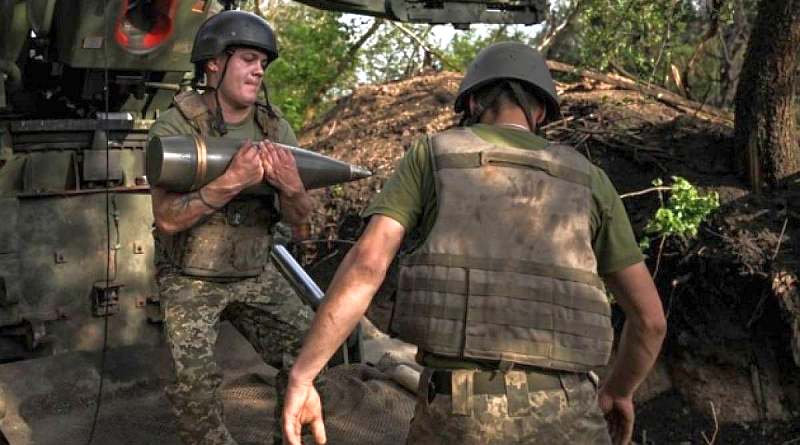

Today — Huliaipole direction.
The enemy (Russian forces) continues offensive actions in the zones of its 5th and 35th Combined Arms Armies (CAA) of the “Vostok” task force, reinforced by several units of the 40th Separate Marine Brigade and the 76th Air Assault Division, moving in the general direction of Huliaipole — Orikhiv and north of Huliaipole along both banks of the Haichur River.
Evidently, the main (closest) task of the enemy forces in this direction in the operational-tactical plan is to advance the main forces of its forward units and formations to the Omelnyk — Shyroke — Yehorivka — Chervona Krynytsia area, as well as to the Ternuvate area.
The continued advance of the forces (troops) on the left flank of the Russian “Vostok” task force (5th and 35th CAA) aims primarily to create favorable conditions for the further advance of the Russian 58th CAA “Dnepr” towards the Orikhiv-Zaporizhzhia direction. This, in turn, means primarily the elimination of the Orikhiv defense area of the Armed Forces of Ukraine (AFU).
1. As of now, the forward units of the advancing Russian forces in the aforementioned directions have managed to reach the following positions and areas with their main forces:
– They have reached the southern and eastern outskirts of the village of Dobropillia (some small enemy infantry groups are already present in the village itself).
– Advanced in the direction of Pryluky — Rizdvyanka to a distance of up to 3.8 km.
– Reached the southeastern outskirts of the village of Vozdvyzhivka.
– Achieved the line of Tsvitkove — Krynychne.
– Also secured the line of Staroukrainka – Zaliznychne, completely occupying both villages.
– Reached the area 1.5 km east of the village of Huliaipilske.
– Occupied the villages of Myrne and Luhivske, advancing 2-2.5 km northwest from this line.
Additionally, in the zones of both advancing Russian armies, there are numerous small enemy infantry (assault) groups that have infiltrated the combat formations of the forward Ukrainian units and subunits, securing positions in their tactical rear, especially in the following:
– 1.7 km east of Nechaivka village, as well as in the Pishchane area.
– On the northern and southern outskirts of Ternuvate village.
– In the Rizdv’yanka — Kosivtseve — Dobropillia — Vozdvyzhivka area, the enemy executed numerous “infiltrations” of their small infantry groups.
– A similar situation has developed in the area of Vozdvyzhivka, Verkhnya Tersa, and Hirke villages, where not only are the nearest forest strips “filled” with Russian assault infantry, but they are also present in the villages themselves.
– In the directions of Myrne — Charivne and Myrne — Huliaipilske, several small Russian infantry groups were simultaneously recorded, which are also present in the settlements of Charivne and Huliaipilske.
– Additionally, the enemy executed numerous “infiltrations” northwest of Luhivske and even managed to organize several intermediate (“accumulating” for their assault infantry) positions there. As a result, the most distant “infiltrated” Russian small infantry group has been noted in the area between Chervona Krynytsia and Yehorivka.
Thus, it can be stated that during the reporting period, the enemy achieved a number of significant tactical results in the Huliaipole direction, advancing west from Huliaipole and northwest from their positions on the Haichur River approximately 7-8 km, and in some sections — 10-11 km.
Considering the results of the Russian troops noted in my previous review, achieved during their attacking/storming actions on the left flank of their 36th Army’s (from the line of Pryluky — Solodke) northwest direction (towards Solodke — Nova Zaporizhzhia), it is also worth noting the fact of a further, although rather slow, deterioration of the overall situation for the Ukrainian Armed Forces in the Huliaipole direction.
2. Currently, the most threatening section (direction) regarding the achievement of the operational-tactical objectives set by the Russian command, in my opinion, is the left flank of the advancing Russian group at the junction of the operational zones of Eastern and Dnipro Commands.
The Russian units operating in the Myrne — Charivne directions (and further towards Novoselivka and Huliaipilske), as well as from Luhivske towards Chervona Krynytsia, are evidently very close to breaking through into the Omelnyk and Yehorivka area.
This actually has a completely logical explanation. After all, these actions are directly and explicitly linked to the retention of the Ukrainian forces’ Orikhiv defense area in the offensive strip of the neighboring 58th Army’s Eastern Command. Should the Russian troops break through into the aforementioned area, they would effectively take a position surrounding Orikhiv from three sides. This, in turn, would make its further defense very problematic for the Ukrainian Armed Forces.
Especially considering that the forward units of the 42nd Motorized Rifle Division (MRD) from the 58th Army of the enemy have likely already “infiltrated” their assault groups not only in the Novodanylivka area, southwest of Novoandriivka, and on the southeastern outskirts of Mala Tokmachka, but also in Orikhiv itself (more details on this in one of the following reviews).
However, in my opinion, it is not worth “dramatizing” the overall situation to the west and north of Huliaipole. Although the enemy is quite successfully “fragmenting” the Ukrainian defense in the tactical zone in this direction, using its numerical superiority in assault infantry and supporting its attacking/assault, mainly “infiltration” actions with the effective use of its own tactical UAVs, the pace of its advance in an operational-tactical sense remains relatively low.
Moreover, there is another nuance. The further successful advance of the forward units of the Armed Forces of Ukraine from the Krasnohirske – Novohryhorivka line southward (towards Uspenivka) could potentially create some ADDITIONAL difficulties for the Russian command directly on the Huliaipole direction.
Yes, it has not yet created them, but it clearly can, because in this case, the Russian command will receive an objective need to cover the right (northern) flank of its grouping advancing from the Haichur River in the west and north-west directions (that is, towards Orikhiv) with more significant forces and means. This likely already forced it to deploy part of its 127th Motor Rifle Division from the 5th CAA with a front to the north, but if the Armed Forces of Ukraine advance further south, the situation for the Russian command in this sense may worsen even more.
There is another point in the Russian command’s plan regarding the organization and conduct of its offensive in the Huliaipole – Orikhiv direction, which, in my opinion, from the operational point of view, let’s say, looks very dubious. The fact is that the Russian group of troops concentrated and deployed for an offensive in this direction actually has to do this not only in the area, which is constantly expanding along the front, but also in directions that consistently diverge (and SIMULTANEOUSLY towards Orikhiv and to Ternuvatyi). This objectively already leads to the “dispersal” of forces and means concentrated for an offensive on Orikhiv from the east.
Yes, the 5th CAA with UG “Vostok” is the most powerful army of this group, and the 35th CAA is also not “small” (it includes at least 3 deployed full “cadre” brigades), especially considering the fact that both were clearly reinforced with a number of ADDITIONAL units and subunits, including from the naval infantry and airborne forces, for this purpose.
Theoretically, these forces and means should be sufficient for such a wide offensive with a clear surplus. But the longer these armies have led and continue to lead active offensive actions with minimal results for themselves, the more the aforementioned factor begins to “play against them.” Especially when their opponent (the Armed Forces of Ukraine) itself goes on the offensive in the sector of the neighboring army (the 36th CAA).
It must be agreed that the real depth of advance, which amounted to 7 to 10-11 km over 2 months of stubborn offensive battles with quite significant losses, is clearly not the result that the Russian command expected, starting from the end of spring this year, when its summer campaign started. Moreover, it is evident that in this direction, at this time, it had to repeatedly intersperse the planned periods of its offensive activity with forced periods of “consolidation and regrouping.”
Currently, the Russian command is trying again to “galvanize” its advance from Huliaipole towards Orikhiv, probably believing that in the strips adjacent to this direction of the 36th and 29th CAAs, it has ALREADY managed to stabilize the situation with the Ukrainian advance.
But whether such an assessment of the situation in the operational zone of the GW “East” by the Russian command will be accurate in reality, we will probably find out in the coming months.
Photo: General Staff of the Armed Forces of Ukraine
