
Anastasia Gurin / Mirror Weekly
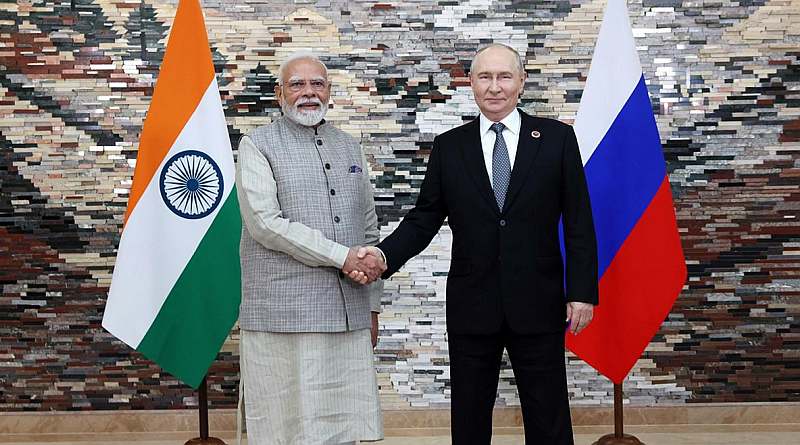
At a recent summit in Central Asia, which strictly adhered to a predetermined schedule, Indian Prime Minister Narendra Modi seemed to step away from the planned script for a moment to reproach Russian dictator Vladimir Putin — the leader of a country that has been a close partner to New Delhi since Soviet times. Over a month ago, the President of Kazakhstan made a sharp remark about the war. Putin’s “friends” have started to criticize him more openly, writes WSJ.
The time has come “to move from an endless war to its conclusion,” Modi told the head of the Kremlin during the summit in Kyrgyzstan.
This is not the first time Modi has criticized the war, but the new remark was particularly decisive. It marked a barely noticeable change in tone that some of Moscow’s partners have taken in communicating with Putin in recent months, as the losses from the full-scale war, now in its fifth year, increase for both Russia and its allies.
In July, Kazakhstan’s President Kassym-Jomart Tokayev, an ally of Russia, made a similarly sharp remark during a meeting with Putin in Omsk. Tokayev noted that he hears from many countries asking why Russia is still waging war.
“The nature of the conflict is not entirely clear to many, including us,” he told Putin.
These words came as the effects of the war are increasingly felt both inside and outside Russia. Russia’s offensive in eastern Ukraine has largely stalled. Ukraine has also raised the cost of the war for Moscow by attacking oil refineries and warehouses of e-commerce giants. When CIA Director John Ratcliffe visited Moscow last month, one of his messages to the Russian dictator was: it’s time to return to the negotiating table.
Russia’s partners have also suffered from the consequences of the war. India is under pressure from the West to stop buying Russian oil. In July, a Russian missile strike on a cargo ship in the Black Sea killed four Indian crew members. Escalation in these waters has also led to disruptions in the Caspian Pipeline Consortium, on which Kazakhstan depends for its oil exports.
“There may be growing concern that the escalation of the conflict is spreading and affecting other countries and their economies,” noted Hanna Notte from the James Martin Center for Nonproliferation Studies.
Moscow has attempted to forge closer ties with India, which has long been a loyal consumer of Russian oil and weapons. However, India’s dependency on Russian oil has angered Washington. Last year, U.S. President Donald Trump criticized India for purchasing Russian oil, taking measures that led to an increase in tariffs on Indian goods to 50%.
Modi’s recent comments have also signaled to India’s Western partners that he understands their concerns, even as the country prepares to host the BRICS summit — a group that includes Russia, China, and Brazil. BRICS is seen as a challenge to the Western-led world order.
“India wants its Western partners to know: even if India buys more oil or weapons from Russia, in the end, it does not support the war,” noted Professor Sreeram Chaulia from the Jindal School of International Relations.
Criticism from former Soviet states highlights Moscow’s declining influence in Central Asia and the South Caucasus. American companies have made significant investments in countries like Kazakhstan and Armenia, offering an alternative to Russian patronage.
Tokayev’s statement in July came amid drone strikes disrupting the Caspian Pipeline Consortium and deterring ship owners from loading at the terminal in Novorossiysk. American oil companies in the consortium, such as Chevron and ExxonMobil, may have approached Kazakhstan to express their dissatisfaction with the delays, suggested Carnegie Center research associate Temur Umarov.
“The main reason for Tokayev was Western pressure,” noted the analyst.
Armenia’s public opposition to Putin has grown amid a broader rift in relations between Russia and the former Soviet republic. Armenia expressed disappointment with Moscow for not using its peacekeepers to prevent bloodshed during Azerbaijan’s 2023 offensive in Nagorno-Karabakh.
Last year, Trump hosted the leaders of Armenia and Azerbaijan at the White House to sign a peace agreement, which includes new American investments in Armenia, particularly in the creation of a data processing center.
“There is a belief that Russians are now focused on Ukraine, which gives these countries the confidence that they can afford to be more critical of Moscow,” Notte noted.
This weekend, Trump’s envoys Steve Witkoff and Jared Kushner are expected to visit Moscow and Kyiv with a proposal to end Russia’s war against Ukraine. However, Russia is pessimistic about the prospects of reaching any deal as a result of these visits, Bloomberg reported.
According to agency sources close to the Kremlin, expectations are extremely low. Previous trips by Witkoff and Kushner to Russia have yielded no progress, and there is no reason to believe Trump’s envoys will bring “acceptable proposals” this time. Putin is ready to end the war only on his terms, and Russia’s demands are becoming increasingly stringent, as Moscow believes it has a military advantage.
Analysts note that Putin shows little willingness to soften Russia’s main demands, and the Kremlin’s stance towards the White House has also become harsher.
In the cover image: Indian Prime Minister Narendra Modi and Russian President Vladimir Putin during a personal meeting in Bishkek on August 31, 2026. Photo: Occupying forces’ media
