
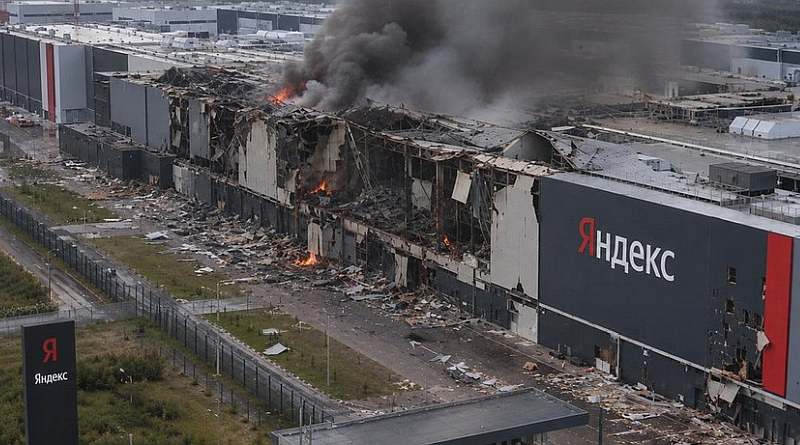
The war of “data centers” began at Russia’s behest in late spring. If fuel is hard to reach, bridges are not easy to destroy, and the dispersed production of “long arm” equipment still needs to be found, then data processing centers are clearly visible distinctive buildings, most likely not covered by any on-site air defense systems. It’s a perfect target with immediate damages, and the market for AI components is overheated—new racks and chips might not be available until the end of 2028.

Russians targeted the physical core of mobile operators’ networks (Kyivstar, Vodafone, Datagroup) and traffic exchange points (UA-IX) with ballistic missiles. The goal was simple—to sever the internet connectivity between regions and disable mobile communication in order to paralyze both civilians and the missile threat alert system.
The physical hubs of Ukrainian cloud providers were targeted: commercial data centers in Kyiv (such as the infrastructure at the level of KVC “Parkovy”, De Novo hubs, GigaCloud) and in Western Ukraine, where backups of state and large private companies were stored.
Local server structures of state agencies were also hit—attacks were made on buildings of ministries, regional administrations, and the Ministry of Internal Affairs, where databases and routing servers were located.

Overall, there are approximately 10-11 objects of varying levels. From them, “ripples spread out.” Periodic severe terminal failures in stores began. PrivatBank and Monobank systems were disrupted due to the loss of connection with processing centers, and people simply could not pay for bread with a card. Automated sorting centers of “Nova Poshta” stopped — without connection to the central base, logistics reverted to the stone age with paper invoices.
“Diia” experienced disruptions: the frontend worked, but retrieving documents (licenses, passports, tax numbers) stalled for days, as the physical registries of the Ministry of Justice and the Ministry of Internal Affairs were severely damaged.
Due to the failure of eHealth and Helsi, doctors could not issue electronic prescriptions — the issuance of insulin and critical medications in pharmacies stopped, and paper prescriptions returned.
The Fundamental Mistake of Sovereign “Cheburnet”
The Russians made one fundamental mistake in their strategy: they measured us by their own standards and needed a quick image.

For Russia, the loss of a data center is death without resurrection. Their “sovereign cheburnet” is confined within the country. They cannot transfer databases of the Ministry of Defense, FSB, or Sberbank to Amazon or Google cloud — sanctions, paranoia, and isolation policy. Everything is physically located in Ryazan, Balakovo, and Udomlya. If the hardware burns, the data burns. The overseer ensures nothing goes abroad.
And Ukraine, in 2022–2023, legislatively allowed critical state databases, registries, and bank backups to be moved to global clouds (AWS, Microsoft Azure, Google Cloud, data centers in Poland and Germany). Therefore, when they struck our data center in Kyiv, they were merely destroying a piece of hardware and local cache. Yes, it caused disruptions, and providers had to reroute for days.
But we restored backups from Frankfurt or Warsaw, and communication was duplicated through a distribution network of tens of thousands of Starlink terminals, which their missiles couldn’t reach. We decentralized and moved to the global cloud. Meanwhile, they remained on their physical servers in the Central Federal District, waiting for our drones to arrive. And they waited.
Kinetic denazification of Russian IT
It turned out that the “great IT state” couldn’t restore its data centers after physical destruction without Western supplies of Nvidia, Intel, and Cisco/Arista networking equipment. Redundancy? Data mirroring? No, they’ve never heard of it. Everything relied on gray imports and improvisation.
Russia is under a total embargo on supplying high-performance chips (Nvidia H100/A100, the latest generations of Intel Xeon or AMD EPYC). Delivering 10-20 “PC parts” or consumer graphics cards via Kazakhstan is possible. But transporting containers of industrial server racks, multiplexers, and special-purpose FPGAs for data centers is a complex logistical operation taking 6 to 18 months and costing three to five times the market price. Russian analogs simply don’t exist: “Elbrus” and “Baikal” processors aren’t produced in the necessary volumes due to Taiwanese TSMC’s refusal.

Theoretically, any IT giant should have geographically distributed data centers with 100% redundancy. However, in conditions of hardware scarcity, Russians began to economize: the main loads were grouped in a limited number of hubs. Concurrent strikes or damage to two key nodes triggered a domino effect — backup data centers couldn’t handle the redirected traffic and started to collapse under the burden.
Along with them, hundreds of thousands of bots disappeared, which once strongly supported the “Russian world” (similarly, networks of advocates for Scottish independence collapsed during bombings in Iran). A strange new world: Russia and Iran can only be loved for money, and there is no more truth — only advertising campaigns with different budgets.
Ripples in the water for the military-industrial complex and repressive machine
Ripples also spread across Russia, impacting their sensitive system. Geoinformation services and satellite images from “Yandex.Maps,” used by their logisticians, volunteers, and military for supply routes, fell apart.

Yandex’s cloud capabilities, involved in computer vision algorithms for Russian UAVs and AI training, have been slightly singed.
Surveillance systems were instantly blinded. The data center infrastructure, which processed arrays from surveillance cameras (“Sphere”/”Orion”), the Ministry of Internal Affairs databases, border guards, and the Unified Registry of Conscripts (the same electronic summonses), went down. This created ideal blind spots for draft dodgers, deserters, the opposition, and our agents.
The collapse of “Yandex.Pay” and integrations with banking APIs caused an avalanche of load on backup banks (Sberbank, VTB), leading to local collapses of payment systems.
230 MW to ashes
In the mega-data center of Yandex in Sasovo (40 MW), our drones broke through the roof right above the chillers and generators. Without cooling, machine rooms turned into an oven in 15 minutes — motherboards and scarce Nvidia graphics accelerators just melted onto the floor. In Vladimir (another 30 MW), they didn’t even bother burning the hardware: they simply carried away optical collectors and transformers, sending the routing of the entire Central district into network isolation for weeks.

With the backbone monster of “Rostelecom” in Udomlya at 80 MW, it turned out even more elegantly. Since it stands right next to the Kalinin Nuclear Power Plant, they hit not the building but the high-voltage nodes and diesel tanks. The fire consumed cable trestles, leaving the Ministry of Defense racks without cooling — along with them, the electronic summonses databases and military-industrial complex logistics invoices melted down.
The strike on Sberbank’s energy center in Balakovo (82 MW) caused emergency shutdowns of servers and a software crash of data arrays. As a result — terminals, CRM, and internal databases of companies across the country went down. Delightful, very delightful.
The disabling of these specific monsters (with a total capacity of over 230 MW) created the same hardware famine. Tens of thousands of computing units were lost (including scarce tensor processors for AI). Physically, it is impossible to fill this gap with gray imports — it would require trainloads of equipment, which manufacturers from the USA and Taiwan simply will not sell to Russia. And even if they do, this hardware would arrive around 2028.
Hang in there, in Cheburnet, have a nice mood.
On the cover: Consequences of the Ukrainian drone attack on the “Yandex” data center in Russia. Photo from open sources
