
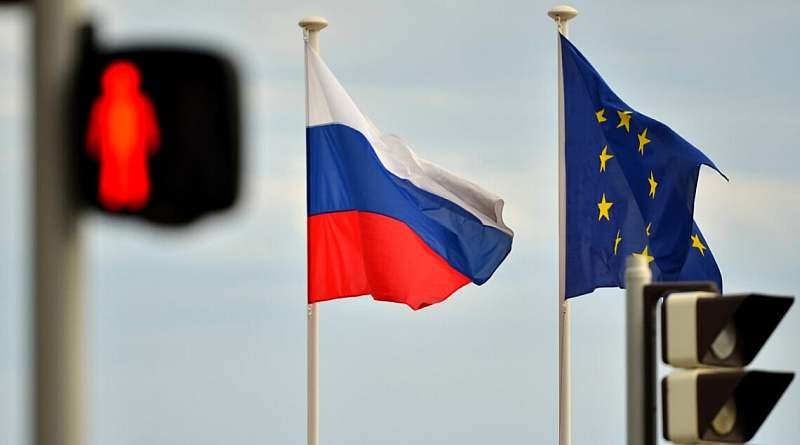

Information on the current losses of Russia due to sanctions as of 21.10.2026.
1. Ukrainian drones have completely blocked the shipment of goods to Russia through the Black Sea.
– Novorossiysk, one of Russia’s largest seaports, has effectively stopped servicing container imports due to a lack of carriers willing to work on this route due to Ukrainian drone attacks. Last year, the port handled 1.1 million containers, ranking third in Russia after the Far East and St. Petersburg ports.
– However, in October, the last Chinese companies operating on the route to Novorossiysk redirected ships to St. Petersburg. Since early August, when the first container ship was sunk by drones in the Black Sea, the number of ships in St. Petersburg increased by 25–30%.
– Not only are cargoes from Europe and the USA, which previously arrived via Turkey to Novorossiysk, being redirected to St. Petersburg, but also imports from China, India, and Iran.
– Ukrainian drone attacks have disrupted the usual logistics of Russia’s maritime imports through the Black Sea and forced carriers to seek alternative routes.
2. Russia’s maritime oil exports have fallen to a monthly low due to the closure of the Port of Primorsk.
– Russia’s maritime oil exports in the four weeks to October 18 fell to 3.59 million barrels per day — the lowest level in a month. The reason was the suspension of shipments at the Baltic port of Primorsk, likely due to maintenance. By the end of the week, the port’s operations resumed, and shipments through Novorossiysk also resumed.
– In the week to October 18, average daily shipments fell to 3.13 million barrels — the lowest level since March. During this period, 31 tankers loaded 21.91 million barrels of Russian oil compared to 24.63 million barrels on 34 ships the previous week.
– The value of maritime exports also decreased: to $2.33 billion for the week and $2.61 billion on average over four weeks.
– Ukraine has resumed strikes on Russian oil refineries, although their intensity has decreased. One of the four primary processing units at the Ryazan Refinery has been halted. Such disruptions may increase the volume of oil available for export, but Russia’s capabilities are limited by reduced production.
– In September, oil production in Russia fell to 8.64 million barrels per day — the lowest level since mid-2020. Easing of certain US restrictions, agreements on diesel fuel trade, and changes in the approach to the shadow fleet tankers may support demand from India but are unlikely to cause a sharp increase in crude oil exports.
3. The Bank of Russia has been reducing gold reserves for the tenth consecutive month to cover the state budget deficit.
– In 2026, it may reach 7.3 trillion rubles, double the initial plan. The rate of gold sales became the highest since 1998 when the country experienced a default and currency crisis.
– In September, the Russian Central Bank’s gold reserves decreased by another 0.2 million troy ounces, or about 6.2 tons, to 72.8 million ounces. This is the lowest level since the end of 2019. Since December last year, reserves have decreased by a total of 2 million ounces — about 62 tons.
– After the 1998 crisis, Russia accumulated gold for decades, increasing its reserves more than fivefold. At the beginning of 2022, they amounted to about 74 million troy ounces, or 2.3 thousand tons, which secured Russia the fifth position in the world for gold reserves.
– The current sell-off is linked to the decline in oil and gas revenues and the growing budget deficit. The Russian Ministry of Finance is using assets from the National Wealth Fund, including gold, and the central bank is selling corresponding volumes as part of operations reflecting the fund’s reserve usage.
– As a result, the Russian Central Bank became the largest gold seller among central banks worldwide. The Russian authorities are spending accumulated financial resources to finance state expenditures, including military spending.
4. Profit of Russian “Severstal” fell by 61% over nine months.
– The Russian metallurgy company “Severstal” reduced its profit by 61% from January–September 2026 and decided not to pay dividends for this period.
– Over nine months, the company and its subsidiaries earned 19.29 million rubles in profit. Gross profit decreased by 21% to 129.92 million rubles, and operating profit fell by 45%. The profit tax paid has decreased by more than 3 times. Investments decreased by 40%. Net debt has increased by more than 2.5 times since the beginning of the year. Free cash flow is negative (minus 27.6 billion rubles).
– The company explained the decision to withhold dividends by the need to focus resources on completing key strategic projects. In the second quarter, the company also did not pay dividends, citing unfavorable market conditions and weak demand for steel products.
5. Russia retained third place among gas suppliers to the EU, providing 11% of imports in September.
– In September 2026, Russia provided 11% of all natural gas imports to the European Union, remaining the third-largest supplier after Norway and the USA. Russian gas accounted for 5.9% of pipeline deliveries and 5.1% of liquefied natural gas (LNG) imports, according to Kpler, ENTSOG, and EOA data.
– Norway remains the largest gas supplier to the EU with a 36% share. The USA holds second place with 32.1% of imports, with all American gas being delivered in liquefied form. Algeria’s share was 10.6%, and Azerbaijan’s was 4.5%.
– European imports are gradually shifting towards LNG. In September, LNG accounted for 47% of all gas deliveries to the EU, while pipeline gas made up 53%. American companies supplied more than two-thirds of all LNG imports to the European Union.
6. The EU will not ease energy sanctions against Russia despite the US agreement on diesel fuel.
– The European Union will not ease sanctions on Russian fossil fuels, despite Washington’s agreement with Moscow regarding diesel fuel supply until April 2027. This was stated by European Commission President Ursula von der Leyen in the European Parliament.
– She called Russia an unreliable supplier that uses energy dependence as a weapon and reminded that it was Moscow that reduced gas supplies to Europe. Donald Trump, defending the agreement with Russia, stated that the EU also bought Russian energy resources but did not provide details.
– In December, the European Commission plans to present a new mechanism for protecting the single market. It is expected to allow the rapid restriction or prohibition of imports from countries that violate competition rules, with minimal consultations with member states.
– In parallel, the EU is preparing additional tools for supply diversification and energy solidarity.
7. Norway detained two cargo ships, one of which is connected to the Russian “Arctic LNG 2” project.
– On October 14, the Norwegian Coast Guard detained two cargo ships off the coast of northern Norway. One of them, Ya Qing Hai Yang, is under US, EU, and Swiss sanctions due to its participation in supplying equipment for the Russian “Arctic LNG 2” project.
– According to Starboard Maritime Intelligence, at the beginning of October, the ship was located a few kilometers from the Russian-Norwegian border. It left Hong Kong, made several stops in the Far East, and was heading via the Northern Sea Route. The ship was using the flag of Guatemala, although this country does not have an open public shipping registry.
– In 2024, Ya Qing Hai Yang transported modules for electricity production from China to the Russian port of Utrenny, intended to service “Arctic LNG 2.” After this, the ship was included in the US, EU, and Swiss sanctions lists.
8. Hungary is ready to abandon “Rosatom” on Russia’s key nuclear project in the EU.
– Hungary is considering the possibility of removing the Russian “Rosatom” from the expansion of the “Paks” NPP and is looking for alternative contractors. The new government of Péter Magyar is ready to incur financial losses to sever cooperation with the Russian state corporation, which received a €12.5 billion contract without a tender in 2014 under Viktor Orbán.
– The Hungarian authorities are reviewing the project and assessing the legal, technical, and financial consequences of replacing the contractor. A final decision is expected by the end of 2026 or early 2027. The government leans towards the conclusion that the expansion of the NPP is necessary, but without the participation of “Rosatom”.
– For Russia, this poses a threat of losing one of the most important footholds in the nuclear energy sector of the European Union. After Finland terminated its contract with “Rosatom” in May 2022, the Hungarian project remained a key opportunity to maintain the presence of the Russian state corporation in the European market.
– Now, not only the multibillion-dollar contract is at risk, but also Moscow’s political influence on Hungary’s energy policy.
– Budapest has already paid “Rosatom” more than €2 billion before the start of major construction work in February. In the event of contract termination, the country risks losing €1.1 billion of the paid funds and additionally paying penalties for contract breaches.
– Despite these risks, the new authorities are ready to consider changing the contractor. A European supplier would simplify foreign policy issues and reduce the project’s dependence on sanction risks.
– Meanwhile, the Russian nuclear industry still largely retains access to the European market: in 2025, Russia accounted for about 23% of enriched uranium supplies to the EU and 16% of natural uranium.
– The loss of the Hungarian project would be another blow to “Rosatom’s” positions in Europe and evidence that even the government of a country that previously defended cooperation with Moscow is willing to reconsider it to reduce dependence on Russia.
