
Vitaliy Portnikov / Vilni Media
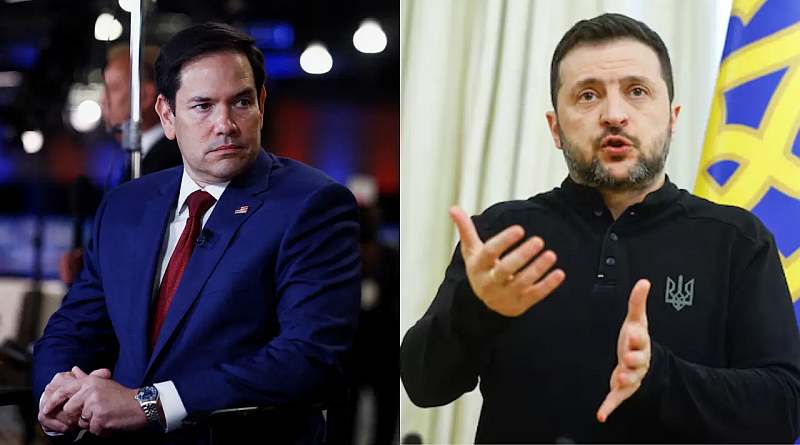
President of Ukraine Volodymyr Zelensky and U.S. Secretary of State Marco Rubio exchanged statements regarding the continuation of the negotiation process between Russia, Ukraine, and the United States.
The Ukrainian president claims that the American negotiators are pressuring their Ukrainian colleagues, demanding the concession of the non-occupied part of the Donbas in exchange for American security guarantees after the end of hostilities.
The U.S. Secretary of State, in turn, called these claims false and emphasized that Washington had not imposed any decisions on Ukraine. He highlighted that it is Kyiv that must decide its response to Russian conditions. Meanwhile, U.S. security guarantees, according to Rubio, can only take effect after hostilities between the Russian and Ukrainian armies conclude. Zelensky responds that this is just the tip of the iceberg, and that the assessment of the situation largely depends on interpretations, but insists that the U.S. indeed mentioned giving up Donbas.
All of this could be called a real diplomatic scandal if the parties were not dealing with completely abstract matters. In reality, there are currently no full-scale Ukrainian-American-Russian negotiations. Those that have occurred resembled more the act of buying time, necessary for Putin to continue the war against Ukraine while simultaneously preventing the United States from increasing sanctions against Moscow. This Russian performance for an audience of one—Donald Trump—ends as soon as Putin realizes he can communicate with him without any negotiations, and that new sanctions will not follow. And now is an opportune moment for the Russian president, as the American leader needs Russian oil to maintain the energy balance in a burning world.
There is also no clear understanding of what American security guarantees entail. Under Trump, the U.S. was decisively against Ukraine joining NATO, and even during Biden’s presidency, there was not much enthusiasm for it in Washington. The reason is obvious: the United States is trying to avoid a situation where it would have to enter into a direct conflict with the Russian Federation. This will inevitably happen if Ukraine becomes a NATO member and Russia attacks again. But if the Americans categorically exclude the possibility of war with Russia due to fears of nuclear conflict, then what meaning could any guarantees have? Especially today, when we see how U.S. allies in the Persian Gulf—where real American bases are located, and the American fleet is stationed—have fully felt their defenselessness, witnessing attacks on American military bases and shelling of U.S. troops. In the world of a new war, American guarantees are a phantom. But it seems neither Rubio nor Zelensky is willing to admit this.
Furthermore, the condition of ending the war by withdrawing Ukrainian troops from Donbas appears just as phantasmal. For then it would have to be acknowledged that Putin waged war for four years, throwing hundreds of thousands of his compatriots into the meat grinder and spending colossal resources only to gain control over Kramatorsk and Sloviansk. The demand for the withdrawal of Ukrainian troops from Donbas is just part of a broader operation to absorb the entire Ukraine. And the withdrawal of Ukrainian troops from any city will not stop the war—it will only prolong it.
Thus, we are dealing with an entirely new form of diplomatic scandal—one that corresponds to modern reality. When parties argue not about possible political steps but about formulations that exist only in the imagination of political process participants. The Americans have their illusions: that the war in Ukraine can be ended through Ukrainian concessions and, afterward, mutually beneficial economic relations with Russia can be restored. Ukrainians have others: that the U.S. will provide security guarantees that will prevent new aggression. Neither of these aligns with reality. But that does not mean there is no way out. There is.
And it is primarily related to undermining Russia’s economic potential and striking at its military-industrial complex. If Russia has no resources for war, there will be no war. Yes, mutually beneficial economic cooperation with it would become impossible in such a case. But instead, there will be a chance to prepare for a new war, which may begin again—when Russia restores its economic potential and is ready for a new leap.
