
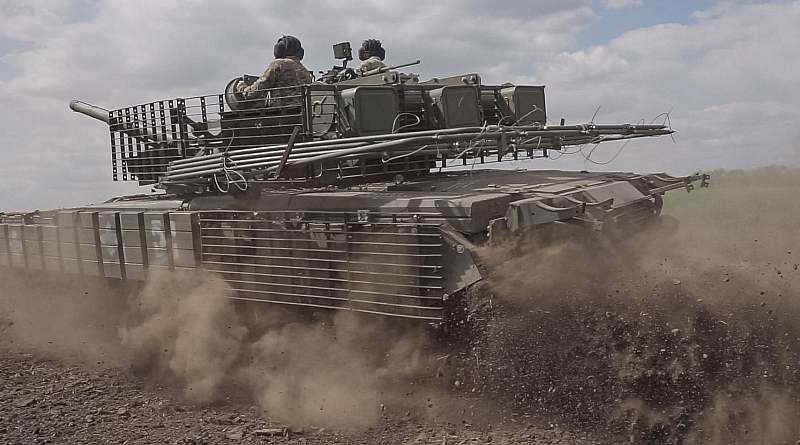
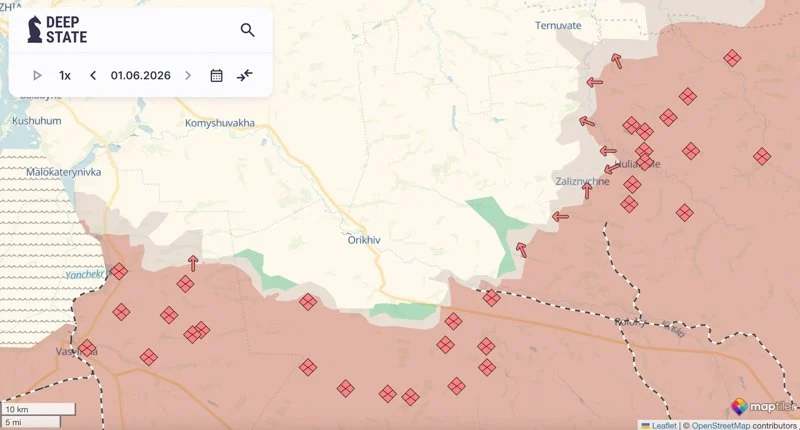
As of the end of May, the operational situation in the Orikhiv direction has shown a significant shift in trends in favor of the Ukrainian Defense Forces. Although the enemy has concentrated a significant grouping of troops (comparable in size and structure to the forces engaged in the Sloviansk direction), it has not achieved operational goals in the Orikhiv area or in the western part of the Zaporizhzhia region.
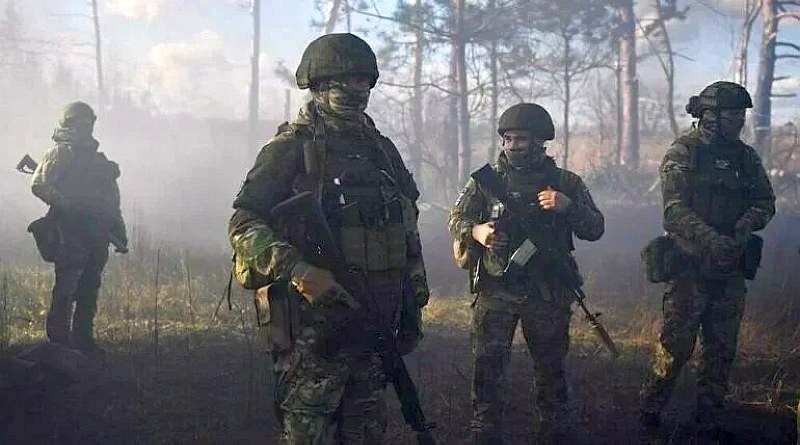
The core of the Russian grouping consists of the forces of the 58th Combined Arms Army of the “Dnepr” troops, reinforced by units of the 18th Combined Arms Army and a significant contingent of the Russian Airborne Forces, whose commander also heads the “Dnepr” Group. Overall, the enemy has concentrated five divisions in this direction, including the 19th, 42nd, 47th motorized rifle divisions, and the 7th airborne assault. The 76th airborne assault arrived here, but its regiments are currently engaged in combat near Pokrovsk. Despite this, the Defense Forces have effectively halted the Russian advance.
The most indicative is the situation on the Stepnohirsk — Kamianske section. During May, Ukrainian units pushed the enemy back from most of Stepnohirsk, established control over the central areas of the city, and reached certain sections of the E105 highway. The Russian command had to urgently transfer units of the 247th Airborne Assault Regiment and other reserves here to prevent further retreat. The battles for Plavni and Prymorske continue; however, it is the Russian troops that are forced to address the problem of holding positions rather than developing an offensive.
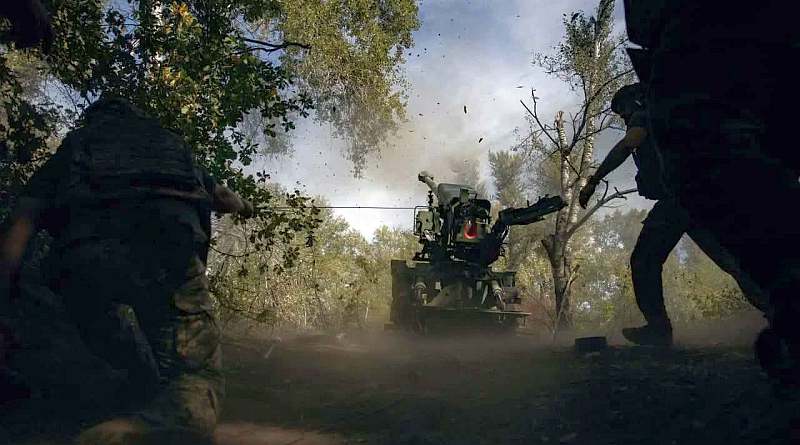
An equally important achievement of the Defense Forces is the stabilized situation in the Mali Shcherbaky — Shcherbaky — Pavlivka direction. Attempts by the enemy to restore lost positions ended in failure. Enemy assault groups that infiltrated Ukrainian combat formations were timely detected and isolated. According to several reports, Ukrainian forces also managed to push the enemy directly out of Mali Shcherbaky and Shcherbaky, which significantly worsens the tactical position of the aggressor’s units in this section of the front.
However, the most epic situation is around Mala Tokmachka. Despite numerous claims by Russian propaganda about allegedly controlling the settlement, the actual situation indicates the opposite. Ukrainian units not only retained the settlement but also forced the advanced units of the 42nd division to retreat to Novopokrovka after our successful counterattacks in the Bilohirya area. Thus, another enemy attempt to create preconditions for an assault on Orikhiv ended fruitlessly. Mala Tokmachka has not surrendered for 1559 days (as of June 1). The Ukrainian Carthage.
An important factor increasingly affecting the operational situation remains the Ukrainian strikes on the enemy’s logistics. This primarily involves the systematic targeting of transport infrastructure and supply nodes along the strategic route Rostov-on-Don — Crimea. This route supplies the occupation forces in the Orikhiv and Prydniprovsky directions, and after issues with the Crimean bridge and Kerch crossing — the enemy troop group in Crimea.
Strikes on depots, transport hubs, railway infrastructure, and road routes (the Defense Forces have also targeted roads parallel to the “Novorossiya” highway) are forcing the Russian command to extend supply lines, disperse reserves, and spend additional resources to secure rear areas. As a result, the rate of replenishing ammunition, equipment, and personnel is deteriorating precisely at the moment when the enemy is trying to maintain a high intensity of combat operations.
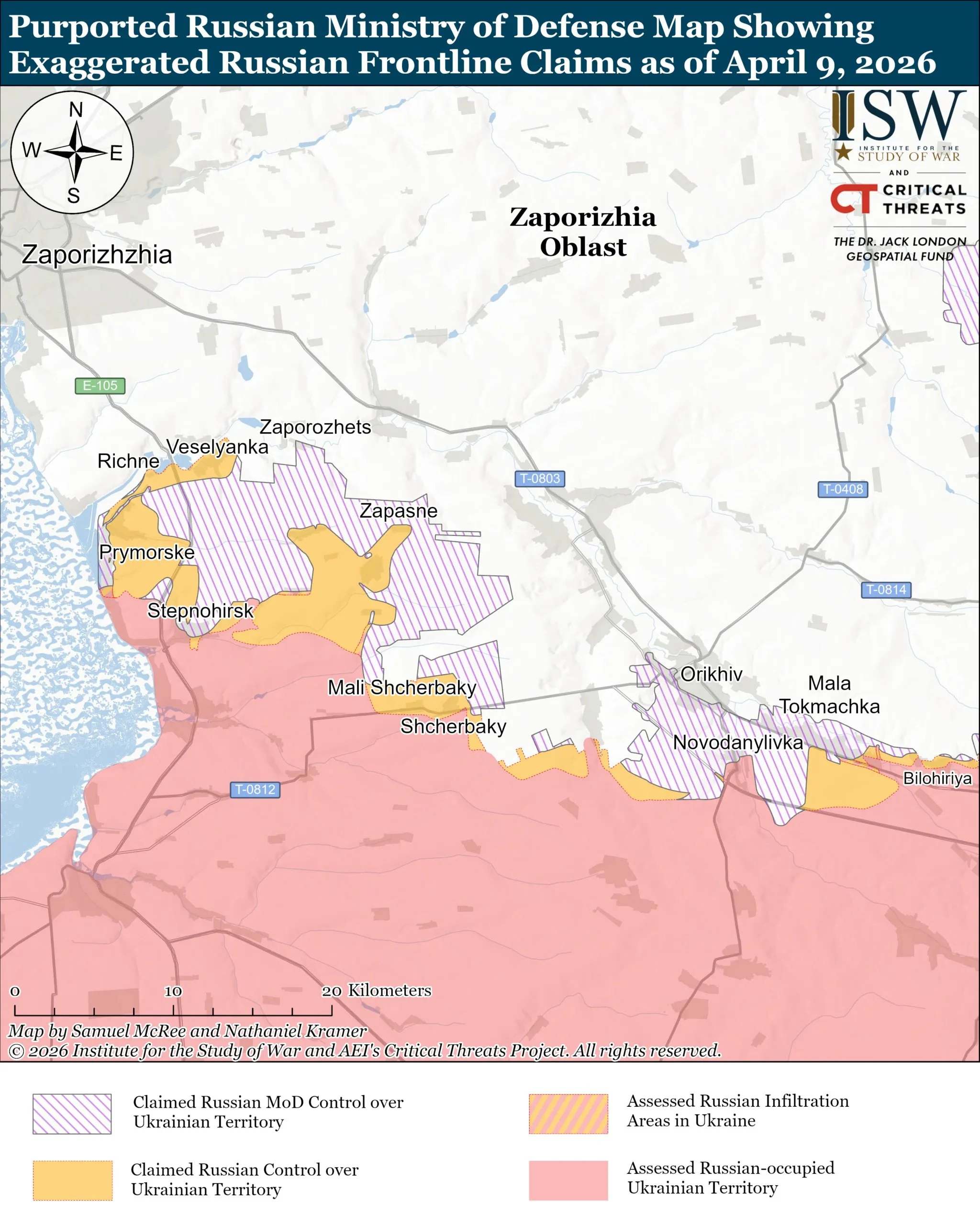
The story of the Russian tactical map, which recently became publicly available, deserves special attention. Its analysis (analysts believe the map is genuine) shows significant discrepancies between the actual situation on the ground and the information used by enemy headquarters and circulated in official circles. Large areas are marked as controlled by Russian forces on the map, although battles are ongoing, or control by the Defense Forces has already been established. This is especially true for the areas of Stepnohirsk, Malyi Shcherbaky, and Mala Tokmachka.
The published document has essentially become another confirmation of the Russian command’s systematic exaggeration of its successes and the concealment of the actual state of affairs from both its own population and the higher military-political leadership. The occupation of Ukraine on credit has gained momentum among the enemy’s military leadership, as writing and drawing are easier than capturing Mala Tokmachka.
Overall, the current operational situation on the Orikhiv direction indicates the exhaustion of the 58th army’s offensive potential. Without a large-scale regrouping and the introduction of fresh reserves into the operation, the enemy is unlikely to be able to resume attempts to break through directly to Orikhiv in the near future.
At the same time, the concentration of significant airborne forces and the transfer of reserves indicate that the Russian command has not abandoned its intentions regarding this direction. Therefore, in the coming months, attempts to resume offensive activity are to be expected, although currently the initiative in several key areas is increasingly passing to the Defense Forces.
Cover photo: 25th Separate Dnipro Airborne Brigade
