
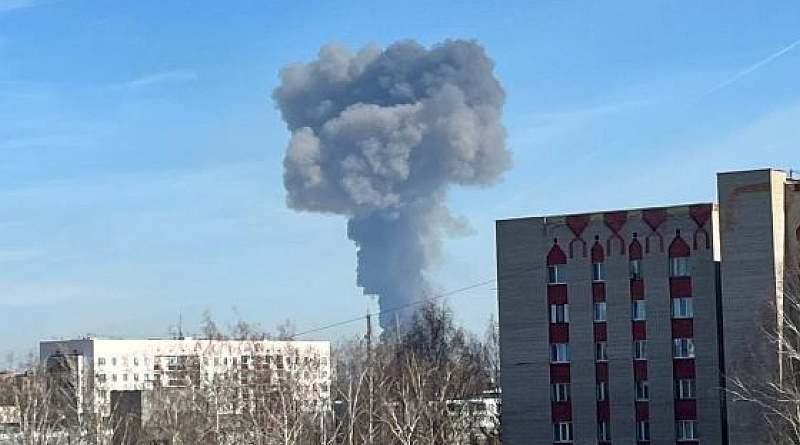

On Tuesday, at the giant “Nizhnekamskneftekhim” (NKNKh) in Tatarstan, there was such a blast that windows shattered within a radius of several kilometers. Officially – a “technical incident” on a dryer.
But what’s interesting: there was no air alert in Tatarstan. And you know what? There were no drones or missiles from us there, because this is even better than a direct hit! It was a “self-inflicted wound” due to the systemic overload we initiated earlier through other plants, and I see a nice connection here 🙂.
First, a little statistics for general understanding.
Tolyattikauchuk (No. 1 in Russia): Capacity ~820,000 tons/year. It critically depends on the supply of industrial gases from “TolyattiAzot” and “KuybyshevAzot” (where there have been hits and accidents in recent months). When there started to be production disruptions (which are needed for inertization and processes), plant No. 1 significantly declined.
NKNKh (No. 3 in Russia): Capacity ~700,000 tons/year (~17% of the Russian market). For some positions (halobutyl rubbers, isoprene rubbers SKI-3), they hold up to 100% of the Russian market.
Missile connection: Synthetic rubbers (in particular polybutadiene) are the binding base for solid rocket fuel. Without them, neither Iskanders nor Topol missiles nor S-300/400 air defense missiles fly.
Now let’s examine the details of this “pop,” because they are critical and very indicative here.
1. Accumulative domino effect.
Earlier, we systematically “worked through” TolyattiAzot and KuybyshevAzot. This led to a shortage of hydrogen and other industrial gases for Tolyattikauchuk (the No. 1 enterprise in Russia). When the market leader started to “cough” and slow down, all the load fell on NKNKh. Nizhnekamsk provides ~17% of all Russian rubber, and for some positions, it’s a 100% monopoly. The system was commanded to “Work for yourself and for that guy from Tolyatti.”
2. Missile pressure on the roosters.
Amid this, the Kremlin demands the impossible – to increase missile production by 50% compared to last year. Synthetic rubber is not only for tires for armored personnel carriers, but it’s also the binding base for solid rocket fuel. Without rubber, “Iskanders” and other solid-fuel products just won’t fly. To keep up with this pace (+50% to the plan with the non-working No. 1), they simply “ignored” scheduled shutdowns and technical measures at NKNKh. Operating to the limit in three shifts gave an expected result – an explosion and fire at such a giant, which will be visible from space tomorrow.
3. Technological dead end and sanctions
NKNKh relies 70% on equipment from Linde, Siemens, and Honeywell. Quality service has been absent for two years. When you force a worn-out installation to run at 120% capacity without spare parts, – the metal simply “tires,” and the automation fails. The boiler couldn’t handle the pressure. Someone on staff got used to the needle on the gauge constantly being in the red sector, as it’s been for half a year. Everything will be fine, said the management 😆.
4. Logistic loop.
Connection with Ust-Luga. When we hit Ust-Luga, we closed the “door” for petrochemical exports, creating excessive pressure in the entire system. Stopping NKNKh is impossible due to the continuous cycle, and there’s nowhere to export. As a result – full warehouses and critical operating modes of equipment, which only rested during shift changes.
In summary:
The strikes on the Baltic, Tolyatti, and Cherepovets created the effect of a “clogged chimney.” NKNKh tried to digest an impossible order for missile makers without spare parts and regulations, and ultimately the system failed. The explosion is not a catalyst, but it’s definitely a litmus test of the system’s brokenness. And that’s very good for us.
We’ve created conditions in which Russian industry is devouring itself. Without a single one of our drones in the skies of Tatarstan, a systemic collapse occurred the day before yesterday. And this is only the beginning, as the strength resource in the “unparalleled” plants is depleting faster than they can draw up reports.
And the latest report from Rosneft shocked all investors: a 90% drop in net profit – that’s no joke. It’s guaranteed that someone got ripped off upon exiting in 2025 😆
Photo: TG channel “Two Majors”
