
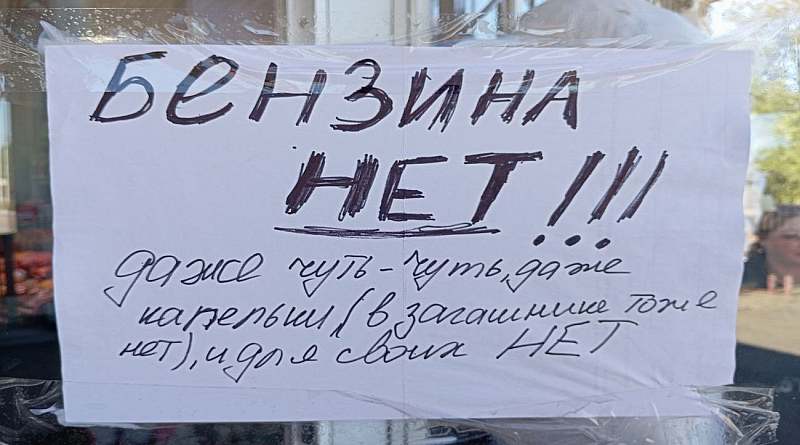

Information on the current losses of Russia due to sanctions as of 20.06.2026.
1. Ukrainian drone strikes on fuel infrastructure have led to the loss of hundreds of tons of fuel and the disruption of contracts in Russia.
– Attacks by Ukrainian drones on Russian oil product storage facilities in 2024–2025 resulted in the loss of hundreds of tons of gasoline and diesel fuel, as well as the disruption of several major fuel supply contracts. This is evidenced by court materials in Russia.
– According to published documents, after drone strikes, fuel owners appealed to the courts demanding compensation for destroyed oil product reserves.
– It concerns hundreds of tons of gasoline and diesel fuel lost due to fires following the attacks. Russian fuel storage operators attempted to cite force majeure circumstances, but courts in several cases sided with the clients.
– Judges noted that attacks on fuel infrastructure are no longer an exceptional event, and therefore owners of such facilities must consider relevant risks and take measures to protect their property.
– Court cases demonstrate that strikes on oil depots not only cause direct losses to Russia from the destruction of fuel and infrastructure. Consequences also include contract disruptions, compensation payments, increased insurance and logistics costs, and heightened risks for the entire fuel industry. This increases pressure on Russia’s energy sector.
2. Gasoline shortages first began to threaten Moscow due to strikes on refineries.
– A series of strikes by Ukrainian drones on Russian oil refineries has brought Russia’s fuel market to a critical brink. For the first time, the situation has posed a real threat of gasoline shortage in the Moscow region—the largest fuel consumption center in the country.
– Since the beginning of the year, Ukrainian drones have struck refinery sites dozens of times. The attacks on facilities supplying fuel to central Russia have been especially impactful. As a result, the total loss of oil refining capacity is estimated at approximately 600,000 barrels per day.
– If the damaged facilities cannot quickly resume operations, Russia risks losing over a quarter of its usual seasonal fuel production capacity.
– Signs of a growing fuel crisis are already emerging in the Moscow region. Queues are being reported at gas stations, some networks are imposing restrictions on gasoline sales, and fuel prices continue to rise. Between 2024 and 2025, the strikes on the refining industry were unpleasant for Russia but not critical. However, the increasing frequency and scale of attacks are gradually undermining the industry’s resilience.
– Continued high-intensity strikes could exacerbate the fuel shortage, raise prices, and create additional problems for Russia’s economy and logistics.
3. Gasoline production in Russia has fallen by a quarter due to strikes on refineries.
– A series of attacks by Ukrainian drones on Russian refineries has led to a sharp decrease in gasoline production. By the end of the second decade of June, Russia’s automotive fuel production had fallen by approximately 25% year-on-year.
– While refineries were producing around 120,000 tons of gasoline per day in March, by April it was 110,000, in May 100,000, and following a new wave of attacks, volumes could have fallen to 85,000 tons per day.
– At the same time, summer gasoline consumption on the domestic market is estimated at a minimum of 110,000 tons per day. The current production shortfall amounts to about 25,000 tons daily, or nearly a quarter of the required volume.
– To compensate for the shortfall, Russia is forced to use accumulated reserves, increase fuel purchases from Belarus, and even resort to maritime imports of gasoline. Some unscathed refineries are also attempting to ramp up production.
4. In Hungary, legislation has blocked Orban’s return to the position of Prime Minister.
– President of Hungary Tamás Schüek signed the 16th amendment to the constitution, which prohibits individuals who have held the position of Prime Minister for more than eight years in total from assuming the position.
– The new rules are retroactive and consider all terms in office since 1990. This means that former Prime Minister Viktor Orbán, who led the government for a total of 16 years, is legally barred from leading the cabinet again.
– The president’s administration stated that the document underwent a constitutional compliance check and contains no violations. The authors of the amendment explained its necessity for protecting the principles of the rule of law and democratic governance.
– The decision may become one of the most important political steps in Hungary after the change of power. It effectively prevents Orbán’s return, who for many years remained one of the closest Kremlin partners in the European Union and regularly blocked or delayed certain EU decisions on supporting Ukraine and increasing pressure on Russia.
5. In the USA, it has been proposed to use frozen Russian assets to purchase weapons for Ukraine.
– A group of American senators from the Democratic and Republican parties introduced a bill allowing the use of confiscated assets of the Russian Central Bank and other sovereign Russian funds for purchasing weapons and military equipment for Ukraine.
– The initiative proposes amendments to the REPO Act passed in 2024, which granted the US President the right to direct blocked Russian assets to support Ukraine. Now, American legislators are proposing to directly allow the use of these funds to replenish Ukraine’s military arsenal.
– The authors of the bill emphasize that Russia should bear financial responsibility for the war it initiated. In their view, frozen reserves can become a source of funding for Ukraine’s defense needs without additional burdening the budgets of Western countries.
– For the Kremlin, such an initiative poses a serious threat. If the law is passed, Russian state assets could effectively be used to purchase weapons that will be used against the Russian army.
– It also creates an additional precedent for US allies, who have so far been limited to using income from frozen Russian reserves, rather than the assets themselves.
– It is estimated that around $50 billion of Russian state assets are frozen in the USA, while the largest part — approximately 190 billion euros — remains blocked in Europe.
6. The European Union will insist on the supply of gas to Turkey from alternative sources, rather than from Russia, in future agreements with Ankara.
– During her visit to Turkey, German Minister of Economy Katharina Reiche stated that Brussels places great importance on moving away from Russian energy resources and will promote this position in all future agreements involving Turkey.
– Ankara is currently negotiating with “Gazprom” for new gas supply contracts, as the current agreements are nearing expiration. Turkey remains the second-largest purchaser of Russian gas after China.
– Meanwhile, the Turkish government aims to transform the country into a regional gas hub. However, deepening energy cooperation with Russia may complicate relations with the European Union, which is consistently reducing its dependency on Russian energy.
– As Reiche noted, Turkish officials acknowledge the importance of moving away from Russian supplies but emphasize that quickly replacing them is impossible either economically or due to the limited availability of resources.
