

Information on current Russian losses due to sanctions as of 07.04.2026.
1. In March, Ukraine used more strike drones on targets in Russia for the first time since the start of the full-scale war than Russian forces used against Ukraine.
– These conclusions were reached by ABC News after analyzing the daily statistics of the Ukrainian Air Force and the Russian Ministry of Defense.
– According to the Russian side, in March, air defense systems allegedly shot down 7,347 Ukrainian drones, averaging 237 units per day. This is the highest monthly figure ever recorded by Russian military statistics.
– Meanwhile, the Ukrainian Air Force reported that during the same period, Russia used 6,462 drones against Ukraine — an average of slightly more than 208 per day. In addition, Russian forces used 138 missiles of various types.
– According to official data, Ukrainian air defense intercepted or neutralized about 90% of the drones (5,833) and nearly 74% of the missiles (102). Thus, the intensity of drone attacks from Ukraine increased so much that, for the first time, it exceeded the scale of Russian drone strikes in one month of the war.
2. Ukrainian drones struck the Russian frigate “Admiral Makarov” during a massive attack on the Krasnodar region on the night of April 6, while it was in the port of Novorossiysk.
– The operation was planned and coordinated by the Security Service of Ukraine. The final extent of the ship’s damage is currently being clarified by intelligence.
– Russian pro-war Telegram channels also confirmed the attack. According to their reports, the frigate was docked and tried to fend off the drones using the ship’s anti-aircraft missile system.
– “Admiral Makarov” belongs to the 11356R “Burevestnik” project. There are only three such ships in the Russian Navy. Frigates of this type can carry “Kalibr” cruise missiles, which are regularly used for strikes on Ukrainian territory, as well as “Shtil-1” anti-aircraft missile systems.
– After the loss of the missile cruiser “Moskva” in April 2022, Russian sources considered “Admiral Makarov” as one of the potential new flagships of the Black Sea Fleet. Another ship of the same project — “Admiral Essen” — had previously been damaged during an attack on Novorossiysk port infrastructure in March this year.
– Strikes on ships in Novorossiysk indicate increased vulnerability of Russian naval infrastructure even in ports far from the front line.
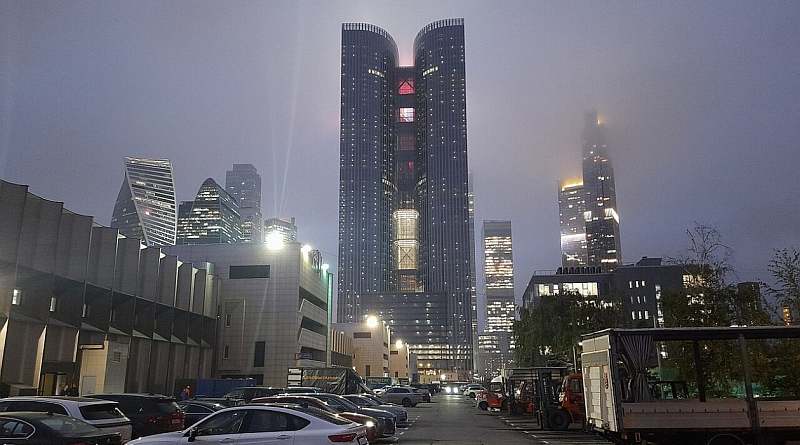
3. The Russian state monopoly “RZD” is forced to put up for sale one of its most expensive assets in the Moscow City business center to partially cover debts.
– This concerns the Moscow Towers skyscraper, which the company put up for auction with a starting price of 281 billion rubles. The auction is scheduled for May 21, 2026.
– The building was commissioned in 2024. At that time, “Russian Railways” purchased it for approximately 193.1 billion rubles and planned to move its central office to the complex. However, this plan was not realized.
– Ultimately, the Russian government, which is discussing financial support for the state monopoly, essentially forced the company to dispose of the skyscraper. The sale is supposed to partially reduce the debt burden and allow avoiding a sharp increase in freight tariffs.
– The situation demonstrates the deteriorating financial condition of the Russian railway monopoly: even large-scale infrastructure assets acquired just a few years ago have to be sold to stabilize debts.
4. Russia may become one of the main indirect victims of the war with Iran, despite short-term benefits from rising oil prices.
– On one hand, the fuel shortage in the global market has already pushed prices up and increased Moscow’s income from energy exports. If the conflict drags on, the demand for Russian oil may increase even more, along with prices.
– At the same time, strategic risks for the Kremlin are significantly deeper. In particular, the development of Ukrainian drone technologies and their potential export to Gulf countries creates new challenges for Russia.
– The escalation of the conflict between Iran and Arab states also complicates Moscow’s attempts to simultaneously maintain a partnership with Tehran and develop relations with countries like the UAE.
– An additional factor is the risk of deteriorating relations with the USA. Potential support for Iran in attacks on American targets may have serious political consequences for Russia.
– The worst scenario for Moscow is the possible collapse of the Iranian regime and its return to the global economy. In such a case, Russia would lose an important ally as well as a key element of its geopolitical strategy.
– The integration of Iran into global markets would open new routes for exporting oil, gas, and raw materials from Central Asian countries, weakening Russia’s influence in the region and undermining its long-term plans to restore dominance in the post-Soviet space.
– Ultimately, despite short-term economic gains, the war could result in strategic losses for Russia in both geopolitics and energy influence.
5. The war in the Middle East has caused a sharp rise in Russian oil prices, reaching the highest level in more than 13 years.
– On April 2, the price of Urals in the port of Primorsk rose to $116.05 per barrel, and in Novorossiysk to $114.45 per barrel. This is almost twice the benchmark set in the Russian budget, which is about $59 per barrel.
– The increase is linked to disruptions in the global market: about 20% of the world’s oil supply passing through the Strait of Hormuz is under threat due to the escalation around Iran.
– Against this backdrop, the Urals discount to Brent narrowed to less than $27.75 per barrel, a minimum since mid-December. Moreover, Russian oil is already trading at a premium on certain routes: for deliveries to India, it is about $6.1 per barrel more expensive than Brent compared to $3.9 two weeks ago.
– The sharp price increase generates additional revenue for Russia and partially reduces budgetary pressure.
– Meanwhile, this effect is limited by infrastructure attacks: attacks on ports and refineries, especially in the Baltic where about 40% of maritime oil exports are handled, cause shipment disruptions and constrain the ability to fully convert high prices into profits.
6. As of January 1, 2026, Russian citizens’ credit debt reached approximately $500 billion for the first time.
– In the last quarter, the debt increased by about $11 billion (+2.2%). The largest portion is mortgages, which account for 48.1% or about $240 billion. Consumer loans make up another 29.7% — approximately $148 billion, auto loans are about $33 billion (8%). The rest — about $76 billion — is attributed to microfinance organization loans, accrued interest, and other types of credit.
– Thus, the debt burden of the Russian population continues to grow, with the main volume concentrated in long-term mortgage obligations and consumer lending.
7. Russia is increasingly openly interfering in political processes in Hungary ahead of parliamentary elections on April 12.
– Support from the Kremlin for its ally in Budapest is hardly concealed anymore. On the eve of the elections, Putin received Hungarian Foreign Minister Péter Szijjártó and promised stable supplies of Russian oil. This move is seen as a political sign of support for Viktor Orban’s government, which in recent years has systematically weakened the EU’s sanctions policy against Russia and blocked certain decisions regarding aid to Ukraine.
– The Hungarian authorities are actively spreading narratives aligned with the Kremlin’s position. A large-scale information campaign with posters discrediting Ukrainian President Volodymyr Zelensky and opposition politician Péter Magyár is being conducted in the country.
– Additionally, the topic of an alleged sabotage on the pipeline and statements by the Russian Foreign Intelligence Service about an “EU and Ukraine conspiracy” are being used.
– A separate resonance was caused by a published conversation from 2024, in which Szijjártó appeals to Russian Foreign Minister Sergey Lavrov to assist in lifting sanctions from Gulbakhor Ismailova and assures the Russian side of complete readiness to help. This data has heightened concerns among EU countries about Budapest’s close political contacts with Moscow.
– Despite active Kremlin support, Orban’s positions in pre-election polls remain weaker. His campaign increasingly relies on antagonism against Ukraine and EU institutions. Meanwhile, opposition candidate Péter Magyár appeals to historical memory about the events of 1956 and emphasizes the need to preserve Hungary’s real sovereignty.
8. Kazakhstan declined the participation of Russian companies in the construction of three thermal power plants — in Semey, Kokshetau, and Ust-Kamenogorsk.
– The project in Kokshetau will be carried out independently by the country, while the plants in Semey and Ust-Kamenogorsk will be built by a Kazakhstan-Singapore consortium with the participation of “Samruk-Energo”.
– In Kokshetau, design has already begun, with the station’s capacity expected to be about 820 Gcal, and the launch planned for the first quarter of 2029. The cost is estimated at approximately $650 million, while the other two stations are around $870 million each.
– Initially, it was planned that the projects would be implemented with Russia’s involvement, and “Inter RAO” would act as the general contractor. The total construction cost was estimated at roughly $2.7 billion.
– However, the Kazakh side did not receive confirmation of preferential financing from the Russian Federation. According to agreements, Russian banks were supposed to provide 15-year loans, but issues arose with securing financing and subsidizing interest rates for equipment purchases.
– As a result, Astana reoriented the projects towards its own resources and alternative partners, indicating a decrease in Russia’s role in energy infrastructure projects in the region.
9. China became a key factor that allowed Iran to mitigate the impact of sanctions and maintain significant revenues from oil exports.
– Today, Iran sells oil worth billions of dollars monthly, and almost the entire volume is purchased by China. Ten years ago, Beijing bought about 30% of Iranian oil, but now it accounts for virtually all exports.
– A large-scale infrastructure to bypass sanctions has been established for this. Payments are made through small Chinese banks with limited international presence, which are less vulnerable to US sanctions. Additionally, shell companies, including those in Hong Kong, are used to funnel financial flows.
– The main buyers are independent Chinese refineries, known as “teapots,” which have replaced state energy corporations that stepped back from direct purchases due to sanction risks.
– Trade is also disguised using fake accounts and incorrect oil labeling. Western officials estimate that such a system allows Iran to receive tens of billions of dollars annually and use these funds to finance activities abroad, including military expenditures.
– China is described as Iran’s main partner in bypassing sanctions, highlighting that without this support, Tehran could not maintain its current level of economic and military activity.
10. In the European Union, debate is intensifying over revising the veto mechanism that allows individual countries to block decisions of the entire bloc.
– The initiative is being pushed by a group of states led by Germany and Sweden. German Foreign Minister Johann Wadephul stated that the principle of unanimity in foreign policy and security matters should be abolished. He said the experience of recent years, particularly regarding aid to Ukraine and sanctions against Russia, has shown the current system’s inefficiency.
– Meanwhile, some countries, including France and Belgium, oppose changes, considering the veto a key tool for protecting national interests.
– The discussion has intensified in light of the blocking of certain decisions. For instance, in late March, progress on allocating about $97 billion in funding to Ukraine was stalled as Hungary blocked the initiative due to disputes over the “Druzhba” pipeline.
– As a result, tensions in the EU are escalating between the need for swift decision-making and the desire of states to retain control over key foreign policy steps.
