
Paul Krugman / iPress Translation
Nobel laureate in economics Paul Krugman asserts that American society is becoming increasingly skeptical of artificial intelligence, not only due to fears of job loss or potential technological risks. He emphasizes that the current investment boom around AI absorbs trillions of dollars but creates surprisingly few jobs and provides almost no tangible benefits to the average American. Meanwhile, massive investments in data centers and computational infrastructure play a noticeable role in rising interest rates, while the technology enriches only a small number of people. Such societal backlash against AI may have important political consequences.
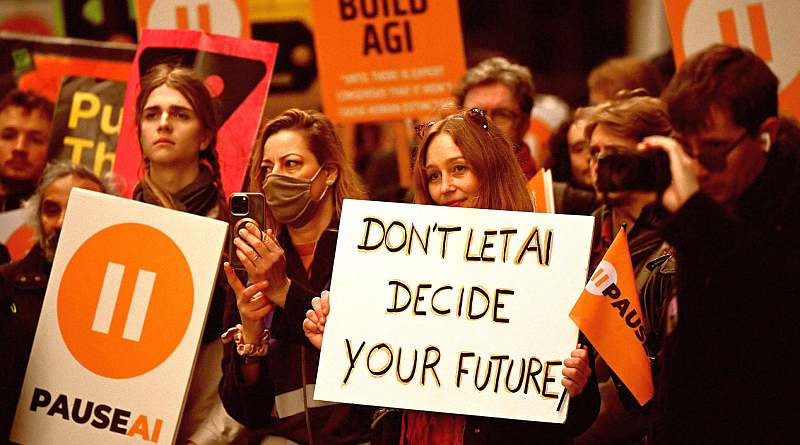
In America today, there is one unifying trend: Americans really, really hate AI. What began as a kind of NIMBY protest – no one wants a data center in their neighborhood – has evolved into serious doubts about the technology itself. For those of us who remember the euphoric optimism that greeted the tech boom of the 1990s, the current massive negative reaction to AI is quite striking. Here are the results of a new Wall Street Journal survey:

Only 28 percent of Americans believe that the development of AI technologies should proceed at full speed. All others want it slowed or stopped – temporarily or permanently.
Of course, Donald Trump remains an ardent supporter of AI. He believes that the public’s dislike of AI is merely a marketing problem and that he can solve it by making everyone call AI “superintelligence.” But the same WSJ survey indicates that only 7 percent of Americans trust Trump’s leadership in AI regulation. Given Trump’s extremely low approval ratings, his support for AI, excuse me, “superintelligence,” is likely further deteriorating Americans’ attitudes toward this technology.
Historically, Americans have been technology enthusiasts. As a nation, we are not Luddites. So what explains Americans’ dislike of AI?
It is obvious that almost daily, loud warnings are sounded that AI will destroy humanity or, short of that, take away everyone’s jobs. And these warnings come not from some left-wing oddballs – they are voiced by the AI industry representatives themselves.
And we really ought to be afraid—very afraid. The ability of AI models to break supposedly secure systems independently, without prompting, against the owners’ intentions, and then lie to people about their actions is truly shocking. Furthermore, there’s undoubtedly an element of financially motivated hype: “Our technology is so powerful it can destroy the world, so you’d better invest in our IPO.” There’s also significant karmic payback: the AI giants’ pursuit of the holy grail of AGI—artificial general intelligence—was surely a strategy aimed at making huge money on Wall Street, unlike the more modest and probably more successful Chinese strategy of creating moderately scaled and cost-effective models.
However, there’s also a more mundane reason for public discontent with AI: it’s a technology of the oligarchs, created by oligarchs and for oligarchs, with almost no benefits reaching ordinary Americans.
In other words, never before in history have corporations spent so much money—playing a significant role in the rapid rise of interest rates—to create so few jobs.
Data centers themselves are essentially rows of servers with blinking lights, employing very few people. Here are the U.S. Bureau of Labor Statistics figures for the category covering data centers as well as several other activities. Employment in this category has been declining since November 2022—the month often cited as the start of the AI boom, as that was when ChatGPT became widely available:

But won’t the AI boom at least temporarily create many construction jobs? Some—yes, and Jared Bernstein wrote a good post on how to ensure these are quality jobs. However, all signs indicate that investments in AI will create far fewer jobs, even in construction, than expected.
Let’s not forget: this is truly a massive investment boom. In Sunday’s review, I cited estimates by Stijn Van Nieuwerburgh, suggesting that we are entering the biggest capital expenditure boom in U.S. history, far surpassing even the large railroad boom after the Civil War:

These are forecasts, not already incurred expenses. But the AI investment boom has already gained momentum. Here are IT investments as a share of GDP: they sharply increased at the end of 2024 and are now significantly exceeding the levels of the 1990s tech boom:

With such a surge in spending, it’s logical to expect a sharp increase in non-residential construction expenses – that is, construction for business rather than housing.
But in reality, we see something entirely different. Under Biden, non-residential construction grew rapidly, largely thanks to his administration’s support for clean energy. In contrast, under Trump, this indicator essentially stalled despite the massive AI investment boom:

How is this possible? Because even during the construction of a data center, actual building work is relatively minimal. According to van Nieuwerburg, when a multi-billion dollar campus is built for training AI models,
“About a third of the [investment costs] is allocated to the facility itself and the energy infrastructure, while roughly two-thirds goes to computing equipment and related IT systems.”
So, there is little traditional construction involved. And most of the “computing equipment” and other hardware are imported!
Overall, the deep unpopularity of AI is not difficult to understand. We have a technology that enriches a small number of people, but its creators warn it could destroy millions of jobs, if not the entire world. And even the usual argument in favor of policies beneficial to oligarchs – job creation! – doesn’t hold up here, because even in the short term, very few jobs are created.
Will the unpopularity of AI matter? There are signs that it will. Currently, Republicans have so many problems that it’s hard to single out one, but Chris Caldwell recently wrote in an interesting article that the deep unpopularity of data centers could become the turning point that makes Ohio “blue” this year, meaning it could tilt the state towards the Democrats and potentially determine who will control the Senate.
Thus, there are significant reasons for the public’s negative reaction to AI — and not just a potential apocalypse. This reaction is so strong and appeared so quickly that it may have important political consequences.
Isn’t it super?
