
Edward Lucas / Translation by iPress
The founder and director of the Baltic International Centre for Security and columnist Edward Lucas believes that Europe risks once again finding itself in a situation where major powers agree on its security without its full participation. He warns: possible agreements between the US and Russia to end the war against Ukraine may resemble the logic of Yalta – dividing spheres of influence behind the backs of smaller countries. In contrast, Europe should insist on the principles of the Helsinki Accords of 1975, where the rules were common for everyone, not determined by the power of the great states. For this, Europeans need unity, political will, and readiness not only to reject unacceptable agreements but also to propose their own security model.
On Thursday, leaders of the US, Russia, and China will meet in Shenzhen – without European participation. Europeans were also excluded from the Russia-Ukraine negotiations in Abu Dhabi last week, mediated by the US. In the next round of peace talks regarding Ukraine, Europeans will be present – it seems this is a concession by the Russians at the request of the Americans. But Europeans should be vigilant. If the agenda is already set, they will be there not as full participants but as subjects of discussion – along with matters of their own security.
In 2021, the Kremlin demanded the actual demilitarization of the countries that joined NATO after 1997. The Biden administration rightly rejected this demand. Now, it seems Trump’s envoys are considering a much tougher package of Russian demands as part of a deal to end the war in Ukraine.
In response to this threat of a new Yalta that is becoming increasingly apparent, Europeans have reacted with hesitation and disunity. At a summit in Dublin last week, leaders representing over 500 million people and an economy of 28 trillion euros – almost a quarter of global GDP – reacted to this existential issue by creating a committee: national security advisors from the UK, France, Germany, Italy, and Poland, along with representatives of the European Union, who have not yet been defined.
It’s good that Poland is included in this format. But a better solution would be to give a leading role to the EU’s chief diplomat, Kaja Kallas, or at least ensure her participation. EU treaties place responsibility for foreign policy on her, not on a specially created committee. The former Prime Minister of Estonia has unparalleled understanding of the Kremlin’s negotiation tactics. The Trump administration dislikes her – and that’s another reason to insist on her presence.
Ignoring Kallas’ role reinforced the Eastern Europeans’ feeling that “our knowledge and understanding of Russia and its former victims are still considered questionable compared to the fantasies and prejudices of Western Europeans,” noted former Estonian President Toomas Hendrik Ilves. In reality, all Europeans are currently being sidelined.
While Russian and American negotiators celebrate their ability to make deals, Europeans and Ukrainians are left with only the costs and risks, slightly covered by paper promises similar to those Stalin made at Yalta regarding democracy in Poland. According to leaks, Ukrainians will be asked to leave fortified positions in Donbas in exchange for NATO membership.
But what kind of NATO? For the sake of a pan-European peace agreement, the US may withdraw not only combat forces but also critical support forces and capabilities, without which rapid reinforcement of allies is impossible. Then, only promises will remain from the American presence.
Meanwhile, Russia’s war machine will gain new fuel by lifting sanctions, and its propaganda will receive a powerful boost from a behind-the-scenes agreement between superpowers over the heads of troublesome neighbors.
This toxic pie may already be mixed, but it’s not yet baked. European negotiators must firmly oppose all components of this potential deal. Without them, it won’t work. No one can force Europeans or Ukrainians to sign any part of it. Europe is wealthy enough to support Ukrainian aspirations – including through the confiscation of frozen assets of the Russian Central Bank. It can strengthen sanctions. Midterm elections in the US offer hope for a change in American policy. Now is the time to fight, not to concede.
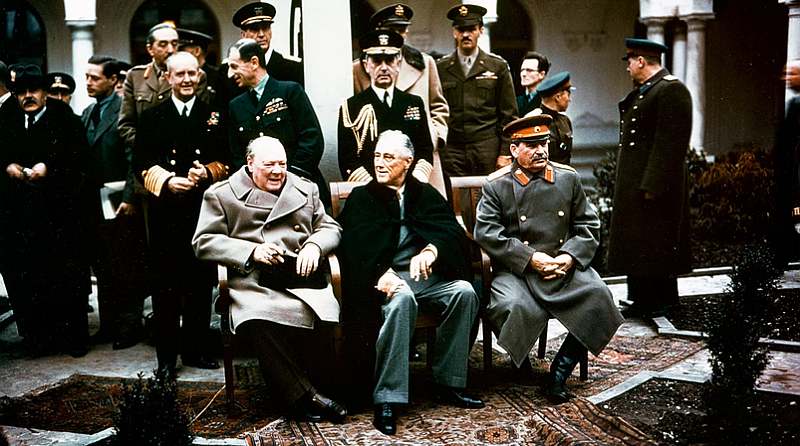
Europeans should also offer a positive alternative. The grim message of Yalta 1945, when Stalin already effectively controlled half of Europe, was: “what’s mine is mine, and yours can be negotiated.”
A much better principle was enshrined in the Helsinki Accords of 1975: “here are the rules; they apply to everyone.” These agreements resulted from transatlantic unity and persistence over two years of negotiations. In the next 15 years, Western governments and dissidents effectively used them to curb and undermine the Soviet Empire.
Helsinki helped undo the consequences of the first Yalta. Reviving their far-sighted spirit could prevent a second.
In the image: Winston Churchill, Franklin Roosevelt, and Joseph Stalin at the Yalta Conference, 1945. Photo: Army Signal Corps Collection in the U.S. National Archives
