
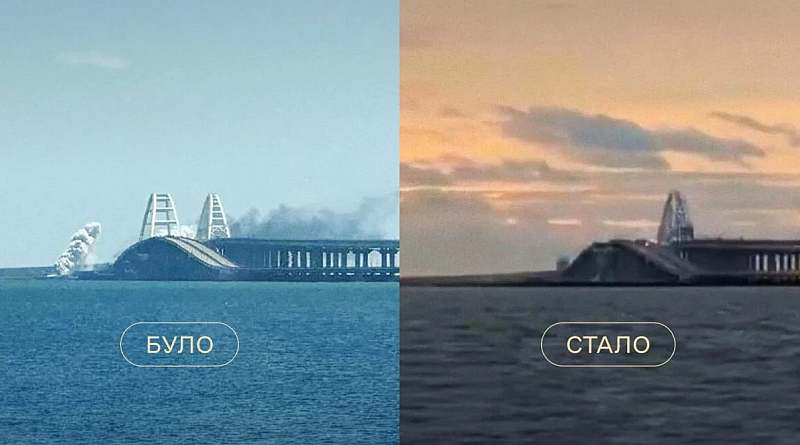

There are many reasons why the Day of the Fallen Bridge will go down in the history of this war as a turning point—on par with the victorious battle for Kyiv and the Day of Liberation of Kherson.
Most of these reasons have already been listed over the past day by international commentators and military experts—indeed, Crimea becomes an “island,” the Russian army stationed there will remain helpless without supplies, like our blocked units in the spring of 2014 (it is especially pleasant for me to think about this and to savor such a “restoration of justice” in advance, I do not intend to forget or forgive the then-humiliation of Ukraine), and the Azov Sea becomes a “lake,” and Russian tankers loaded with stolen Ukrainian grain will no longer leave its ports—as Sikorsky joked about Trump, “Ukraine has cards,” and Russia’s main symbolic victory, unshaken in the eyes of its population since 2014, is nullified before the eyes of bewildered subjects, most of whom for the first time begin to suspect that their country is losing the war, and “how can this be” (the smarter ones—I saw today in the feed—are racking their brains, “how could it be” that the Crimean bridge fell, while the ones in Kyiv stand, and console themselves, very comically, that ours were “built by the USSR,” thus, supposedly, they are better)—and international media holdings are rubbing their hands in impatience to see how Pu will now pretend to be cheerful in front of Xi and the fool Krasnov (in the USA they dislike losers even more than in Russia!), and how this will affect the configuration of “Yalta 2.0,” and so on— in short, the strategic consequences of this Day will manifest for a long time, and you can’t see everything at once…
But there is one that, it seems, no one has noticed yet: only now, after 5 years of probably the most disgusting state-terrorist war in history, conceived as a “blitzkrieg,” the “collective West” (and the East, and even, gradually, the South) begins to realize that all these years they were afraid of emptiness. That all the supposed “might of Russia” (including the nuclear one? they haven’t figured it out yet, but it’s a matter of time), mystified in various ways and from different angles by the inertia of the Cold War—is just a BLUFF (“illusion,” as Zabuzhko wrote in “The Longest Journey”).
(Excerpts, in the original language, from an article in “Komsomolskaya Pravda” from May 2018 titled “How Russia Will Protect the Crimean Bridge”, I highly recommend reading, and definitely to the end, – this is literally higher education, postgraduate, or even doctoral level bluffing. Since 17.11.2026, a brilliant illustration of the proverb “you can travel the world with lies, but you can’t come back.” That’s precisely how Moscow “traveled the world” – inflating a balloon coated in blood, and they believed in it.)
The year 2022 shook this belief, but not completely (one of the missions of the American grandfather is to patch up the shaken belief, even with stories about how tanks “got stuck in the mud” near Kyiv: such clowning is actually a quite effective propaganda technique when you need to “cover up” the truth). And now it’s clear that the king is indeed naked. There’s no one to fear. But why did he say we should push NATO back to the 1997 borders? Was he bluffing too? And why did we believe him? And why were we discussing it? And now what?..
And so on and so forth. These are the most serious changes – those that occur in the mind. Because it’s always and everywhere the minds that fight and win, not the hardware. I’m sure that in many minds responsible for making historically significant decisions, today, it has become clear.
Thank you, Armed Forces of Ukraine.
Glory to Ukraine.

Fixing the Russian bridge makes no sense at all, as it is under complete fire control by Ukraine, plus Russian air defense systems have shown their complete failure.
Soviet anti-aircraft systems (“modern” Russian SAMs are just tweaked or enhanced versions of the same old Soviet systems) were relevant in the last century against the threats of that time.
Today, with such a rich variety of ammunition—from giant flying locomotives like the FP-5, through cruise missiles like “Neptune” to a whole array of small and agile drones—they are no longer relevant.
But even if the Russian Federation had modern SAMs, it wouldn’t have saved them, as no air defense system provides 100% hermeticity and protection.
And yes, overall this didn’t concern Russia much, and there were reasons for that.
Moscow started the war against Ukraine when all they had was “Tochka-U,” which couldn’t reach the bridge (and were not accurate enough), and the unfinished “Neptune.”
Well, and one (a single piece) self-propelled gun “Bohdana” (not about the bridge, just as an example), and nothing else—even in small quantities—was there.
In this regard, arranging their cavalry attack on Kyiv, the Russian Federation really risked little. At least that’s how it appeared and seemed to them.
But over these years, a miraculous and effective demilitarization of Ukraine has occurred, only in reverse geometric progression—now the Russian Federation is dealing with a technically and militarily advanced, strong state.
Overall, the Defense Forces of Ukraine are today the strongest army in Europe, this is not praise, no one gives Ukrainians any discounts, it is simply an objective fact.
And the failure to recognize this fact by Moscow is one of its key weaknesses, leading to a constant underestimation of its enemy.
What? NATO helps somehow? Oh, well, yes, just like Iran, North Korea, and a bit of China help the Russians. Which is quite a usual situation—someone is always helping someone in some way. There’s nothing special about it.
But how a state and a people, in which no one believed, transformed from an underdog into a state capable of waging such a fight—that’s impressive, exemplary, and simply beautiful.
I love when it’s beautiful.

Ukraine “took down” the Kerch Bridge in just a day: how this will affect the supply of the Russian army and terror of Ukrainian cities.
On the morning of November 17, the arch and at least two spans of the vehicular part of the Kerch (Crimean) bridge about 270 meters long collapsed, and the railroad section was also partially damaged. This was the result of systematic, high-precision strikes by the Defense Forces of Ukraine on the bridge using combined-type attack means. But a no less relevant question arises: how will the destruction of this logistic artery affect the actions of the Russian occupation forces? Let’s figure it out.
Effective Attack
First of all, I note that the destruction of the Kerch bridge lasted a little more than a day in total.
The shooting calibration was conducted on November 16, confirming the set coordinates and the effectiveness of the route laid out for strike drones, allowing them to penetrate the layered air defense concentrated near the bridge. It’s worth noting that the peninsula’s overall air defense was exhausted over a long period, and it has turned into a real sieve with many vulnerable zones today.
Russia has been unable to provide sufficient air defense coverage for the temporarily occupied peninsula since the beginning of 2026, but the bridge remained the most protected area in Crimea.
The main strike on November 17 consisted of a wave of drones, specifically decoys rather than combat drones, which depleted the nearby air defense systems near the bridge. This was followed by a combined process to finish off the illegal structure – using both drones and missile weaponry. The drones clipped the already leaning arch, while the missiles were directed at the road surface.
The combined impact of these weapons resulted in the arch collapsing at 6 a.m. Kyiv time, bringing down the spans of the road surface with it.
Blockade Effect
In recent years, following the successful SBU operation to blow up the bridge in 2022, there have been debates on the necessity of spending resources to destroy the bridge, with some arguing it had long lost its strategic importance. However, this view is extremely mistaken.
The Kerch Bridge, following the 2022 operation, indeed had restrictions on cargo transportation and rail connections, but remained the most important and shortest logistical artery connecting mainland Russia and the occupied peninsula.
Mainly through the bridge, logistical support (MTO) was provided to the Russian forces group “Defense of Crimea”. Additionally, the Russian army used the peninsula itself as a transit hub for supplying goods to mainland Ukraine, to the Kherson and Zaporizhzhia regions, to support the forces group “Dnepr”.
Military supplies were sent through Crimea to the occupying troops on the left bank of the Dnipro.
In 2026, Ukrainian Defense Forces launched a massive logistical lockdown for Russian occupying forces on the M14 highway, and also struck and destroyed bridges in the Armiansk and Chongar areas. This drastically reduced logistical routes for the mainland path of Russian forces – both in terms of supplying Crimea and the entire “Dnepr” forces group.
The destroyed bridges in Armiansk and Chongar have not been restored, but instead, pontoon and embankment crossings have been constructed. This partially allowed logistics to resume, although the volume and traffic flow do not match those of the existing bridges, and Ukrainian drones occasionally disrupt this process with their strikes.
Parallelly, an operation to blockade the Sea of Azov was launched, resulting in strikes not only on cargo ships and tankers but also on ferries, significantly complicating the supply of Crimea by sea routes.
The peninsula found itself under blockade, not counting the preserved connection via the Kerch Bridge. And today, the last connecting link of this logistics has been destroyed.
Thus, Crimea truly finds itself in a blockade, the “Defense of Crimea” group loses the ability for full support, the peninsula loses value as a transit hub, and the “Dnepr” forces group also loses some MTO volume.
However, transport isolation is not just about the supply of Russian groups in the temporarily occupied territories.
Terror Effect
On the temporarily occupied peninsula of Crimea, Russian occupiers have built a number of launch platforms for kamikaze drones, which they launch both over southern Ukraine and deep into the mainland part of the country. The launches are mainly carried out from Cape Chauda, the “Gvardeyskoye” airfield, and the Balaklava area.
Additionally, from the territory of Crimea, missile attack systems such as ballistic missiles 9M723 OTRK “Iskander-M”, 3M22 “Zircon” and 3M55 “Onyx” are launched, along with sorties of front-line aviation. The entire arsenal for these terrorist activities was transported to Crimea mainly via the Kerch Bridge by both road and rail.
Thus, the supply to the terrorist group for executing its tasks from the territory of Crimea will be reduced after the bridge’s destruction. I repeat, not completely stopped, but significantly reduced.
Reputational Effect
So. At least two spans of the automobile section of the Kerch Bridge have been destroyed. The damage to the base of the railway section’s arch has been confirmed. If the strikes continue, the railway section also doesn’t have long left.
While Russia has been attempting to destroy bridges in Ukraine, especially in Kyiv, for weeks and months, it has only managed to damage them by using a wide range of attack means. However, Ukraine “folded” the Kerch Bridge within a day.
Any sensible person would wonder: isn’t it time to, albeit unofficially, declare a ceasefire/moratorium on strikes against bridges in such a situation? After all, the Kerch Bridge was the most ostentatious long-term project of the Putin regime, which the Russian occupiers failed to protect. What can be said about those bridges in Russia that have not been repaired or maintained for decades and which can be “folded” quicker and with fewer resource expenses?
For instance, with systematic and concentrated work, by the end of 2026, virtually all connections across watersheds in the Bryansk, Belgorod, and Kursk regions of Russia could cease to exist. Of course, then we would have to divert from strikes on refineries, but is the Putin regime aware of this?
The strike on the Kerch Bridge is not just about logistics. It’s not just about the supply of troops and fueling combat actions in the Southern operational zone. It’s not just about the blockade of Crimea. It’s not just about reducing terror in southern Ukraine. It’s a serious reputational blow, especially on the eve of Vladimir Putin’s meeting with Donald Trump and Xi Jinping, during which he will have to pretend that everything is going according to plan. During the trip to the so-called “Yalta 2.0”, the hegemon from the St. Petersburg back alley lost all his cards.
– Vladimir Vladimirovich, what happened to the bridge?
– It fell.
Humiliation that could multiply, as, once again, the final decision on the railway part of the Kerch Bridge has not yet been made.
Conclusions
The strike on the Kerch Bridge from November 16 to 17 is truly a meticulous operation. Measured, deliberate, and highly effective. A targeting strike and the main strike. Exhausting the enemy’s air defense patiently and restrained, followed by the main phase. Russia spent years building the defense of the Kerch Bridge from sea strikes, believing the sky was fully closed, but it was the sky itself that became the main risk zone.
The loss of the Kerch Bridge’s functionality has a complex significance. It brings serious logistical problems with supplying Russian forces in the south, reduces the level of terror, and also blocks a once-important transit hub. And, of course, it is a demonstration of Russia’s vulnerability and helplessness on the eve of the completion of the fifth year of a full-scale invasion. It is both a practical necessity and a moral-psychological pressure on the “superpower” marked by red lines.
The material is published as part of a joint project by OBOZ.UA and the group “Information Resistance”.

The topic of the day is obvious, but let’s count vertically.
1. Ukraine did not touch Russian data centers. Russia attacked Ukrainian data centers. After which it received a RESPONSE that was felt by the entire population of Russia and citizens of other countries linked to Yandex’s infrastructure.
The main functionality was restored by the Russians, but it is highly likely that one of Russia’s three supercomputers was severely damaged. This is long-term harm.
Moscow clearly knew that Ukraine was capable of responding. Such consequences are entirely and completely on the conscience of Russian strategic “genius.”
In the summer of 2026, the Defense Forces of Ukraine (SBS, SBU, missile forces command and others) conducted an awfully clear operation: on one of the nights, objects on both sides of the bridge across the Kerch Strait, as well as several ships in the water, were destroyed. Everyone with eyes connected to their brain saw and realized: Ukraine can dismantle the bridge at ANY MOMENT. It just does not do so.
The mentioned was an element of a sufficiently clear tactic, which was evident in the actions of the Ukrainian command since spring: Ukraine was constructing possibilities and tagging areas of potential escalation and creative RESPONSES.
The Russians were literally told: see what the effect might be by the end of the year. If you escalate in winter, you will immediately receive the most inconvenient response. We do not want unnecessary suffering for the Russian population, but if you don’t hear us, this is also possible.
Moreover, as everyone understands, nobody, especially the Kremlin, is interested in the ENTIRE population of Russia. Therefore, with his escalatory steps, Putin literally sends a warm greeting to St. Petersburg and residents of the Moscow region. This is about 12 million people. Well, and Moscow, but there it depends. And these two regions should be ready to personally thank Putin.
In the summer, during an inspection visit to 2 Wildberries warehouses in St. Petersburg, both of which are one step away from energy facilities, the Ukrainian army, as in the situation with the bridge, showed: it can care for a warehouse or an oil barrel in the port, or it can also target a CHP plant.
The Kremlin is so detached from reality that it dismissed a sober assessment of the RESPONSE potential of the Ukrainian army.
The dismantling of the arch of the bridge over the Kerch Strait is a RESPONSE to the attacks on bridges in Kyiv, Zaporizhzhia, the Odesa region, and other targets. This was warned about in the summer. Moscow knows this, which partially explains the very restrained reaction to what happened. Because they are entirely at fault themselves.
Ukraine is concentrating its efforts solely on undermining the capabilities of the Russian military machine. Therefore, military and clearly defined dual-purpose targets (like chemical plants) are the focus. However, the approach may be slightly adjusted.
The main idea remains unchanged: let’s agree on de-escalation before winter, at least sectoral, optimally – let’s cease fire and stop along the LBS.
This is what last night’s events were about.
2. The second point – the international context.
A meeting in China is scheduled in two days. Putin’s situation wasn’t great to begin with. And now he will go there without the bridge as well.
If you look at Russian media right now, you will NOT FIND OUT what actually happened. You will learn that “structures are damaged,” “trains are temporarily delayed,” and “another attempt to attack” will not affect supply because the bridge allegedly wasn’t used for supplying the peninsula (more on that later). And it will definitely become better than before!
But this nonsense cannot be sold to the Americans and – especially – the Chinese. Putin increasingly looks like a toxic loser. Harassing a toxic loser is both pleasant and beneficial for ratings.
Naturally, this will not make China withdraw its support for Russia. But each such failure increases the cost of Chinese support for the Kremlin. Plus, it provides arguments for reasonable people in the USA and European partners.
AND IT JUST SO HAPPENS that today… “Ramstein,” where Ukraine will be represented by who? Correct. General Yevhen Khmara, who essentially doesn’t have to say anything, just smile, shake hands with partners, and take photos with them. Because he has a well-known background as a serial arsonist and destroyer of strategic Russian objects.
The right sequence of events positively influences the moods of partners. It was like this in April 2022 at the launch of “Ramstein,” when there was a reference to the sinking of the Russian Black Sea Fleet flagship – the cruiser “Moskva” – by Ukrainian Neptune missiles. It was like this in September 2022 during the operation in the Kharkiv region. The latest example – it was in June 2026, when the Moscow Oil Refinery heavily smoked.
Ukraine clearly shows: if rhythmic support continues, we will inflict colossal damage on Russia, and if support increases and is complemented by several adequate measures – together with the Europeans, we will achieve a general victory and long-term elimination of the military threat from Russia. So, everyone involved in the operation has spurred multifaceted processes.
3. If we consider the purely practical side.
From October, the storm season begins in that area. From November, the sea becomes rough regularly. Strong gusty winds. This sharply reduces the possibilities of ferry crossings.
Even when one ferry or its replacement is in operation, and it can be reliably utilized for the transfer of military cargoes, this is an acceptable situation. But when predictability is absent – these are risks, and the military cannot rely on luck.
The rail part of the bridge is temporarily in operation. But its fate is predetermined.
Only the land route through Priazovye remains.
In summary, if earlier the occupying group in the Kherson region relied on Crimea, now Crimea becomes a burden, consuming resources.
Among other things, this means that the troops which the Russians brought into Oleshky during the humanitarian pause will be destroyed faster. They simply will not be able to receive adequate supplies technically. Because Ukraine is also working with logistics in the Rostov region.
For example, today they once again targeted the bridge over the Mius River. The Russians will set up pontoons, make embankments. But something will break, something will not arrive at all or on time.
The collapse of the arch of the automotive passage into the only navigable window from the Sea of Azov will disrupt Russian river-sea transport, likely until deep spring. And if the Ukrainian Defense Forces continue to pay attention, then for an indefinite period. Because the arch needs to be removed first.
Negative consequences extend all the way to Tatarstan. Because part of the traffic through Azov started on the Volga. It’s not just the Don that’s blocked.
For now, I won’t dwell on the general supply of Crimea. I’ll just note that Ukrainians are once again becoming the main allies of the peninsula’s residents. Because this summer, the Kremlin showed what will happen next: Crimea will disappear. Simply disappear from the media. And the bridge will disappear, there was no bridge.
Only Ukraine can raise the alarm about growing problems in Crimea caused by the Kremlin. So, dear Crimeans and Sevastopol residents, you know what to do…
Today, the “Gazprom Neftkhim Salavat” plant (Bashkortostan) significantly smoked. Besides affecting the fuel market, it directly impacts the production of rocket fuel and explosives.
Overall, this confirms the thesis: Ukraine is capable of successfully carrying out attacks in different directions simultaneously. These attacks are becoming increasingly destructive.
What’s the solution? Urgently declare victory and start a long celebration. So that by the end of January, all dear Russians are convinced of NATO’s defeat, which has rolled back to the 1949 borders.
After which it will no longer be scary to start returning territories to Ukraine. Because it will be a victorious return! Why hold onto them if NATO is totally defeated?
I personally am ready to actively express regret about the fiasco of the aggressive Luxembourgish military and will understand the gestures of goodwill from dear Russians.
Photo: Ministry of Defense of Ukraine
