
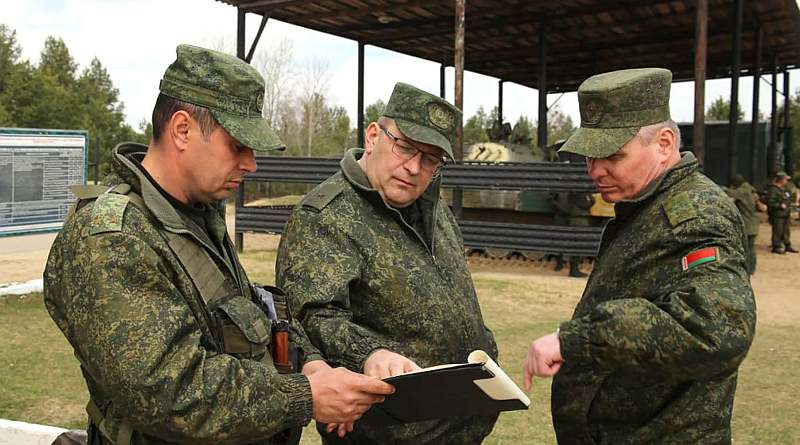

Amid the prolonged war of the Russian Federation against Ukraine and the ongoing pressure from Moscow, Alexander Lukashenko’s signing of the decree to call reserve officers for 2026 appears not just as a “planned event,” but as a worrying symptom. Official Minsk, dressed in the guise of a peacekeeper, continues a quiet but persistent militarization that reveals the shadow of the Kremlin and the fear of a “second front.”
According to the official version from Minsk, the army needs “primary officer positions,” and Belarus requires a reliable mobilization reserve. At first glance, this may seem like a standard bureaucratic procedure. However, as always, the devil is in the details. The call of men under 27, who successfully avoided barracks thanks to university military departments, seems like an attempt to fill the personnel gaps of the Belarusian army with educated, technically savvy youth.
In today’s realities, where the technological aspect of war has reached a new level, “civilians” become a critical resource. This is not just about “filling slots” in the staffing schedule, but an attempt to create a viable core for an army which at any moment may receive deployment orders.
It is impossible to analyze Minsk’s military maneuvers without considering Moscow. Russia, whose manpower losses in the fifth year of its invasion of Ukraine have reached critical levels, desperately needs resources. If not in direct participation of Belarusian soldiers in assaults, then at least in creating a constant threat on Ukraine’s northern borders and NATO’s eastern frontiers.
Russia’s role here is twofold. The Belarusian army is de facto integrated into the Russian military machine. The training of reservists resembles an inventory of assets managed less by Minsk and more by the Russian General Staff.
There is also the topic of political barter. Every “routine” exercise or call is a contribution to the loyalty bank. Lukashenko pays for economic support of the 2020s with “live goods” and infrastructure.
In Belarusian society, the term “hidden mobilization” is increasingly heard. The call of reserve officers is the perfect tool for conducting it without declaring martial law. These people are in positions of platoon and company commanders. Preparing them today, the regime can quickly “put flesh” on this skeleton by calling thousands of ordinary soldiers tomorrow.
The main risk is that the logic of war is often stronger than the logic of a dictator. Lukashenko has skillfully “maneuvered” for years, but by 2026 the room for maneuver has shrunk to the size of a tank tread. By calling the youth, he puts social stability on the line. If these reservists are dragged into a “Russian adventure” beyond Belarus’ borders, the fragile social contract based on the slogan “as long as there is no war” will finally crumble.
Ultimately, the 2026 call is not about the defense of the Brest Fortress. It is about insuring the risks for the Kremlin and preparing for a scenario where Belarus stops being a “balcony” and becomes a staging ground.
For young Belarusians, this decree signals that the status quo of “my house is on the edge” no longer guarantees safety.
