

As of mid-April 2026, the Russians have only managed to create separate breach points along the state border, none reaching the planned 20 km deep into our territory. The implementation of enemy plans is hindered by Ukrainian defense, a resource shortage in Russia, and the high cost of each meter of their advance.
The term “buffer zone” has been one of the key elements of Russian propagandist and military rhetoric since 2023-2024. Formally, Russia explains it as the need to protect border regions (Belgorod, Kursk, and Bryansk regions) from shelling, drones, and raids. In reality, it is a tool for the gradual seizure of Ukrainian territory, creating gray zones, and justifying new offensive actions. This is not about a neutral demilitarized strip by international standards; it is a unilateral advance of Russian troops deep into Ukraine.
The idea of a sanitary zone was first actively voiced back in June 2023. Putin stated that Moscow would consider creating such a zone on Ukrainian territory if shelling of Russian regions did not cease. The depth of the zone was meant to be such that Ukrainian artillery and missiles could not reach Russia.
In May 2024, following the Russian military advance on Kharkiv region, the concept began to be implemented. The Russians attempted to create a “buffer” along the border to “protect Belgorod.” At that time, there were statements about a possible depth of 10-20 km. The actions of Russian units suggested that a “buffer zone” was being created along the border, rather than a deep breakthrough into Kharkiv.
In August 2024, after the start of the Kursk operation by the Defense Forces, this topic reemerged.
On May 22, 2025, from the Valdai bunker, there was again talk of the decision to create a “necessary security zone” along the border. They were already discussing a depth of 15-20 km, especially in Sumy and Kharkiv regions.
At the end of 2025, the enemy’s Chief of General Staff reported that their Northern Military District “already controls about 950 km² in the Sumy and Kharkiv regions, including 32 settlements.” On December 31, 2025, an order was issued from the Kremlin: in 2026, expand the “buffer zone” in these two regions, which became the official task for Russian troops in the northeast.
Throughout 2025, Russian propagandists repeatedly expanded both their consciousness and the size of the “buffer,” frightening themselves with the notion that if the West continues to supply Ukraine with long-range weapons, the “buffer” could reach the borders with Poland or even encompass nearly all of Ukraine.
As of April 2026, the “buffer zone” remains among the priorities of the Northern Military District, which continues to create a 20 km “influence zone” along the border of the Sumy and Kharkiv regions. The Russians employ a tactic of a thousand cuts — by small groups biting off tiny settlements (in the Krasnopil and Velykopysariv directions in Sumy, Zolochiv in Kharkiv), creating new grey zones.
Occupiers systematically seize border villages and heights even where there was no active frontline before. Every such advance is a cut: a small intrusion of 500–1500 meters, fortifying positions and creating a new grey zone. In twelve identified areas, the Russians deploy forces ranging from an assault company to a battalion. Heavy equipment is used minimally, or it does not enter the village immediately — infantry, drones and artillery go first. The goal of each cut is not to seize a large settlement but to expand the zone of influence.
What is the meaning of the zone of influence? To push back artillery positions of the Defense Forces, UAV operator positions, create TV images and other informational effects, maintain a new frontline, shaping an illusion of progress.
In April 2026, a new, previously unobserved threat emerged. Deputy Head of the President’s Office, Brigadier General Palisa, stated that in Russia’s plans for 2026, a point about creating a “buffer zone” in the Vinnytsia region appeared for the first time, i.e., from the side of Transnistria.
What does this look like?
Since the beginning of 2026, Russian troops have advanced in Sumy region by several dozen square kilometers, capturing or partially controlling settlements in the Yunakivka, Krasnopillia, and Velykopysarivka communities. These include villages like Yablunivka, Bezsalivka, and areas near Pokrovka. The depth of advancement reaches one to two kilometers in certain sections, but the enemy constantly tries to expand control using the tactics of small groups, kamikaze drones, and artillery fire.
A similar situation is unfolding in Kharkiv region, where the aggressor is trying to secure itself in the border strip to protect its logistics centers in the Belgorod region.
Vinnytsia region, located deep in the rear, hundreds of kilometers from the front line, represents a separate story in the process of “bufferization.” Theoretically, such a “zone” could become part of a broader plan to destabilize Central Ukraine, creating a threat to logistics and energy infrastructure. However, the contingent stuck in Moldova consists of two light battalions with a total of 56 armored personnel carriers. An attempt by a heavier battalion to storm Defense Force positions near Lyman lasted four hours and ended with a loss of 80% of its weaponry. Vinnytsia’s “buffer zone” will end in six hours. And, likely, the “Pridnestrovian Moldavian Republic” will end in the same timeframe.
The mention of Vinnytsia is more a signal of the Kremlin’s imperial appetites, which no longer hide the desire to “deal” with all of Ukraine. Today, this is a political concept not backed by military force. If Russian plans are scrutinized, “buffer zones” can be found in Mykolaiv and Odesa regions, which, like Vinnytsia, do not share a border with Russia. However, the reality is harsh for the occupants: the lack of personnel, equipment, and resources does not allow them to solve current tasks. What new directions for combat operations?
Why do the Russians persistently push the idea of a buffer zone? Firstly, it is an attempt to create an illusion of victory for internal propaganda. Secondly, to distract Ukrainian brigades from the Donetsk direction, where the enemy has long been unable to break through the defense. Thirdly, to prepare the ground for future negotiations, where the Kremlin will demand “demilitarized” territories.
Already today, it can be concluded that the spring-summer offensive of the aggressor in northern Ukraine has been foiled. The advancement is present but slow and bloody. Every meter of “buffer zone” costs the aggressor hundreds of lives and millions of dollars.
Russians were not the first to invent the concept of a buffer zone. In military history, such zones have often been created to separate parties (for example, in Korea, Cyprus, Gaza Strip). However, in the Russian version, it is not a neutral territory but an instrument of annexation and pressure.
This is how the Kremlin attempts to justify aggression as “protecting its own territory,” create a propaganda image of “victory,” distract Ukrainian reserves from key directions, and prepare the ground for future negotiations where the “buffer” will become one of the requirements.
The Ukrainian side consistently rejects this concept, realizing that it is creeping occupation and the enemy’s appetites have grown from “protecting Belgorod” in 2024 to ambitions to create a “buffer” in Vinnytsia region in 2026. The concept was born as a reaction to Ukrainian strikes but has transformed into a strategy of slowly gnawing away territory. For the Kremlin, the buffer isn’t about protecting national territory but about territorial expansion.
The “buffer zone” in Sumy and Kharkiv regions is not an abstract theory but a daily reality for border communities, where people live under constant fire. Theoretical plans regarding Vinnytsia indicate that the aggressor does not stop at achieved goals and dreams of expanding the war deeper into Ukraine.
As of mid-April 2026, the enemy’s advance is minimal, and the “buffer zone” remains more of a propaganda slogan than a real threat to Ukrainian regional centers.
The tactic of a thousand cuts is not a lightning-fast offensive but a grueling slow war. It gives the Russians small tactical successes and a picture for TV, but costs great losses and does not bring them closer to their strategic goal.
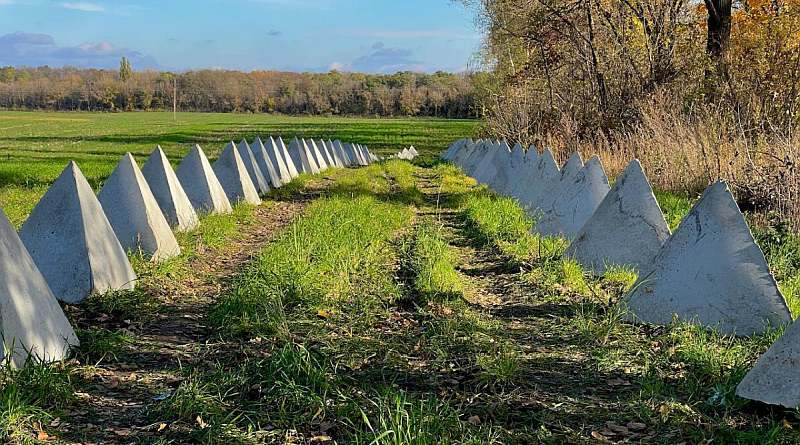
In the image: Fortifications in the Dnipropetrovsk region. Photo: Telegram/Dnipropetrovsk Regional State Administration/Regional Military Administration
