
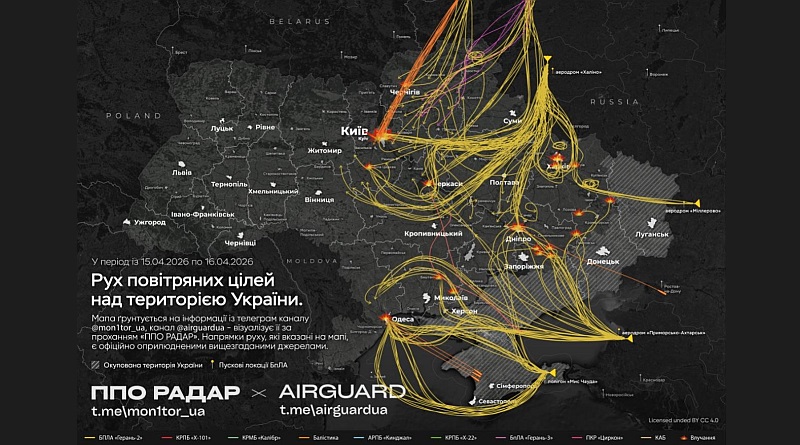

Analysis of the combined strike on April 15. Again unique.
We are dealing with another “pattern break” by the enemy. In recent attacks, they constantly change something (means, time, duration), but this drastic change can be compared to the initial use of Zircon anti-ship missiles from Crimea. If we were previously used to the classic scheme “evening takeoff – dawn launches,” yesterday’s attack became an example of extending the strike over more than 24 hours and, for the first time, launching missiles during the day. To arrive in the evening.
You might immediately recall the daytime strike on Kyiv with cruise missiles when shells hit Okhmatdyt, but that was definitely before lunch. By lunch, hundreds of people were already clearing debris, I saw it personally. For the first time, the Tu-95MS took off at about 2:00 PM, so the cruise missiles would reach us in the evening. Meaning they shifted the missile arrival at targets from morning twilight to evening.
What is this related to? There could be many factors. From special germanium coatings on X-101 missile cameras, allowing them to see the surface below clearly, to the well-known information that at twilight, people and thermal imagers see air targets poorly due to thermal transition. However, our aviation shows that for aircraft onboard radars, these are not difficult targets whether it’s morning or evening. The result, as the classic said, is on the board – 19 out of 20 cruise missiles were shot down in approximately an hour of the combined attack.
When I wrote yesterday evening about the drones striking the distant SNKhZ plant, I mentioned it was too early to analyze the attack since the night was still ahead. And they didn’t delay. They launched 19 ballistic missiles! In two waves, purposefully, even doubling up on targets to: a) hit again if the missiles were intercepted, and b) harm anyone who had already arrived at the missile/debris impact sites. This led to casualties among social services, police, and DSNS. An extremely treacherous and purely Russian tactic against the population. A vile country, nothing more to add.
The interception rate in this case was quite low. 8 out of 19 ballistic missiles. Which is what they wanted. To “drain” the air defense forces for a day, using 659 various UAVs to deplete the rocket reserve of PAC-3 missiles for Patriots. Plus, when you see alerts of a “fast-moving target on Kropyvnytskyi,” it’s likely a strike on the Kanatove airfield, where our aviation’s operational airfield is based.
Conclusions.
This is again a unique strike as the missile attack time was shifted to evening twilight. A new tactic. And it seems our effectiveness did not please them. The next attack will return to nighttime launches.
Time extension. If you calculate the time as the takeoff of the first Shaheds, strategic aviation takeoff, nighttime ballistics, and the last Shaheds in the morning, it’s more than 24 hours for one attack. Maximum exhaustion of crews, people, and equipment.
Ballistic attack in two waves. Extremely fast targets, when at night Kyiv residents couldn’t even make it to shelters. From the launch to the arrival of Iskander – 5 minutes. This is terror and exhaustion of the Patriot PAC-3 missile reserves.
Judging by the fact that Bila Tserkva was hit in warehouse areas near the CHP, perhaps the attackers are still targeting our energy sector, although they should switch to summer targets (water, treatment facilities, bridges, gas). Or maybe they were looking for something in the warehouses.
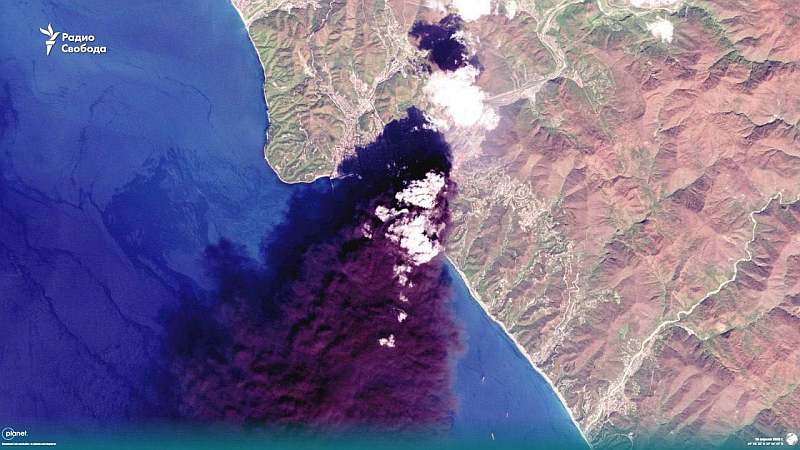
Meanwhile, have a look at how a new seismic zone opened in Tuapse. A new volcano has awakened 😆

On the night of April 15-16, Russia carried out another combined missile-drone strike on Ukraine.
According to the Air Force, 703 attack means were used, including:
• 19 ballistic missiles Iskander-M/S-400,
• 20 cruise missiles Kh-101,
• 5 cruise missiles Iskander-K,
• 659 UAVs of various types.
667 targets were shot down/suppressed (almost 95%). Including:
• 19 out of 20 cruise missiles Kh-101 (95%),
• 8 out of 19 ballistic missiles (42%),
• 4 out of 5 cruise missiles Iskander-K (80%),
• 636 out of 667 UAVs (95+%).
12 missiles and 20 assault UAVs hit, the fate of one more missile is being determined.
The vulnerability remains: ballistics. To counter such a ballistic attack with high chances, 40+ interceptor missiles and enough anti-aircraft missile systems are needed to cover the sky.
Completely solving this problem is impossible, but the percentage of ballistic protection can be significantly increased.
How – has been described a thousand times, but unfortunately, much depends not on Ukraine. Ukraine is doing its utmost: reaching the launch points and production, highlighting sanctions violators.
Consequences of Russian strikes (as of 10:00, unfortunately, as debris is cleared, casualties may increase, plus there are serious injuries):
• Odesa: 9 people killed, 23 injured.
• Kyiv: 4 people killed (including 1 child) and 54 injured.
• Dnipro (city attacked for the third day in a row): 2 people killed, 30 injured; region (Nikopol district): 1 killed and 3 injured.
• Kharkiv: 2 wounded; region (Merefa) – 1 woman killed, 6 wounded.
The nature of the destruction seen by everyone: residential buildings, civilian facilities. In Sumy, a medical facility was affected.
A few days ago, Russians were practically beating their foreheads from overwhelming spirituality, and their leaders literally surrounded themselves with ancient miraculous icons. Having completed their rituals, they almost immediately returned to the routine of war crimes.
Notice there’s been a sharp decrease in talk about “protecting Russian speakers” and “traditional orthodoxy.” Russians are simply killing people in Ukraine, mostly Russian-speaking and Orthodox, because their leaders want to save face and delay accountability, and most other Russians find this comfortable.
This is not just about Russians. I won’t stop repeating, this concerns all Russians. Who either become mercenaries, happily receive money at military factories, or earn from servicing the military machine.
Therefore, the task is to ensure that Russians directly involved in the aggression either physically die or become disabled, and the rest feel very uncomfortable en masse. And they must learn to associate their troubles with the continuation of the war. We need to help with this as much as possible.
Throughout the day, there will be many details.
For now, the main point: as part of an educational effort, good drones visited Tuapse. There is an oil hub with a port in the orbit of “Rosneft” there. Kinetic sanctions have been introduced.
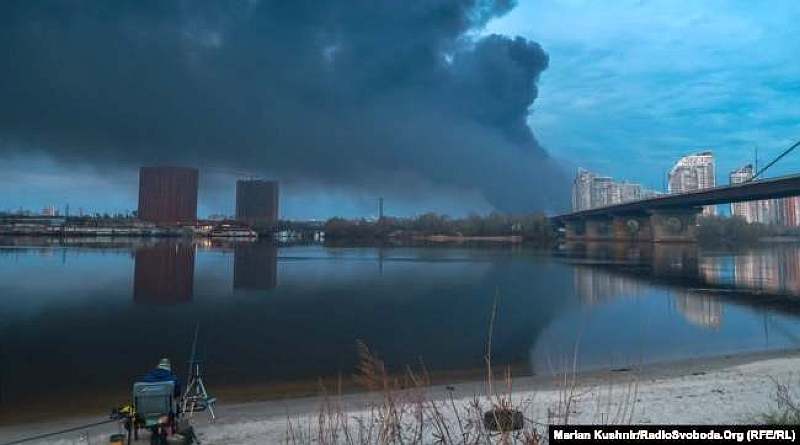

24 hours of terror…
On the night of April 15 to 16, Russian occupiers carried out another 24-hour act of terror, employing hundreds of Shahed-136/BM-35 “Italmas” kamikaze drones and “Gerbera”/“Parody” decoys, along with missile components to strike Ukraine.
From 7:00 on April 15 to 7:00 on April 16, the enemy used the following means:
Drones – 659, of which 636 were shot down (around 400 of them Shahed-136);
Kh-101 – 20 missiles, of which 19 were shot down;
9M723/KN-23/5V55 – 19/8;
9M727/728 Iskander-K OTRK – 5/4.
It’s worth noting that the enemy used the missiles not simultaneously in a concentrated combined strike but with a significant difference in time.
The most victims and destruction were from ballistic missiles, the interception of which remains a major problem either due to the absence of systems capable of intercepting them at the sites of strikes or due to the lack of BK even when systems are available.
At the same time, the interception of cruise missiles showed an extremely high result, and the anti-drone operations reached almost 97%.
The raid from April 15 to 16 represents a 24-hour terror tactic that has been employed by the Russian occupation forces (ROV) more than once. The Russian occupiers accumulate drones in large numbers and then launch the accumulated inventory or part of it, stretching this process over 24 hours or more.
On one hand, this creates an additional effect of moral and psychological pressure and both physical and psychological exhaustion of air defense forces. On the other hand, the reason for such prolonged raids is the lack of sufficient launching platforms for ROV to ensure the deployment of a large number of drones in shorter time intervals.
For example, since April 3, ROV had the opportunity, solely by accumulating from production, to gather more than 1,000 strike means of a combined type. Considering the already expended ammunition in the past day, they have more than 350 units of accumulated inventory remaining.
Nevertheless, despite all the intricacies and a more calculated approach to the use of drones, especially their mass deployment, the main problem for us remains ballistics, which ROV used in a fairly limited manner from the second half of March through the first half of April. Addressing this threat remains just as relevant, as it is one of the means of, in most cases, an inevitable strike.
Countering such raids, which ROV tries to make systematic and regular in their planning, can involve not only passive defense but also active measures—destroying production sites, storage and accumulation facilities, launch platforms, and especially personnel.
