

Information on current losses of Russia due to sanctions as of 06.11.2026.
1. Ukrainian drones attacked the Afipsky Oil Refinery in the Krasnodar region of Russia.
– On the night of November 6, drones attacked the Afipsky Oil Refinery in the Krasnodar region of Russia. According to monitoring resources, a fire broke out on the premises of the enterprise.
– The Afipsky Oil Refinery is one of the largest oil refineries in southern Russia. Its design capacity is about 6.25 million tons of oil per year. The enterprise produces gasoline, diesel fuel, fuel oil, and other petroleum products, which are used, among other things, to support Russian military logistics.
– The plant has repeatedly been a target of Ukrainian attacks. In June 2026, the General Staff of the Armed Forces of Ukraine confirmed damage to the enterprise and a fire on its territory.
2. Oil and gas revenues of the Russian budget rose to a 19-month high due to the rise in Urals prices.
– In October 2026, the federal budget of Russia received 971.2 billion rubles in oil and gas revenues. This is 9.3% more than in the same month last year and exceeded the September figure by 518.8 billion rubles. The revenues were the largest since April 2025.
– The increase was primarily driven by the rise in Russian oil prices. The average price of Urals in September was $92 per barrel and rose to $101.46 in October — the highest level since 2014. Prices were influenced by the escalation of the situation around Iran.
– Revenues from the mineral extraction tax (MET) in October reached 1.122 trillion rubles — 39% more than in September and almost twice as much as a year ago. Another 385.6 billion rubles were received from the additional income tax, which is paid quarterly.
– At the same time, the state returned 415 billion rubles to oil companies due to the fuel damper — a mechanism for compensating suppliers of fuel to the domestic market. Overall support for refiners and the industry also included 139.6 billion rubles in reverse excise tax and 24.3 billion rubles for refinery modernization.
– The increase in oil revenues gave the budget temporary relief, but a significant portion of the funds was directed back to the oil companies. Furthermore, the October result largely depended on the favorable price environment rather than an increase in physical export volumes.
3. Payments to Russian refineries reached their highest level since 2022, increasing pressure on the budget.
– In October, payments to Russian oil refineries for supplying fuel to the domestic market rose to 415 billion rubles ($5.1 billion). This is the highest level since April 2022, when subsidies reached a record 450 billion rubles, according to data from Russia’s Ministry of Finance.
– The payments are meant to compensate oil companies for the difference between more profitable fuel exports and domestic sales. Due to a sharp rise in global oil and petroleum product prices, the volume of subsidies increased from several billion rubles in January to hundreds of billions monthly.
– The primary recipients were large companies, including “Rosneft” and “Tatneft,” which own key refineries. The subsidies also provide financial support to enterprises restoring capacities after attacks by Ukrainian drones.
– At the same time, the government continues to restrict the export of gasoline, diesel fuel, and aviation kerosene in an attempt to prevent a shortage in the domestic market.
– Payments for October accounted for about half of the net oil and gas revenues of the federal budget for that month—829 billion rubles. Overall, since the beginning of the year, subsidies to Russian refineries have approached $20 billion.
– The rise in world oil prices not only increases Russia’s income from raw material exports but also the state’s expenses on supporting the domestic fuel market.
4. Russian regions reduce payments to families of those killed in the war against Ukraine due to budget deficits.
– More than 10 Russian regions have cut payments and benefits to war participants and their families due to lack of funds and insufficient financial support from the federal budget. The cuts affected both compensation for the families of deceased military personnel and regional bonuses for signing contracts.
– Bashkortostan reduced payments the most: by the end of April 2026, aid to the families of the deceased was reduced to 100,000 rubles from 2 million rubles in September 2025. Saratov region cut compensation by 90%—from 1 million to 100,000 rubles. Samara region canceled the payment of 1 million rubles for families submitting new applications, while Belgorod reduced aid from 3 million to 1 million rubles.
– The federal one-time payment to the family of a deceased military servicemember remains at 5 million rubles. Meanwhile, regional support, which local authorities had supplemented since the start of the full-scale war, is gradually being reduced.
– The financial condition of the regions has significantly worsened. While in 2022 their combined budgets had a surplus of 50.6 billion rubles, by 2025 they ended the year with a deficit of 1.54 trillion rubles. The number of regions with deficit budgets increased from 49 to 73. In the first quarter of 2026, the situation with regional revenues remained difficult, and in the summer, local authorities began to cut expenses, particularly on social support. This indicates that the financial burden of the war is increasingly being placed on regional budgets and military families.
5. Russian military satellites might have been rehearsing a scenario for attacking ICEYE satellites, which provide intelligence to Ukraine.
– The Russian military satellite “Cosmos-2612” dangerously approached the commercial radar satellite X36 of the Finnish company ICEYE in mid-October. According to American space analyst Greg Hillinger, this maneuver could have been a rehearsal for an attack on the device.
– ICEYE satellites provide radar images to the governments and military of Western countries, including Ukraine. According to experts, during the close approach, the distance between “Cosmos-2612” and X36 was reduced to about 1 km, and possibly to several hundred meters. U.S. Deputy Secretary of State Thomas DiNanno stated that the maneuvers of the Russian device correspond to actions characteristic of orbital weapons.
– Meanwhile, two other Russian satellites of the same group are approaching the orbit of another ICEYE device — X37. The American company COMSPOC, which tracks space objects, also recorded their movement toward the satellite.
– ICEYE reported that X36 continues to operate, and the company’s satellite constellation is capable of withstanding the loss of individual devices.
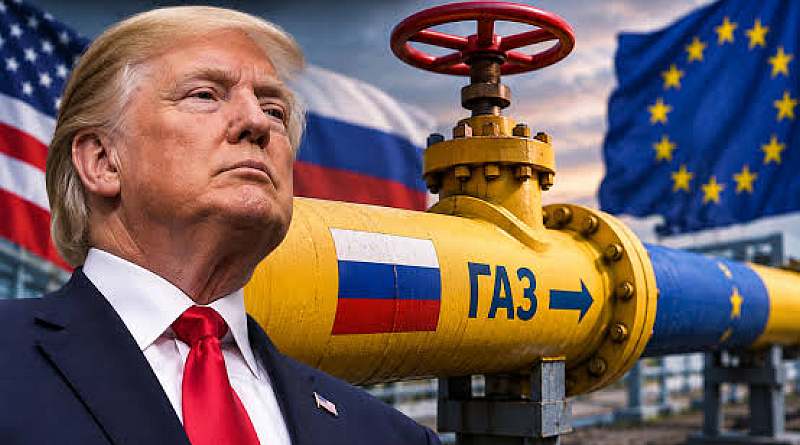
6. The EU rejected Trump’s proposal to resume Russian gas purchases through an American intermediary.
– The European Union does not plan to resume Russian gas purchases, even if supplies to Europe occur through Ukraine with the participation of an American intermediary. Several European diplomats stated this during negotiations in Brussels regarding post-war recovery in Ukraine and security guarantees.
– “The EU fundamentally adheres to the course of refusing dependency on Russian fossil fuels,” noted one diplomat. Another emphasized that there is currently no basis to weaken sanctions against Russia. On the contrary, due to attacks on Ukrainian civilian populations and infrastructure, Europe considers it necessary to increase pressure on Moscow.
– American representatives did not raise the issue of resuming Russian gas purchases during negotiations in Brussels. The idea was promoted by Trump administration officials Steve Witkoff and Jared Kushner. It involves resuming the transit of Russian gas through the Ukrainian gas transmission system, with an American intermediary handling fuel sales.
– Washington views such a scheme as part of a broader economic settlement after the war. It could provide Ukraine with transit revenues and allow Russia to resume gas exports to Europe. However, the proposal contradicts the EU’s approved schedule to completely phase out Russian gas by the end of 2027.
7. Putin transferred the Japanese business of Japan Tobacco under external management.
– Putin signed a decree to transfer the assets of the Russian subsidiaries of Japan’s Japan Tobacco to “temporary management” by a local company. This concerns four production facilities of the largest cigarette manufacturer in the Russian market. Japan Tobacco confirmed the transfer of factories to external management and stated they are assessing the consequences for the group.
– Japan expressed a protest to Moscow and demanded the decision be canceled. This was announced by the country’s Finance Minister, Satsuki Katayama. The largest shareholder of Japan Tobacco is Japan’s Ministry of Finance. Japan Tobacco holds about 37% of the Russian tobacco market. Last year, a quarter of the company’s operating profit came from Russia.
– According to Ukrainian authorities, in 2023, Japan Tobacco paid $182 million in taxes to the Russian budget and was the fourth-largest foreign taxpayer in the country.
– The transfer of assets is occurring amid deteriorating relations between Moscow and Tokyo. In October, Japan imposed sanctions against dozens of Russian companies and individuals connected to the military-industrial complex, as well as 35 ships from Russia’s shadow fleet.
– Other sources of tension include Putin’s visit to the Kuril Islands and the detention of a Japanese journalist in Russia. Meanwhile, Japan maintains its involvement in the “Sakhalin-2” project, crucial for its energy security, influencing Tokyo’s approach to winding down business in Russia.
8. Hungarian OTP Group cannot sell its Russian bank and withdraw profits from the country.
– The Hungarian banking group OTP has not found a buyer for its Russian subsidiary, OTP Bank, and the Russian authorities have blocked another dividend payment to the parent company. This was stated by the group’s CEO, Péter Csányi.
– According to him, selling the bank requires an investor who can negotiate with Moscow and offer a market price. However, finding such a buyer has not yet been possible. OTP finds itself in a situation where it cannot either withdraw the profit accumulated by its Russian subsidiary or sell the asset on acceptable terms.
– The Russian bank continues to operate, with over 80% of its deposit portfolio belonging to European and American companies that maintain operations in Russia. Csányi emphasized that the group does not intend to hand over a functioning bank to the Russian economy for free.
– At the same time, restrictions on dividend payments and difficulties in finding a buyer effectively keep OTP in the Russian market, not allowing it to freely manage its earned funds.
– This situation demonstrates how Russian authorities use regulatory constraints to retain foreign companies’ capital in the country, even without the formal nationalization of their assets.
