

I congratulate the American people on the midterm elections to the Congress of the United States. It was a true political competition and a convincing demonstration of the strength of American democracy.
The American voter has spoken. It is important that the new political balance in Washington becomes an impetus for strengthening the strategic partnership and bipartisan support for our country, as well as for further developing dialogue with all key institutions and political forces in the USA. We must build consistent and professional interaction with all key American institutions and political forces — Congress, the White House, Republicans, and Democrats. This is about systemic diplomacy focused on long-term relationships, sustainable partnerships, and common interests. The reliability of these connections largely determines Ukraine’s defense capability — regardless of the election results or political changes in Washington.
This serves as the bipartisan foundation of our strategic partnership. For many years, we have consistently worked to strengthen it. Bipartisan unity and solidarity of the United States with Ukraine not only best meets our shared interests but also serves the interests of the United States itself and the entire transatlantic community.
In the new stage, one of the primary tasks should be forming a strong Ukrainian caucus in the House of Representatives and the Senate, capable of advocating for support for Ukraine with renewed energy.
We must promptly activate systematic inter-parliamentary interaction — direct contacts between congressmen and senators, cooperation among inter-factional groups, and coordination of relevant committees. Another important direction should be deepening party ties, primarily between Ukrainian and American political forces with established sisterly relations. All this should contribute to developing joint solutions for strengthening the Ukrainian-American partnership. We are ready to begin this work immediately.
No less important is the immediate appointment of the Ukrainian ambassador to Washington. This is required by the current moment, the scope of strategic partnership tasks, and the need to effectively counter the Russian threat.
The Kremlin hoped for a weakening of American support for Ukraine and pressure on Moscow. These calculations should become a strategic mistake. Launching the sanctions mechanism provided for by the Graham law would be a clear signal: the United States will not reduce pressure, and continued Russian aggression will have an increasingly higher cost.
Our common interest is not just to cease hostilities, but to achieve a just and lasting peace that will prevent new Russian aggression and guarantee the security of Ukraine, Europe, and the entire democratic world.


Defeat of Trump, defeat of Putin
The results of the midterm elections for the US Congress, in which the Democratic majority gained control over both houses of the Capitol, indicated a fundamental shift in the balance of political power in Washington. By securing 53 seats in the Senate and over 60% of the seats in the House of Representatives, the opponents of the executive branch led by President Trump have gained real leverage to block any decisions by the White House.
The public acknowledgment of defeat by the current head of the American state, which sounded highly unexpected after loud threats to block legislative work with a veto, reflects the forced acceptance of the new rules of the game. Previously, the presidential administration insisted on the intent to act without regard to opponents, but subsequent contacts with the Democratic leaders confirmed the inevitability of negotiations.
The collapse of hopes for unilateral Republican rule deals a significant blow to the diplomatic calculations of the Kremlin leadership, which had long relied on the foreign policy unpredictability of Washington.
As legislators traditionally advocate a tough stance towards aggressors, the bipartisan control of the Democrats creates an unwavering barrier against attempts to reduce pressure or limit support for Ukraine.
Official Moscow loses its main bet on backstage deals aimed at freezing military actions on terms favorable to the Kremlin. The convincing success of the opposition showed that the American electorate rejected a course allowing authoritarian regimes to buy time and manipulate internal disagreements in the USA.
The loss of full control over the Capitol will force the presidential team to coordinate appointments, budget expenditures, and international commitments with congressmen who are firmly committed to defending democratic institutions.
The Russian regime, eagerly anticipating a paralysis of the American administrative system, once again faces the risk of the revival of a unified Western front ready to consistently increase economic and military pressure.
The definitive defeat of the Republican platform undermines the Kremlin’s scenario of destabilizing the transatlantic alliance. Moscow’s attempts to wait out the current crisis through American elections turn into a futile gamble, as the renewed Congress guarantees long-term and unwavering bipartisan support for Kyiv.
The onset of a period of bipartisan containment deprives the ruling elite in Russia of cherished hopes for a split among Ukraine’s partners, turning the Kremlin’s foreign policy strategy into a set of ineffective illusions.
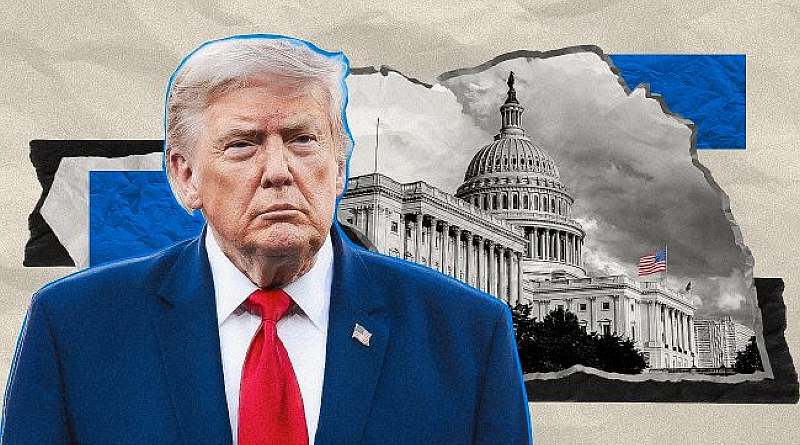
Collage: RBC-Ukraine
