
Anne Applebaum, The Atlantic / Translation by iPress
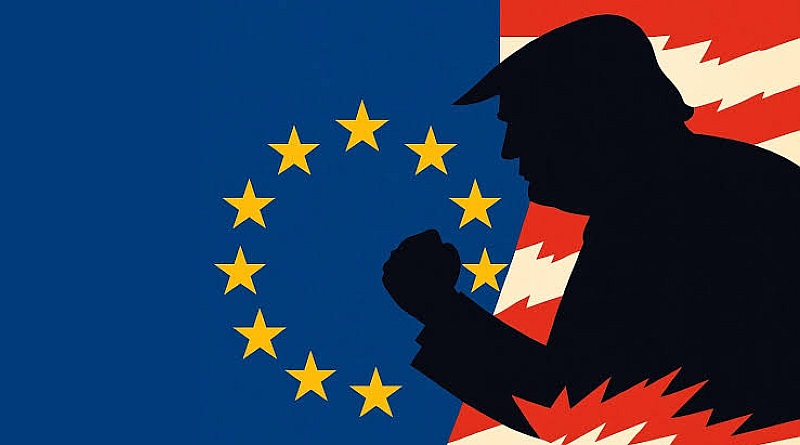
In a column for The Atlantic, Anne Applebaum describes how the Trump administration is increasingly openly interfering in the internal politics of the United States’ European allies. According to the author, Washington has diverged from traditional support for democracy as a political system and instead promotes forces ideologically aligned with the MAGA movement, including pro-Russian parties. Using examples from Poland, Romania, and Germany, Applebaum demonstrates how American officials and Trump allies, as reported by media and politicians, attempted to influence coalitions, elections, and inter-party contacts. She sees this as contradictory: the US calls on Europe to strengthen defense, yet supports politicians who oppose rearmament, aid to Ukraine, and European cooperation.
In March, at a dinner in Athens, then US ambassador to Greece Kimberly Guilfoyle, as Applebaum writes, made a statement that the author considers both arrogant and threatening. According to reports from The Wall Street Journal and Financial Times, Guilfoyle mentioned the problems of the Romanian government coalition and took credit for its future collapse: “We can do this with any country if we want. We can do it here too.”
Later, Guilfoyle found herself at the center of another scandal. The WSJ editorial team also obtained screenshots of messages in which she allegedly asked a Republican Party donor to transfer $100,000 to her American Express account. Guilfoyle and her lawyer denied everything, including the words allegedly spoken at the dinner. However, as Applebaum notes, the scandal proved too serious even for the Trump administration, and the ambassador resigned.
According to Applebaum, if Americans were most outraged by Guilfoyle’s alleged self-interest, Europeans were more alarmed by her boasting about the ability to influence the coalition politics of democratically elected governments of allied NATO member states. The author emphasizes that Guilfoyle was not the only representative of the Trump administration who apparently attempted to exert such influence.
Applebaum reminds us that the US previously supported democracy in Europe as a system, recognizing the legitimacy of elected politicians from the left to the right center. In contrast, the current administration and its business circles, in her view, prefer certain parties ideologically aligned with MAGA, even if they openly sympathize with Russia. Other European politicians, the author suggests, gain Washington’s favor by being willing to advance the commercial interests of its entourage. In at least three cases, according to her reports, Americans tried to persuade elected European leaders to replace government coalition partners with those more to the White House’s liking.
The first example is Poland. Applebaum notes that her husband, Radosław Sikorski, is the Minister of Foreign Affairs of this country, and his party is the largest force in the government coalition. At the same time, Applebaum emphasizes that she does not disclose any non-public information and relies on reports from Polish media, including far-right publications. According to these reports, Trump hinted to the leader of one of the two other coalition parties that he should change his political camp.
This concerns Defense Minister Władysław Kosiniak-Kamysz, leader of the small agrarian Polish People’s Party. In the spring, he attended a ceremony in Washington for awarding the Medal of Honor to an American soldier who saved a Polish soldier in Afghanistan. After the event, organized by Polish activists linked to MAGA, Trump reportedly pulled Kosiniak-Kamysz aside and suggested that he would be treated much better in Washington if he left the current coalition and negotiated with Polish nationalist and far-right parties. The minister ignored this advice. The Atlantic reached out to the White House for comment but had not received a response at the time of publication.
This was not the first display of political sympathies from the Trump administration in Poland. During the 2025 presidential campaign, far-right candidate Karol Nawrocki visited Washington, where he was endorsed by Trump. After Nawrocki’s victory, the American president repeatedly credited himself for the result, as he did after some elections in Latin America. However, Applebaum finds the alleged request of the US president for an allied country politician to change coalitions particularly alarming. She compares such pressure to the times when Soviet leaders decided which Polish communists should govern the country.
Another example is Romania. Applebaum notes that Guilfoyle, while serving as ambassador in Athens, was surprisingly well-informed about the details of Romanian politics. At the end of March, at a business conference in Bucharest, she promoted the “vertical gas corridor” – a system of pipelines between Greece, Romania, Ukraine, and other Southeast European states. Guilfoyle had no previous experience in the field of gas infrastructure, but as ambassador, she became an active supporter of the project. Christos Marafatsos, a lobbyist for the Greek Aktor Group interested in the corridor, accompanied the ambassador so frequently that, according to WSJ, some foreign officials mistakenly assumed he was her chief of staff. The Aktor CEO spoke at the conference immediately after Guilfoyle.
Guilfoyle supported not only the construction of gas infrastructure but also the purchase of American liquefied natural gas (LNG) – both directions of interest to Aktor. The then Romanian Prime Minister Ilie Bolojan supported the gas pipeline itself, which he later confirmed, but did not want to commit to long-term obligations to purchase LNG. Reasons included uncompetitive pricing and Romania’s plans to export its own gas.
Meanwhile, some Romanian politicians supported the purchase of American LNG. During the same trip, Guilfoyle was recorded on video at a dinner in a fancy Bucharest restaurant with Sorin Grindeanu – leader of the Social Democratic Party and Bolojan’s coalition partner – as well as other politicians. One of those present, a former energy minister, was interested in importing American gas and reportedly approached the prime minister and president with a corresponding proposal.
During the next two months, Grindianu’s Social Democrats left the governing coalition and later joined with Romania’s far-right party to support a vote of no confidence against Bolajan’s centrist-liberal government, forcing it to resign. Grindianu categorically denied any influence by Gilfoyle or other Americans on his decision. The leader of Romania’s far-right, George Simion, a pro-Russian politician who has been building ties with MAGA influencers, called himself a “good friend” of Gilfoyle but also denied her influence. Despite these denials, notes Applebaum, suspicions remain in Romania about the role of the American diplomat.
According to the author, the peculiarity of the Romanian government’s downfall lies in the cooperation of the nominally center-left party with the far-right. In doing so, they broke the so-called “cordon sanitaire” – a political rule to avoid governmental alliances with parties linked to fascist ideology. A similar principle operates in Germany, where the Christian Democratic Union (CDU) governs together with the center-left Social Democrats. Some German politicians, writes Applebaum, suspect that the Trump administration would like to see a CDU alliance with the pro-Russian far-right “Alternative for Germany” (AfD), some representatives of which have ties to neo-Nazis. For many Christian Democrats, such a coalition would be a departure from the fundamental values of the party, created after World War II as a counterbalance to extremism.
Instead of direct appeals to the CDU leadership, Trump supported the AfD on his Truth Social network. Congratulating the party on its victory in recent regional elections, he wrote: “THEY ARE GAINING STRENGTH and are no longer going to tolerate it!” Elon Musk, who is close to the Trump administration and a major donor to the Republican Party, remotely participated in an AfD event before the last Bundestag elections. According to Applebaum, due to the significant weight of Musk’s posts in X algorithms, such participation effectively became large-scale free advertising for the party.
Applebaum also recalls another episode, which has already been written about earlier. At the beginning of the year, a delegation of German deputies from various parties arrived in Washington for meetings at the Pentagon and the State Department. According to a high-ranking representative of the CDU, they were told that only CDU and AfD deputies would be allowed into the buildings, but not Social Democrats and other members of the delegation. The CDU representatives ultimately also refused to enter. The party leadership took this episode as a signal that Washington recognizes AfD as the only acceptable partner for the CDU.
According to Applebaum, this incident demonstrates the Trump administration’s disregard for German democracy and exposes a contradiction in American foreign policy. On one hand, Washington urges Europe to build up its own armed forces. Speaking at NATO headquarters last summer, U.S. Deputy Secretary of Defense for Policy Elbridge Colby stated that allies must “take primary responsibility for the defense of Europe with conventional forces.” Germany, Poland, and Romania, the author emphasizes, have taken this requirement seriously.
On the other hand, the Trump administration, as assessed by Applebaum, supports parties and leaders who oppose defense spending or cooperation, sympathize with Russia, or question European borders. AfD co-chair Alice Weidel opposes military aid to Ukraine and European defense cooperation. Another party co-chair, Tino Chrupalla, called for the withdrawal of American troops from Germany. Romanian far-right leader George Simion previously advocated for restoring Romania’s borders as they existed before 1940, which would include modern-day Ukrainian territories. Polish far-right groups, according to the author, increasingly reproduce anti-European and anti-Ukrainian narratives prevalent in Washington and Moscow, undermining the idea of a joint European defense.
Thus, Applebaum concludes, Washington simultaneously encourages European rearmament while supporting political forces that hinder it. Previously, Europeans could rely on principled American support for democracy as a system and their opposition to Russia and other authoritarian regimes. Now, in the author’s view, some in the administration are primarily driven by commercial interests, while others may pursue even more dangerous political goals. Applebaum ends the column with a rhetorical question: does America want Europeans to build large armies and then destroy European institutions and hand these armies over to nationalists? The author reminds that similar policies have already been tried in the 20th century—with catastrophic failure.
