
Marc Champion, Bloomberg / Translation iPress
Bloomberg Opinion columnist Marc Champion, who writes about Europe, Russia, and the Middle East, emphasizes that the Trump administration is rapidly losing the leverage that has ensured the US’s exceptional role in global politics for decades. Overreliance on economic pressure, commercial incentives, and threats weakens Washington’s ability to secure concessions from partners and adversaries. Ukraine and Iran reveal the limits of this transactional approach: once leverage is used or lost, it ceases to function as a means of deterrence. Meanwhile, the US still has resources that can restore some influence – notably critically important for Ukraine, the Patriot interceptor missiles, and the possibility of transferring production technology.
President Donald Trump views the art of geopolitics primarily as a matter of money and leverage. Thus, he relied on businessmen to do the work of diplomats in Gaza, Ukraine, and the Persian Gulf – and they have failed. As Ayatollah Khomeini once said, the revolution that founded the Islamic Republic of Iran “was not about the price of watermelons.”
This miscalculation does not necessarily have to be decisive. Money remains an extraordinarily powerful tool (it is impossible to fight for long without it), and thanks to a significant reserve of “soft power,” the world’s largest economy, and the most powerful armed forces, the US has long had a unique ability to persuade other countries to act in the desired direction. However, Trump’s inability to control the wars in Ukraine and Iran points to an increasingly serious problem: American leverage is weakening, and he himself accelerates its destruction.
This may seem paradoxical since Trump applies pressure more openly and severely than probably any of his predecessors, whom he portrays as weak. Just look at his tariff policy and how he has used allies’ economic and security dependence to make them pay more. Or at how the US uses dollar dominance for pressure through sanctions – a policy that spread widely under former President Barack Obama and gradually prompts governments worldwide to try to reduce their dependence on the American currency.
Yet in geopolitics, leverage works best when it doesn’t actually have to be used: once it’s used, it can be lost, and at best, it becomes merely a tool of punishment. A striking example is Trump’s increasingly acute trade war with Canada. Another is his February decision to attack Iran. The threat of American air power had long been leverage deterring Iran from closing the Strait of Hormuz or even openly pursuing nuclear weapons. Once Trump ordered a strike, from which Iran tried to shield itself, Tehran lost the incentive to restrain itself.
This mix of wasted advantages and excessive reliance on commercial incentives accelerates the decline of the US’s global dominance, which arguably began with the excesses after 9/11. This was evident again this week when Trump suddenly claimed that under his predecessor Joe Biden, the US allegedly gave Ukraine $300 billion for the war with Russia and added that he intends to demand the return of this money – if not from Kyiv, then from Europe.
This will not happen, if only because this figure is fabricated. Likewise, Trump’s statement on Monday that Kyiv and Moscow had supposedly agreed on a ceasefire regarding strikes on each other’s energy infrastructure was false. It seems this “agreement” came as news to both parties: the exchange of drone and missile strikes continues. Meanwhile, it’s important to understand why the president chose this moment to promote such fabrications.
The short answer, of course, is the midterm elections. Trump’s war in Iran is unpopular in the country, and he is looking for ways to distance himself from its negative consequences. That’s why on Monday he wrote on Truth Social that he asked Ukrainian President Volodymyr Zelensky to stop strikes on Russian oil refineries and then claimed that it was the Ukrainian strike campaign, not the conflict with Iran, that first drove the price of diesel at American gas stations above $6 a gallon.
Like the $300 billion aid figure for Ukraine, this half-truth aimed to shift blame onto others. Trump’s message is: if the US debt is out of control, if inflation is lowering the standard of living, and American arsenals are depleted, then, as the British like to say: “It’s not me, boss.”
This may be enough to convince wavering American voters in November, but it is unlikely to influence the geopolitical recipients of Trump’s message. By ceasing all new American aid to Ukraine and supplying only the weapons that other Kyiv allies must purchase, he has gradually lost influence over Zelensky’s decisions. It is simply more difficult to force Ukraine to abandon one of its most important military strategies – destroying Russian oil refining capabilities – when Trump sharply reduced the significance of the US for Kyiv’s war efforts.
Moreover, his figures are not convincing. The total volume of all military, financial, and humanitarian aid from the USA to Ukraine over more than four years of Russian invasion as of June was not 300 billion, but 131.5 billion dollars, according to the Ukraine Support Tracker of the Kiel Institute in Germany, which conducts the most comprehensive accounting. At the same time, according to the Congressional Budget Office of the USA, during the first four months of the war with Iran, the USA spent 42.3 billion dollars (actual Pentagon expenses as of August 1 were approximately $38 billion. $42.3 billion is part of a June request by the administration for additional appropriations, which the budget office considers directly related to the war – iPress). This is significantly less, but the rate of expenditure was more than four times higher than in the case of Ukraine, and it has already caused greater damage to US ammunition stockpiles and readiness.
Who Spends More on Ukraine
Total contributions as a share of gross domestic product

Trump’s demand to return his imaginary 300 billion dollars is an attempt to recreate the negotiating power he lost after turning the supply of American weapons to Ukraine into a commercial transaction. His controversial threats and statements regarding Iran should also be viewed in a similar light – as attempts to fill an increasingly large vacuum of influence.
To end the war in Iran, the USA needs to find partners capable of providing the influence Washington now lacks. As for Ukraine, Washington remains an important partner and supplier of critically needed weapons, and although this alone may no longer be sufficient to force Zelensky to change his decision, Trump still has a transactional tool of influence he can use.
Ukraine is desperately in need of Patriot interceptors to destroy ballistic missiles that Russia is currently producing at a pace that should concern not only Ukraine but also Europe and the USA. Despite the reduction in American stockpiles, if Trump can deliver enough of these missiles to make even a slight difference for Kyiv this winter, it will set an example for other allies to follow. He could also renew his previous proposal to allow Ukrainians to produce Patriot interceptors under license. By combining these incentives into one package, the USA could indeed gain sufficient leverage to persuade Zelensky to halt strikes on oil refineries.
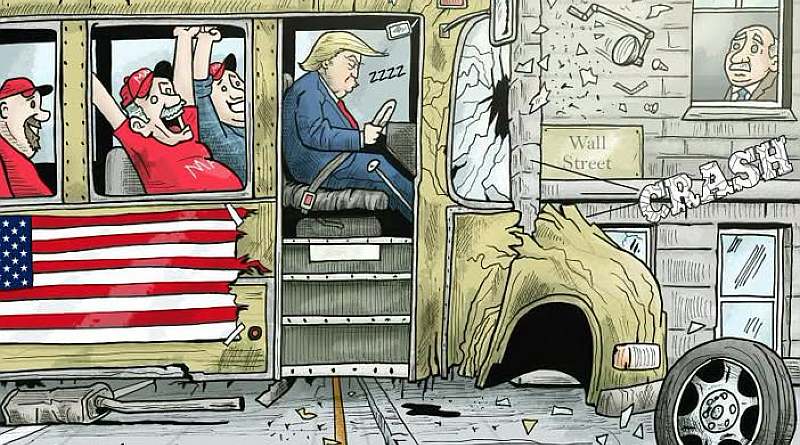
Illustration: Jason Lutes
