
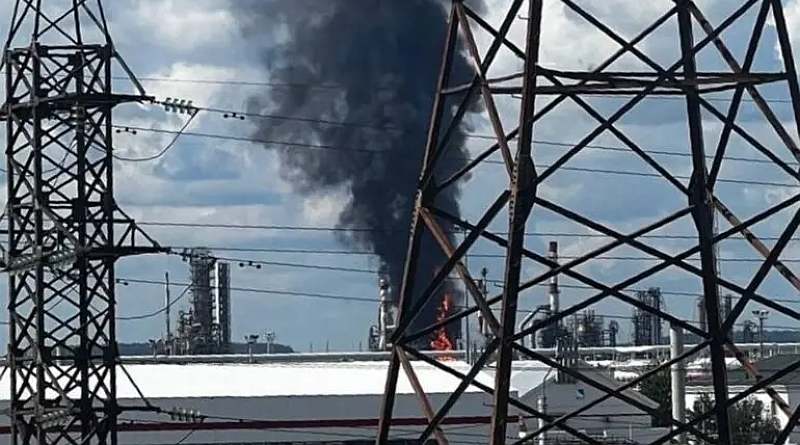
Ukraine and Russia have agreed not to strike energy facilities, Donald Trump reported. Volodymyr Zelensky subsequently stated that he awaits specifics and hopes for an agreement that will last a long time, not just until the elections in Russia.
“Ukraine has agreed not to strike Russian energy facilities. Russia has agreed to do the same,” Trump wrote on his network Truth Social.
He believes that the increase in world diesel prices is mostly caused by the war between Russia and Ukraine, not Iran.
Russia has not yet officially commented on Trump’s loud statement about halting strikes on energy.
And it is still unclear what specific agreements are in question and when they are to take effect.
Trump’s statement appeared on the evening of September 14, when Russia once again attacked Kyiv and its region with drones. Shelling continues in the Mykolaiv, Kharkiv, Zaporizhzhia, and Dnipropetrovsk regions.
Zelensky on a Step Towards Peace
Ukraine is not sure that Russia wants to adhere to any agreement, Zelensky commented on Trump’s statement.
He stated that the country proposed such an agreement with Russia that would stop the destruction of critical infrastructure.
“Food, energy, and other elements of basic life security must be protected, and Russian strikes are primarily aimed at this. Ukrainian energy facilities, port infrastructure, logistics, even food and pharmaceutical warehouses are targeted daily,” the Ukrainian president’s evening statement on social media said.
According to him, if partners are ready to ensure Russia’s “real desire” not to hit electricity or other energy facilities, or food supplies, then Ukraine is ready to “ensure the corresponding absence of our strikes.”
The president expressed hope that this initiative would be long-lasting and not collapse after the Russians hold elections and receive “a reduction in tension regarding gasoline and diesel.”
Elections to the State Duma will take place on September 18-20.
“The war must end. And a de-escalation step regarding critical infrastructure can be the first step towards peace. We expect specifics from our partners,” Zelensky said.
Meanwhile, when asked by the BBC whether the ceasefire statement is not Trump’s invention, sources in the President’s Office noted that “the person is trying to somehow justify what is happening with fuel prices.”
On Sunday, Trump stated that he asked Zelensky to stop strikes on Russian plants producing diesel fuel.
“Zelensky has to do one thing. He has to stop knocking out diesel fuel in Russia. Let him target other places, but not diesel fuel, because it leads to a shortage of diesel fuel,” the US president said during a visit to Ireland.
In recent months, world prices for oil and petroleum products have continued to rise due to the war against Iran, which the US, along with Israel, started in February.
Since then, the Strait of Hormuz, through which about 25% of the world’s oil supply and about 20% of liquefied gas passed, has remained almost closed. Experts consider this the main reason for the increase.
Since the end of August, Russia has been conducting nearly continuous drone attacks on civilian and transport infrastructure in Ukraine. In recent weeks, Russian drones have targeted gas stations, and the railway infrastructure has long been one of the main targets of Russian strikes.

In early September, Donald Trump’s envoys Steve Witkoff and Jared Kushner met with Vladimir Putin in Moscow, and the next day they arrived in Kyiv for talks with Volodymyr Zelenskyy.
After these meetings, the parties stated that agreements had been reached, but promised to provide details later.
In Kyiv, it was also reported that preparations were underway to resume trilateral negotiations involving Ukraine, Russia, and the USA, possibly as early as October.
Analysis: Trump made Zelenskyy a scapegoat, but he himself is to blame for the diesel crisis
Oleksiy Kalmykov, BBC economic analyst:
Diesel fuel is produced from oil at refineries. The main reason for the price increase is that there is less oil and diesel fuel in the world.
There is less because Trump started a new war in the Middle East, not because Ukraine is defending against a Russian invasion and in the process damaged Russian refineries, forcing the Kremlin to ban the export of diesel fuel, which powers tanks and ammunition trucks.
For context: before the war, the world consumed about 100 million barrels of oil and approximately 30 million barrels of diesel daily.
Now — the facts.
Due to the war in Iran, oil exports from the Persian Gulf countries have decreased by at least 10 million barrels per day compared to last year’s level, according to the International Energy Agency (IEA).
Diesel exports have fallen by 1 million barrels.
Due to the war in Ukraine, Russian oil exports over the same period decreased by 0.6 million barrels, and diesel by 0.8 million barrels, according to KSE and Bloomberg data.
In other words, Trump’s strikes on Iran cost the world 11 million barrels of oil and diesel per day, while Zelenskyy’s strikes on Russia cost about eight times less.
The reason for the high prices of oil and oil products is their shortage. The shortage is only partially explained by the precision of Ukrainian drones.
Statistically, 90% of the result is due to Trump’s war with Iran.
