
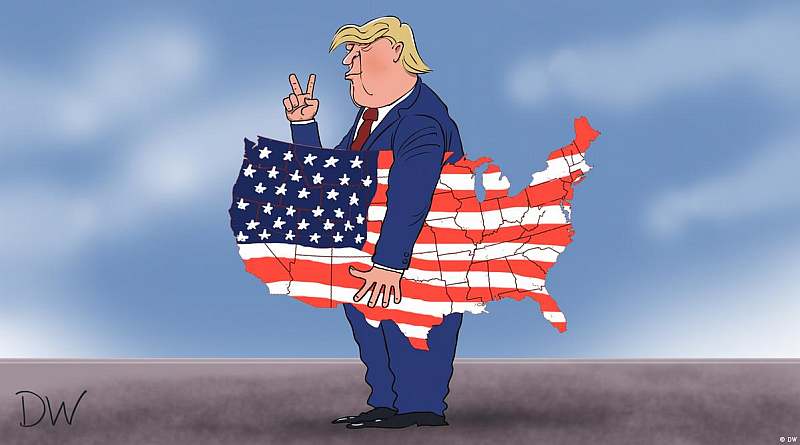
U.S. leadership has suffered a significant blow. Europeans should hope for the best but prepare for the worst.
It was likely a shock for everyone to witness the vile spectacle of American envoy Steve Witkoff fawning over Vladimir Putin this past weekend. Equally shocking was their behavior at a meeting in Moscow, where Witkoff and his equally inconspicuous partner, Donald Trump’s son-in-law Jared Kushner, traveled in a Russian government cortege and used a Kremlin translator.
But many other events are also shocking. Like the relentless Russian drone attacks on Kyiv and other Ukrainian cities, the horrific words and repugnant actions from Washington have become commonplace. Who now remembers the dates or details of the outrageously unfair U.S.-Ukraine investment deal? Or the threats to annex Greenland? Or the strange pantomime at the Alaska summit? Just like the daily presidential rants on social media, these episodes grab our attention only for a moment before they are replaced by the next shock-content.
Recently, two new books were published trying to assemble the news flow into a coherent picture. Journalist Luke Harding’s book “Betrayal: Trump, Putin, and The New Age of Conquest” features vivid descriptions of these and other events. It also explores the deep-rooted issue of Donald Trump’s bizarre one-sided and deferential relationship with the Kremlin. Harding is lost in his conclusions.
However, British security expert Keir Giles in the book “American Overthrow: Moscow’s Endgame in Its Long War with Washington” claims that Trump’s presidency is a Kremlin victory at the heart of the U.S. administration. It concerns not only the president’s personal subservience to Putin. The Trump administration has adopted prominent Russian approaches to power—both internationally and domestically. The greed-driven intertwining of personal and political interests, the weakening of institutions, and false patriotism—all of this is familiar to those who have observed Russia’s decline over the past quarter-century.
This comparison is undoubtedly striking, though some may find it contrived. Optimists believe that midterm elections, if conducted according to the Constitution, will show that the defensive mechanisms of the American system hold up. However, some, including Giles, fear that the administration, even if it loses the election, will not abandon its main goal: to retain power after the end of the four-year presidential term in 2028.
Possibly. But the idea that such a chaotic and talkative person as the current U.S. president could keep serious clandestine relations with a foreign intelligence service for many years seems unlikely. However, it is bad enough that Trump’s behavior merely reflects a narcissistic admiration of strong leaders and limitless ignorance in almost everything else.
Read the books, but do not get too fixated on these issues. It’s intriguing to ponder whether the U.S. president is truly a Russian agent and potential dictator or pretending. But this can lead to paralysis in thought and inaction. The current administration, like many before it, is a divided coalition. It includes serious individuals like CIA Director John Ratcliffe and the tragicomic duo Witkoff-Kushner. Allies must manage as best as they can.
Yet there are other, more important priorities. A positive aspect of the Americans’ trip to Kyiv was that national security advisors from E3 countries—the UK, France, and Germany—arrived to support their Ukrainian counterparts. At the Anchorage summit in 2025, there were fears that the U.S. might make a deal with Russia and force Europeans to impose it on Ukraine. Now that looks less likely: a cynical, neo-Kissingerian division of spheres of influence on such a scale would require coordinated actions and determination, which the White House severely lacks.
The real shock for Europe should not be the antics of the U.S. administration but their consequences: political, military, and diplomatic weakness inflicted by Americans upon themselves, and new, burdensome obligations for their allies.
