

Information on current losses of the RF due to sanctions as of 06.09.2026.
1. On the night of September 6, Ukrainian Defense Forces attacked the Ryazan Oil Refinery.
– A fire is observed in the area of the enterprise. Official confirmation from the General Staff of the Armed Forces of Ukraine regarding the attack results is expected.
– The Ryazan Refinery is part of the state corporation “Rosneft” and is one of the largest oil refining enterprises in Russia. Its design capacity is 17–18 million tons of oil per year, or about 5% of all Russian oil refining capacity.
– The plant produces gasoline, diesel fuel, aviation kerosene, fuel oil, and bitumen, supplying fuel to the central regions of Russia. Its products are delivered to other regions and federal highways through rail infrastructure and pipelines.
– The plant has repeatedly become a target of Ukrainian strikes. After previous attacks, its operations had to be halted.
2. Russian marine oil exports in August fell to the lowest since March.
– In August, Russia reduced marine oil exports by 12% compared to July — to 3.83 million barrels per day. This is the lowest figure since March 2026.
– The main reason was a sharp decline in supplies through the Black Sea. Exports through Black Sea ports fell by more than half — to 380.3 thousand barrels per day.
– Due to increased military risks, the cost of tanker rentals has risen, and some shipowners avoid sending ships to the Black Sea.
– Russia is attempting to redirect flows to the Baltic: in August, exports from there increased by 1.7%, to 1.87 million barrels per day. However, the Baltic infrastructure can no longer fully compensate for the losses in the southern direction.
3. Russian gold has flooded into Hong Kong in record volumes due to Western sanctions.
– In the first seven months of 2026, Hong Kong imported almost 100 tons of gold from Russia — a record volume, nearly three times the figure for the same period in 2025.
– After the US and the UK closed their markets to Russian gold in 2022, Russian producers increasingly redirected exports eastward. Hong Kong and mainland China did not impose similar restrictions.
– Since the beginning of 2022, companies in Hong Kong have purchased Russian precious metals worth approximately 276 billion Hong Kong dollars ($35 billion). A significant portion of Russian gold that arrives in Hong Kong eventually reaches mainland China.
– Chinese buyers also use Hong Kong for storing gold bars due to Beijing’s quotas on gold imports to the mainland.
– Hong Kong is increasingly becoming a key hub for gold trading and clearing. In July, a pilot program for a new precious metal clearing system was launched there.
– The strengthening role of Hong Kong is further supported by logistics disruptions in the Middle East, including issues with the gold hub in Dubai.
4. Russian figure skater Kamila Valieva was stripped of her neutral athlete status.
– The International Skating Union (ISU) revoked the neutral status of Russian figure skater Kamila Valieva. The 20-year-old Valieva can no longer compete in ISU international competitions, earn world ranking points, or vie for world titles. She was informed of the decision by letter.
– In 2024, the Court of Arbitration for Sport (CAS) disqualified Valieva for four years due to a positive test for trimetazidine, taken in December 2021. The disqualification was backdated, so the penalty period ended in December 2025.
– In February 2026, Valieva returned to competitions in Russia after the disqualification ended but was not eligible to participate in the 2026 Olympics in Milan and Cortina d’Ampezzo.
5. The Baltics may block Russia’s grain transit through their ports.
– Latvia and Lithuania are considering restricting or completely banning the transit of Russian grain through their ports following a sharp increase in such shipments.
– Russia has begun more actively rerouting its grain exports to the Baltic Sea due to issues with port infrastructure and shipping in the Black and Azov Seas. In the season from July 2025 to June 2026, Russia exported 46.3 million tons of grain through the Black and Azov Seas — about 90% of all sea exports.
– Meanwhile, by mid-August, applications for rail transport of grain to Russian ports in the Baltics had reached 5 million tons.
– Latvia has already tightened control over the origin of grain transiting to the ports. The authorities are also considering a complete ban on the transit of Russian grain through the country.
– There is particular concern over the potential shipment of grain illegally taken by Russia from occupied Ukrainian territories.
– Lithuania stated that using its port infrastructure for exporting Russian grain is “no longer acceptable.” However, a specific decision on the ban has not yet been made.
– Strikes on Russian port infrastructure and increasing military risks in the Black Sea are forcing Russia to seek alternative routes for grain exports. However, this flow may now face new restrictions in the Baltic countries.
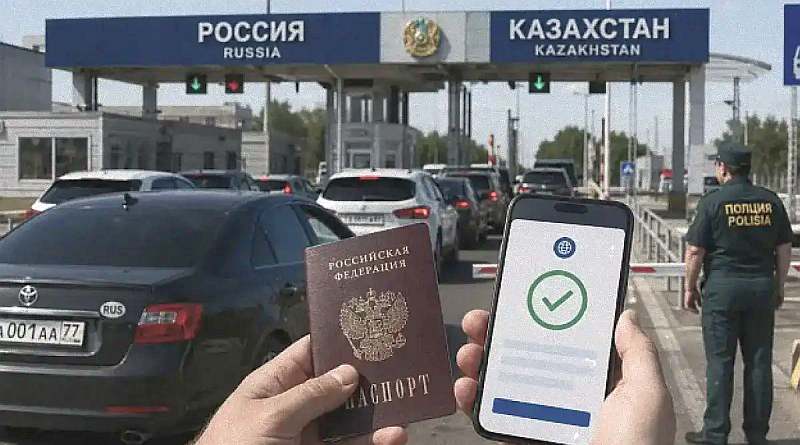
6. Kazakhstan introduced paid entry for Russians amid rumors of a new mobilization.
– Kazakhstan has implemented paid electronic entry permits for citizens of countries with a visa-free regime, including Russians. The QazETA system has been operating in test mode since August 25.
– Until November 1, foreigners will be allowed entry without a permit but will be informed about the new rules. From November 1, the electronic document will become mandatory for those arriving by plane, from November 15 at road checkpoints with China, Turkmenistan, and Uzbekistan, and from November 30 at the borders with Russia and Kyrgyzstan. From December 15, the requirement will extend to railway and sea checkpoints.
– Applications must be submitted at least 72 hours before the trip. The permit will be valid for 180 calendar days and will allow multiple entries. Its cost will be about 3900 tenge (730 rubles) if arranged in advance and about 7800 tenge (almost 1500 rubles) if arranged at the border.
– After the announcement of mobilization in Russia in 2022, Kazakhstan became one of the main destinations for Russians leaving the country. According to the Ministry of Labor of Kazakhstan, over 400,000 Russians arrived in the country at that time, with about 100,000 of them staying. Currently, Russian citizens can stay in Kazakhstan without additional documents for up to 90 days.
