
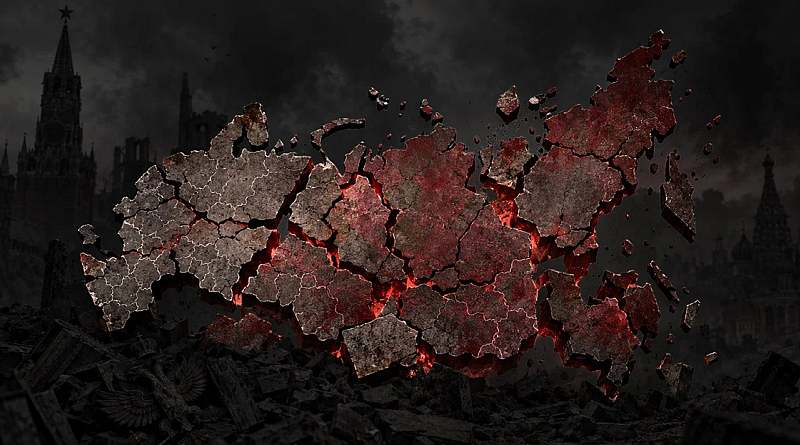
Russian Imperialism as a Source of Global Destabilization
The full-scale military aggression of the Russian Federation against Ukraine is a natural manifestation of Russia’s historical imperial and colonial policy, which has been carried out over many centuries. Propaganda campaigns aimed at denying Ukrainian statehood, genocidal practices in temporarily occupied territories, and the deliberate settlement of Ukrainian lands by ethnic Russians reflect traditional methods of expanding and maintaining this colonial empire.
Despite the obvious destructiveness of such a state model, part of the world’s political elites remain captive to “Moscowcentrism,” artificially separating the actions of the Putin regime from the deep-seated aspirations of Russian society and expressing concern about the possible collapse of the Russian Federation.
Meanwhile, the geopolitical reality of 2026 demonstrates that Russia has become one of the key sources of global hybrid threats. Cyberattacks, arson, sabotage against the communication and energy infrastructure of European states, as well as direct interference in the internal political processes of democratic countries pose a direct challenge to the international security system.
Moreover, the Kremlin is rapidly expanding military and technical cooperation with other authoritarian regimes, particularly with Iran and North Korea.
Manifestations of this integration include the joint development of the “North-South” transport corridor, large-scale schemes of exchanging oil for goods and weapons, and the direct involvement of North Korean military units in the war against Ukraine.
In this context, preserving the Russian Federation within its current borders will only mean a temporary freezing of the conflict, after which the “empire” will inevitably regain strength for new aggression against both Ukraine and other neighboring states. The decolonization and deimperialization of the Russian Federation are the only reliable conditions for ensuring lasting peace.
Origins of the West’s Fear: Historical Trauma of the 1990s and the Myth of Stability
To understand the reasons for the West’s restraint in providing decisive military and political support to Ukraine, it is necessary to analyze the origins of the fear of Russia’s disintegration.
This fear is deeply rooted in the destructive processes of the 1990s that accompanied the collapse of the USSR. In American scholarly circles, particularly in the works of historian Stephen Cohen, the period following the dissolution of the Soviet Union under Boris Yeltsin’s leadership is depicted as a large-scale humanitarian and socio-economic catastrophe. The implementation of radical reforms led to rapid demodernization and impoverishment of the population, resulting in over 70% of citizens falling below or near the poverty line. Amid the financial collapse in the summer of 1998, Western governments faced for the first time in history the phenomenon of a state, overloaded with nuclear weapons, atomic reactors, and dangerous chemical and biological materials, reaching a stage preceding administrative and political dissolution.
It was precisely this threat of uncontrolled proliferation of nuclear weapons and the loss of centralized command over them that forced the West to act with extreme caution, focusing on preserving Russia’s integrity as the lesser evil compared to the prospect of nuclear chaos.
The current Kremlin regime successfully exploits this historical trauma, attempting to present any discussions about decolonization as aggressive anti-Russian propaganda from the West aimed at artificially dismembering the state. Moscow’s official narrative emphasizes that the decentralization of the 1990s was a purely situational anomaly that is forever in the past thanks to the constructed “power vertical.”
At the same time, analysis shows that this stability is deeply illusory. The Russian Federation has not managed to transform into a stable civic state, a functioning federation, or a viable empire. It remains a neocolonial structure, maintained solely by forceful repression, the ideology of the “Russian world,” and temporary cash inflows from raw material exports. Under conditions of strict centralized suppression of any manifestations of alternative political and ethnic identities, destructive factors inevitably accumulate, capable of tearing the system apart from within at the first available opportunity.
Deconstruction of Systemic Risks of Collapse: Expert Debate
Opposition to the idea of the disintegration of the Russian Federation in Western discourse is based on arguments from authoritative researchers calling for extreme caution. Specifically, radical nationalism expert Marlène Laruelle warns that the collapse of Russian statehood will inevitably provoke a series of internal civil wars, where newly created entities will fight over administrative borders and economic resources. According to her, the security forces and Moscow elites, who hold control over the vast nuclear arsenal, will use maximum force to suppress separatism, pushing ethnic regions further into civilizational regression.
This thesis is supported by Kevork Oskanian from the University of Exeter, highlighting the tendency of collapsing empires to crush and annihilate smaller ethnic groups under their weight. The scholar emphasizes that a forced or uncontrolled dismantling attempt could reproduce the scenario of the civil war of 1918–1920, but under conditions of massive saturation of conflicting sides with nuclear weapons and modern means of destruction.
Russian philosopher Ilya Budraitskis adds to this picture with a warning that decolonization cannot be successful without a fundamental reformatting of the consciousness of Russians themselves and overcoming the chauvinistic foundations of their culture; otherwise, new, even more aggressive forms of authoritarianism will emerge in place of the old empire.
Contrary to these concerns, American analyst Janusz Bugajski in his book “Failed State: A Guide to the Breakup of Russia” argues that disintegration is a natural and inevitable consequence of the internal degradation of the Russian Federation. According to his conclusions, the processes of disintegration are accelerated by a set of factors, among which the key ones are:
- Lack of a viable national identity that unites citizens around common values, rather than coercion;
- The fragility of a personalized regime lacking systemic institutional supports;
- Exposure of total corruption and incompetence of the state apparatus during the military campaign against Ukraine;
- Economic regression due to the loss of key European energy markets and sanction pressure;
- Significant military losses and the destruction of the myth of the army’s invincibility;
- Growing dissatisfaction among federation subjects due to harsh financial and resource exploitation by the center;
- Systematic violation of ethnic minorities’ rights and the destruction of regional self-governance;
- Inevitable weakening of Moscow’s control in the event of military defeat in Ukraine;
- Gradual realization by regional elites of the benefits of their own sovereignty over loyalty to the center;
- The general historical trend towards the dissolution of large imperial formations in the modern world.
Valerii Pekar notes that tightening the screws in times of crisis only multiplies internal tension, making the future explosion maximally chaotic.
However, if the disintegration process is managed and supported by an international coalition, most risks, particularly regarding nuclear weapons, can be successfully minimized. Controlled collapse will allow the forging of agreements with new entities, whereby international recognition and economic assistance are granted solely in exchange for denuclearization and adherence to basic legal norms.
The structural-economic dimension of Russia’s disintegration requires special attention from researchers and experts, which is detailed in the works of Doctor of Economics Ihor Lipsyts. According to him, the collapse of the Russian state will result not so much from sudden political upheavals as from the inevitable systemic atrophy of central authority due to the final collapse of the Soviet-Russian raw material economic model. As eastern and Siberian territories become logistically and economically closer to Asian markets, and Moscow loses the ability to financially subsidize regional budgets, the central government loses the main lever to maintain peripheral loyalty.
Geopolitical Opportunity of the Century: Why the West Should Not Fear Russia’s Disintegration
The main fear of Western political elites remains the illusion that preserving an integral Russia is the key to global predictability. However, as Anton Drobovych notes in a work for The Jerusalem Strategic Tribune, the controlled disintegration and pacification of the Russian aggressor is not a threat but the “geopolitical opportunity of the century” for the USA and the European Union.
Key arguments for why the West should overcome this fear and seize the initiative:
- The empire is a source of constant instability, not stability. Preserving the Russian Federation within its current borders guarantees repeated aggressions every 5-10 years.
- Unique “window of opportunity.” Today, Russia is weakened by the war against Ukraine, its military and economic potential is exhausted, and its power structures show vulnerability.
- Neutralization of the authoritarian bloc. A controlled collapse of Russia will undermine the axis of autocracies (Russia – Iran – North Korea – China).
- Exclusive rights and competence of Ukraine. Ukraine possesses unique practical experience in understanding the internal mechanisms, weaknesses, and ethnopolitical map of Russia.
- Control instead of chaos. The West is frightened by the scenario of an “uncontrolled collapse,” but by refusing a proactive strategy, the West increases the likelihood of a chaotic explosion.
Regional and ethnic dimensions of the collapse: North Caucasus, Volga region, and Siberia
The ethnic and regional dimensions of the potential collapse of the Russian Federation demonstrate that the imperial center faces varying levels of national consciousness, readiness of regions for sovereignty, and forms of potential resistance. These processes are most prominently manifested in the North Caucasus, the Volga region, and also in the regions of Siberia and the Far East.
1. North Caucasus
The North Caucasus occupies a special place in the structure of the potential collapse of Russia — a complex ethnoconfessional conglomerate (Dagestan, Ingushetia, Chechnya, Kabardino-Balkaria, Karachay-Cherkessia, Adygea), where Moscow’s colonial pressure has created a critical level of systemic tension.
- Ingushetia and Dagestan: Although the Chechen Republic of Ichkeria traditionally attracts the most attention due to the experience of two wars in the 1990s, equally serious disintegration processes are unfolding in Ingushetia and Dagestan. In Ingushetia, an organized movement is growing for the restoration of sovereignty and the return of territories, effectively annexed by Chechnya according to the controversial 2018 border agreement with Chechnya. As noted by leaders of the Ingush independence movement, the region has a high mobilization potential of a population dissatisfied with Russian authority due to its strong clan structure, memory of the 1944 deportations, and land conflicts. In Dagestan, the crisis is deepening due to a harsh mobilization policy: the use of representatives of indigenous peoples as “cannon fodder” in the war against Ukraine led to the most powerful protests in 2022, exposing the rift between the society of the autonomy and the imperial center.
- In this context, the significance of the so-called “Kadyrovites” is often exaggerated. There are major doubts that they will form the future liberation army of Chechnya or the Caucasus. Kadyrov’s formations are the personal guard of the dictator, built on subsidies from Moscow. In the event of a weakening of central authority, only a small part of these units (those serving under coercion or out of desperation) might join the liberation movement or disband.
2. Volga region
Moving from the Caucasus to Inner Eurasia, the Volga region (Idel-Ural) should be noted, where national consciousness has deep historical roots.
- Bashkortostan: A clear indicator of the growth of the Bashkir national movement and the level of readiness for resistance were the events of January 2024 in Baymak. The sentencing of Bashkir public figure Fail Alsinov triggered the largest unauthorized protests in Russia since the beginning of the full-scale invasion. The number of protesters reached about 10,000 people, while the population of Baymak is 17,700. Alsinov had long consistently opposed the exploitation of Bashkortostan’s natural resources by Moscow companies and sharply criticized the mobilization, claiming that the war in Ukraine does not align with the interests of the Bashkir people and is effectively a hidden genocide of indigenous peoples.
- Tatarstan: Unlike Bashkortostan, where the protest has a pronounced popular and anti-colonial character, Tatarstan possesses the highest level of ready institutional and economic infrastructure for autonomous existence among all the republics. Although the Tatar elite currently demonstrates outward loyalty to the Kremlin, Tatarstan has a powerful administrative apparatus, developed industry, and a memory of the sovereignty of the 1990s. In the event of Moscow’s weakening, Kazan is capable of quickly taking control of its own resources, becoming the locomotive of the disintegration of the Volga region.
3. Siberia and the Far East
Moving further east, two main scenarios for the development of the subjects of Siberia and the Far East can be distinguished:
- National republics (Sakha-Yakutia, Buryatia):
- Sakha (Yakutia): Demonstrates the highest level of readiness for independent statehood among Siberian regions. Yakutia has a clear ethnic self-identity, vast territory, rich resource base (diamonds, gold, gas), and experience in defending its interests in the 1990s. During that time, Yakutia’s local elite gained control over the diamond mining giant “Alrosa.” The money received went directly to the region, ensuring the “post-Soviet emancipation of the Sakha people.” Yakutia even adopted its own Constitution (1992), proclaiming regional ownership of natural resources before the adoption of the all-Russian constitution.
- Buryatia: Faces a more complicated situation. On one hand, high Buryat losses in the war against Ukraine have created deep dissatisfaction with the Kremlin. On the other hand, the high demographic proportion of ethnically Russian population and strong economic dependence on subsidies hinder the rapid growth of independent self-determination. In the event of central collapse, Buryatia will likely need to find a balance between creating a national state and joining new regional unions.
- Regions with predominantly Russian populations (Siberian and Far East alternatives):
- In areas where ethnic Russians constitute the majority (Krasnoyarsk Krai, Irkutsk Oblast, Primorye), the national factor is absent, but there exists a strong “Siberian/Far East regionalism.” The level of self-awareness here is based on the economic factor: for years, Siberia’s wealth has been siphoned to Moscow, leaving regions with environmental issues and poverty. If national republics choose the path of self-determination, these territories are likely to follow the path of creating resource-oriented technocratic state formations (similar to the Siberian or Far Eastern Republics), whose main goal will be to retain income from the exploitation of minerals in the region and direct trade with the Asia-Pacific region and the USA.
An important legal-political precedent in the international assessment of the Caucasian dimension of Russia’s decolonization was the adoption by the Verkhovna Rada of Ukraine of Resolution No. 2672-IX dated October 18, 2022, “On the Statement of the Verkhovna Rada of Ukraine on the Condemnation of the Armed Aggression of the Russian Federation against the Chechen Republic of Ichkeria, the Occupation of its Territory, and the Crime of Genocide of the Chechen People.”
In addition, the Ukrainian parliament has taken significant steps in support of other peoples in the region by adopting a Resolution on recognizing the right of the Ingush people to create an independent state and a Resolution condemning the genocide of the Circassian people (Adyghe) perpetrated by the Russian Empire. These decisions laid the legal foundation for the decolonization of the entire Caucasus.
International Legal Legitimation and the Role of Ukraine
The process of decolonization of the Russian Federation is gradually moving beyond a purely theoretical expert discourse and is taking on the characteristics of an official international legal trajectory. A key event in this context was the adoption of Resolution 2588 (2025) by the Parliamentary Assembly of the Council of Europe on January 30, 2025. This document explicitly calls on member states of the Council of Europe to seek the implementation in the Russian Federation of the Declaration on the Granting of Independence to Colonial Countries and Peoples, adopted by UN General Assembly Resolution 1514 (XV) on December 14, 1960. Thus, supporting the national self-determination of the oppressed peoples of Russia is officially recognized as being in accordance with the fundamental principles of international law and the interests of long-term peace. Furthermore, the step is based on a number of previous European institutional decisions, including the European Parliament Resolution 2024/2579, PACE Resolutions 2540 (2024) and 2558 (2024), as well as relevant declarations of the OSCE Parliamentary Assembly.
At the national level, Ukraine is already demonstrating leadership in legislatively strengthening this course. On July 15, 2024, the Verkhovna Rada of Ukraine registered draft law No. 11402 “On the Basic Principles of State Policy of Ukraine on Interaction with the National Movements of the Colonial Peoples of the Russian Federation,” signed by 81 members of parliament from all parliamentary factions.
Scenario Modeling and Comparative Analysis of Russia’s Future
To prepare informed recommendations for Western political elites and to alleviate their fears about the collapse of the Russian Federation, it is necessary to conduct a comparative assessment of the existing scenarios of developments within the Russian territory. Notably, one such analytical model has been developed by the Clingendael Institute of International Relations. Attention should also be paid to Janusz Bugajski’s concepts.
Comparison of Scenarios for the Socio-Political Situation in the Russian Federation

Probable Political Landscape of Future Subjects
The notion that a “belt of democratic states” will immediately emerge on the ruins of the Russian Federation is a dangerous illusion and wishful thinking. Democratic systems will not appear everywhere. The political landscape after the collapse will be extremely diverse and will depend on the historical context, religious factors, elite structures, and the economic resources of the regions:
- Northern Caucasus: The formation of secular Western democracies here is unlikely. At best, in some republics (for example, in Cherkessia or part of Kabardino-Balkaria) a symbiosis of traditional customary law (adat), moderate Islam, and democratic institutions may develop. In contrast, in Dagestan, Chechnya, and Ingushetia, there is a high probability of the emergence of conservative religious Islamic (and in some areas, even radical Islamist) states. This is due to the high level of religiosity of the population, the decline of secular institutions during years of Russian rule, and the significant influence of the Muslim factor in opposing the imperial center.
- Volga region (Tatarstan, Bashkortostan): The most likely outcome is the formation of hybrid or national-authoritarian regimes with a gradual transition to secular democracy. These republics have a strong administrative elite, a high level of urbanization, and industrial potential. Islam here is moderate and secular in nature, so religious radicalism is unlikely, although struggles for resources and borders between neighboring republics may maintain tight centralization of power.
- Siberia and the Far East (Sakha-Yakutia, Buryatia, potential “Siberian Republic,” “Far Eastern Republic”): The emergence of resource-oriented technocratic or corporate-oligarchic autocracies is expected here, which may later transform into pragmatic secular states under external influence (USA, Japan, China). The main motive of these entities will be control over their own resources and direct trade with the external world without Moscow’s intermediaries.
- Western/Central (ethnically Russian) part: In place of the imperial core, there is a high likelihood of the emergence of a revanchist-authoritarian state (“Moscovia”) under the control of security forces or ultranationalists. Overcoming the imperial complex at the center itself will take decades, so expecting rapid democratization of the Russian core is not realistic.
To prepare balanced recommendations, it is necessary to consider this diverse spectrum of potential future regimes.
Conclusions and Recommendations
The analysis indicates that attempts to artificially preserve the territorial integrity of the Russian Federation to avoid transitional chaos are a strategic mistake for the West and an existential threat to Ukraine. Maintaining a colonial empire under any political scenario leads only to a short-term respite before the next stage of aggression.
Instead, a managed dissolution and decolonization of Russia can permanently remove the nuclear threat, eliminate energy blackmail of Europe, and provide freedom to oppressed peoples. The West should accept the reality that in place of the RF, a diverse conglomerate of entities will emerge — from secular democratic and technocratic republics in the Volga region and Siberia to conservative Islamic states in the Caucasus. A pragmatic policy of containment, denuclearization, and diplomatic engagement with each type of regime separately is a much safer alternative than maintaining a single aggressive nuclear empire.
To shape effective international policy in this direction, the following steps are required:
- Development of a coordinated strategy: The USA, United Kingdom, and European Union countries, together with Ukraine, need to develop a comprehensive action plan in case of the disintegration of the Russian Federation, rejecting the logic of maintaining the status quo.
- Diplomatic engagement with regions: Initiate official communication channels with representatives of national liberation movements of oppressed peoples and regional elites demonstrating a desire for sovereignty, using the legal framework of PACE Resolution 2588 (2025).
- Establishment of denuclearization mechanisms: Declare that the mandatory condition for lifting sanctions from new state entities and providing them with financial assistance will be the full transfer of nuclear weapons and materials under strict control of international institutions, as well as joining the 1968 Treaty on the Non-Proliferation of Nuclear Weapons.
- Adoption of relevant legislation: The Verkhovna Rada of Ukraine is recommended to urgently adopt Bill No. 11402 (or an equivalent), creating a precedent for state support of liberation movements of colonial peoples of the Russian Federation at the level of national legislation.
- Economic pressure on imperial institutions: Intensify sanction policies, focusing on blocking the technological development of the Russian nuclear sector (particularly the “Rosatom” corporation) and the final cessation of all oil and gas transit operations, depriving the Kremlin of the ability to corrupt European political elites.
- Institutionalization of contingency planning (Track 1.5 / Track 2): Create a joint interagency working group to analyze risks with the participation of experts from the USA, EU, and Ukraine. The main task should be the development of practical response scenarios in case of destabilization of the Russian Federation — from monitoring nuclear facilities and preventing weapon leakage to coordinating actions in case of loss of central authority control over certain regions.
- Involvement of Ukrainian expertise as a practical bridge: It is advisable for Western partners to utilize Ukraine’s unique practical experience in understanding the internal mechanisms, ethnopolitical map, and vulnerabilities of the Russian Federation. Ukraine can serve as a mediator in establishing initial dialogues between Western security institutions and constructive representatives of regional elites and national movements that share a non-violent path of transformation.
- Systematic legal assessment of RF’s colonial practices: Consistently promote the legal assessment of Moscow’s colonial policy towards indigenous peoples on international platforms (UN, PACE, OSCE). Ukraine’s experience — particularly the Resolution of the Verkhovna Rada No. 2672-IX regarding the recognition of Ichkeria as a temporarily occupied territory — should serve as a legal and analytical foundation for developing international mechanisms to protect the rights of oppressed peoples.
- Formation of a “carrot and stick” framework for new regional entities: Formulate clear and understandable conditions for potential new state formations on the territory of the Russian Federation: prospective international recognition, lifting of sanctions, and economic assistance will be provided exclusively in exchange for complete denuclearization, renunciation of territorial claims against neighbors, adherence to human rights, and guaranteeing the security of critical infrastructure.
