
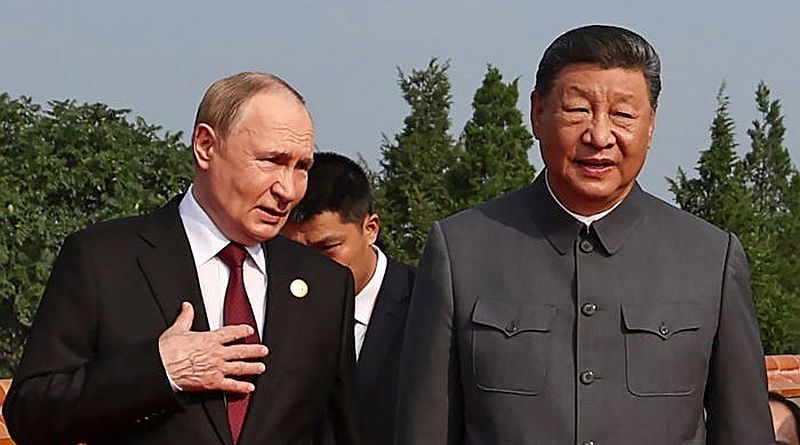
Alicia García-Herrero is the Chief Economist for the Asia-Pacific region at the investment bank Natixis and a Senior Fellow at the Bruegel think tank. She spoke with Tyzhden about the asymmetry of the Russia-China partnership, the growing dependence of Moscow on Beijing, and Europe’s dual-track policy towards Russia and China.
— There is a claim that the partnership between Russia and China is deeply asymmetrical, and this asymmetry works in a way that Russia loses its sovereignty while China takes advantage of it. Do you believe this is true?
— Of course, these relations are very asymmetrical. And Russia, being well aware of this, is making every effort to preserve its sovereignty in various ways.
If you look at the Xi Jinping and Vladimir Putin summit in May 2026, despite numerous statements about good neighborliness, equal partnership, and mutual respect, it is evident that Putin did not achieve his main goal – securing the approval of the “Power of Siberia–2” project. This refers to the second pipeline that was supposed to supply Russian gas to China. This indicates that Putin was probably not ready to agree to all the terms required by Beijing. But there were also questions regarding the price: China insisted on gas prices close to domestic Russian prices, which means extremely low.
But why did this happen? Because of the asymmetry of these relations. I think there is a limit to this asymmetry that Putin does not want to cross. Another thing that China, in my opinion, sought was broader access to the Arctic.
Yes, Putin needs China, and yet he cannot cede a large part of sovereignty. This is precisely why Putin sometimes turns towards the United States — feeling cornered in these relations.
— Do you think there is resistance from the Russian elites? Does Putin feel any pressure on how he builds the partnership with China?
— Of course. But I would not limit the resistance only to the elites. It is also worth including the manufacturing sector in Russia.
If you produce cars or anything else that China massively exports to Russia, you would ask for protection. That is why there are tariffs on electric vehicles in Russia – significantly higher than in Europe, although few people know about this. They were once canceled, then reinstated… China pressures Putin, and this intensifies hostility among the elites in Russia.
I think there is an ideological current in Russia that believes turning to Asia is the only way out since relationships with the West are already lost. But even among representatives of this current, I notice an increasing openness to other parts of Asia.
Look at the relations with Modi. It is clearly a turn within a turn – away from China, but still within Asia. So this pressure exists.
— Despite the increase in trade volumes between Russia and China since 2022, we see two facts. First, China refuses to transfer technology to Russia and only sells goods. And second, China does not invest in production in Russia. What does this mean for their relationship?
— Frankly, this is what China does everywhere. I understand that Russia is not Iran and is in a stronger position, but it is a very similar model.
The transfer of technology is indeed limited and selective. It mainly concerns the supply of dual-use goods, which does not imply the capability to produce them. For example, we can mention microelectronics, CNC machines, and components for drones. But this does not give Russia the ability to produce them if these technologies are cut off for some reason. I think that historically, Russia has also been cautious about selling its sensitive systems such as certain engines, technologies for submarines, or hypersonic weapons.
We know there is one contentious issue. I mean the situation with the People’s Liberation Army of China (PLA) — and I’m not talking about the last purge in China in January 2026, but actually around 2024. That purge was related to Putin’s complaint to Xi, claiming that technologies were seized by the PLA without permission.
Thus, there is also a dual concern here. China does not want to transfer technologies and wants Russia to become absolutely dependent on dual-use goods. But, in addition, China wants to push — even today — for the transfer of military technologies from Russia. And I think Putin is quite worried that this is happening without his leverage.
In my view, Putin feels an even greater need to leverage whatever remains in terms of technology transfer towards China to become less dependent on dual-use technologies from China. The game is somewhat different and very complex, and I am ready to assert that it makes the relationship very unstable because it is truly asymmetrical. It’s like a game of poker: who will play these cards better to gain more.
— Let’s move to the European perspective. I want to refer to the thesis you expressed in an article co-authored for a Kiel Institute report. There is a statement about the dual-track structure that Europe should adhere to in its policy towards China and Russia. Could you elaborate on this?
— China often figures as a party facilitating the war against Ukraine, but there are many other topics that fill the agenda of relations between Europe and China. Some of them are negative, and we all know them: the shock of “China 2.0” for Europe, — but there is also cooperation on climate. There are many issues.
I can confidently say that for many years, Ukraine was usually at the forefront. Something like: “Alright, we cannot discuss other issues. We first need to state our policy regarding your relations with Russia.” First China-Russia and then our own issues. But over time, especially after Trump came to power, dialogues with China involved rhetoric directed at the USA: “The USA is doing more for Russia than we are.”
For me, this dual-track means: alright, there are things we want to discuss regarding China beyond the issue of Russia — I understand, that’s one track — but we must maintain another. No conversation can happen without this dual-track approach. You cannot block negotiations with China because, in my opinion, it is now too important for Europe. Because duality does not mean a division into “good” and “bad.” It means a division into “related to Russia” and “not related to Russia.”
The concept of a dual-track will encourage not to forget and to check that you are discussing this dual influence of China on Europe: one through Russia and Ukraine, and the other directly. That’s why, in my opinion, it is important to keep it in mind.
— Regarding the possibility that Europe might find itself in a situation where it lifts sanctions against Russia in the future. What do you think needs to happen for this to occur? Should Russia pay reparations or take some other radical steps?
— I’ll start with the sanctions against China. Europe has imposed sanctions on several of their banks. They are all very limited, but quite costly in the sense that China always retaliates with counter-sanctions. China does not want to be perceived as a recipient of sanctions from Europe.
Every time Europe imposes sanctions on China — announced in January, I can also recall March 2021 — China retaliated by tripling the sanctions and extending them to European research centers like MERICS and even to European parliamentarians. Imposing sanctions on China is quite costly or risky.
Then, of course, the question is: remember when China used to ask Europe to lift sanctions on Russia? That’s no longer happening. And why? Because, in my opinion, a weakened Russia suits China just fine. They — again, returning to the key point — still think that Russia has something to offer China.
I think Putin has been very careful not to exhaust all his leverage, and therefore pressure from China to lift the sanctions is quite muted. And because it’s important in our negotiations with China now — Europe is negotiating with China on issues of overcapacity, in essence — one might assume that China would use its leverage to protect Russia. But that’s not happening.
If Europe does lift sanctions against Russia, it must happen on its own terms, as there is currently not enough pressure from anyone. Therefore, it means that these sanctions are very hard to lift without a decision from Russia, namely to end the war on terms that, in my opinion, are acceptable for Europe and Ukraine. That is important.
If this changes and Putin plays his cards with anything — say, giving away the Arctic to appease China or something similar — then Ukraine might feel more pressure because China could use this leverage to influence Europe. Again, it’s really like a game of poker. How much is Putin willing to give for China to exert pressure on Europe, and will China agree to this?
China desperately needs exports right now. And therefore, its rhetoric towards Europe is changing and becoming somewhat more positive. Earlier China used to say, “I have nothing to negotiate about this. Take it or leave it, you can’t do without me anyway.” Now it speaks more cautiously: “Okay, but you need me, so I might as well forget about this trade war.”
But China knows that the situation in Europe is deteriorating sharply. Look at the 100,000 people Volkswagen has to lay off. China is no longer in a strong enough position to use its leverage to help Russia unless Russia gives everything. And even then — since the Chinese economy is really not feeling its best, except for exports — it would be costly for China.
In a certain sense, this is a beneficial position for Ukraine. Now everything truly depends on Europe. Look at Starmer. He was essentially told, “You spent too much time on international matters.” This, to be very frank, is mainly Russia and Ukraine. So I think that because of this political capital, Europe cannot lift sanctions without some kind of victory—otherwise, what would you tell your taxpayers or your voters? A lot really has to happen for these sanctions to be lifted.
