
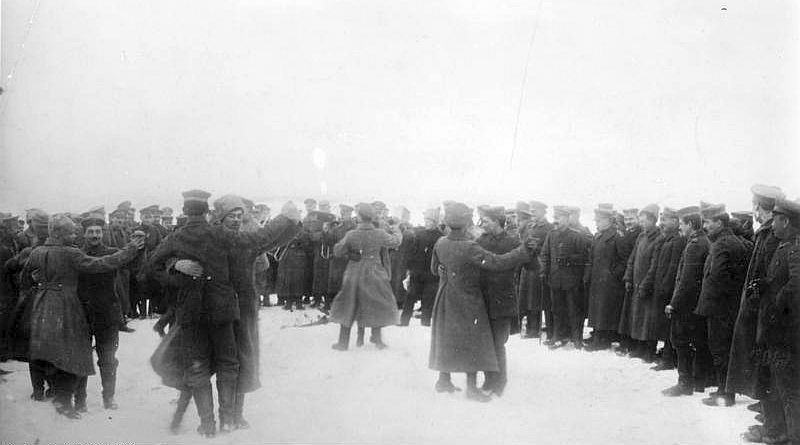
The well-known writer Roman Gul, who was an officer in the Russian army during the First World War and later joined Hetman Pavlo Skoropadsky’s troops and was deported by the UNR Directorate to Germany, described in detail in his memoirs and novels the so-called “fraternization” of Russian soldiers with German army servicemen after the February Revolution of 1917.
It began with stacks of newspapers appearing near Russian trenches, printed in poor Russian – but clear enough to convey that the “landowners and capitalists” were interested in the war, and that “common people” must put an end to it. After reading these simple words, the “common people” ran to enemy trenches, drank with the Germans, embraced, and exchanged items. When officers asked soldiers if they realized that their German “brothers” only came out of the trenches on orders from the command, since there was no revolution in Germany and strict discipline was maintained in the troops, they encountered aggression and a reluctance to think about the meaning of what was said. People in the trenches – like the entire Russian Empire – were tired of the war and wanted to believe that the enemy sincerely desired its end as well.
Bolshevik agitators played a special role in this degradation of the front and society, appearing in large numbers after February 1917 and, unlike representatives of “traditional” political parties who urged the military to fulfill Russia’s obligations to its allies, repeated word for word what could be read in German propaganda newspapers – that the “bourgeois” government was interested in the war, that “common people” did not need it, and that landowners and capitalists should fight. This was Lenin’s political program, well-known from Ukraine’s 2019 election campaign. Therefore, immediately after the October coup, Lenin proposed to the assembly of deputies to adopt a decree on peace – the first legislative act of the Bolsheviks, calling for negotiations on a just democratic peace.
Lenin’s problem (as well as Zelensky’s problem 100 years later) was that the enemy had no intention of ending the war – on the contrary, it sought to use the rise to power of politicians who desired peace and propagated the idea that their predecessors were interested in continuing the war, to ultimately destroy the adversary. The terms of Germany’s peace proposals in 1918, like the terms of Russia’s peace proposals after the change of power in Ukraine and then, after the failure of Putin’s “blitzkrieg,” were purely a program for such destruction.
The Bolshevik regime was saved by the continued struggle of the Entente countries, even without Russia’s participation, as well as by the destabilization within Germany itself, paradoxically provoked by Berlin’s efforts to destabilize Russia – because the ideas used for such destabilization proved dangerous for the German monarchy as well. This is the same “black swan.”
We are also approaching the flight of such a swan, as the collapse of Russia’s economic potential may call into question its ability to continue the war for an extended period – and our Armed Forces are working so effectively on this that even Donald Trump has noticed their results.
What might prevent us from surviving and winning could, however, be the same thing that led to Russia’s actual defeat (which was supposed to be among the victorious countries) in World War I: internal societal degradation. Now, more and more people, as we see, are reverting to the ideas of 1917 or 2019—that the government itself is interested in prolonging the war and simply does not want to end it by finding a “common language” or compromises with Putin.
This is classic nonsense. Just as Lenin in 1917, Zelensky in our time does not seem interested in continuing the war—although he does seem interested in strengthening his own power, but these are not one and the same. However, Kaiser Wilhelm and Putin do appear interested in continuing the war, because they see optimal conditions for imposing their terms on the enemy. And the propaganda of the “bourgeois war” is one of the important tools intended to ensure victory.
Russia after February 1917 was not a “country of landlords and capitalists”—it was a country whose inhabitants had a historical chance to dismantle the empire, and make political and economic changes. But for this, it was necessary to unite and end the war—the collapse of Kaiser Germany was just months away… Wilhelm lost the war, but destroyed the chances of the peoples of Russia, who received the Bolshevik version of the empire—lawless, repressive, and criminal. Tens of millions of victims, confiscated land, state enterprises, a new war, living in darkness…
By 2026, Ukraine increasingly resembles Russia of 1917 in terms of attempts to divide us. Yes, we may have an ineffective government—but the alternative to our influence on this government can only be Russian occupation. Yes, we have not created effective mobilization mechanisms—but the alternative to a strong Ukrainian army is the Russian army. Yes, many may not like the decline of democracy and freedoms—but we can completely return to restoring democratic norms only if we preserve the state and nation. And this is something we can do only together.
Of course, if we agree that Ukraine is needed by all of us and is worth fighting for. If we understand that preserving the country that the enemy wants to remove from the map is our common task. If we are able to reject the Bolshevik nonsense about “simple” and “not simple” in favor of our shared responsibility. If we remember that in democratic countries there are no “simple” and complex, there are only citizens. Responsible citizens.
And if there are no citizens—then there will also be no Ukraine.
There will be Russia.
