
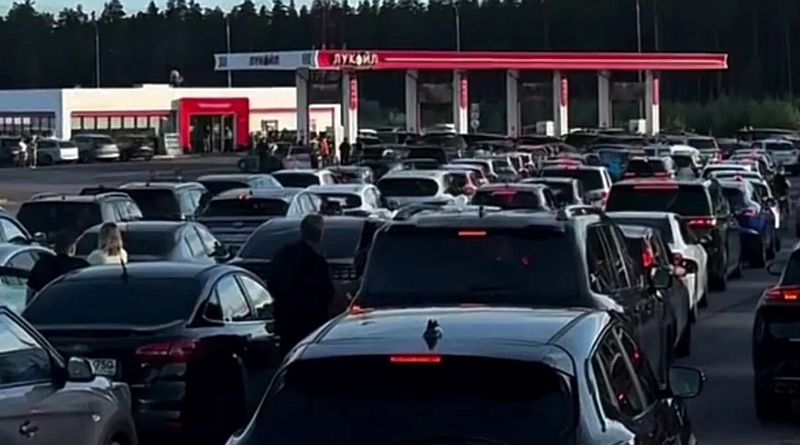
Throughout June, the Defense Forces hit 11 Russian oil refineries, disabling about 42.74% of the aggressor’s oil refining capacity. The result is expected: a fuel shortage in many regions. Just last week, the good drones visited the largest in the southern region Slovyan Oil Refinery, Yaroslavl Oil Refinery, the main lubricants producer of the Russian Federation Ufa Oil Refinery, and Lukoil-Nizhegorodnefteorgsintez Oil Refinery in Kstovo.

The Defense Forces are carefully and consistently targeting oil refineries, export terminals, and pump stations, forcibly reducing Russia’s oil refining capacities. Since January, kinetic sanctions have been imposed on oil refining facilities in Tuapse, Volgograd, Saratov, Yaroslavl, and Rostov regions.
According to Bloomberg, in April, the total output of the refineries in the gas-station country fell to the lowest daily average since December 2009. Almost all major refineries in central Russia have ceased or reduced refining volumes, with affected refinery capacities representing over 30% of gasoline production.
We do not lose focus on middle strikes, which reduce the enemy’s logistics capabilities to transport the gasoline that Russia can still produce.
Separately, let’s focus on the visit of Ukrainian UAVs to the Lukoil-Nizhegorodnefteorgsintez oil refinery — one of the largest petrochemical complexes in Russia: processing over 17 million tons of oil, producing 5 million tons of gasoline, 5 million tons of diesel, 2 million tons of fuel oil, and half a million tons of bitumen. Analyst Oleksiy Kopytko writes that a month and a half ago, the plant began building a unit for the production of methyl tert-butyl ether — a high-octane additive.

The Defense Forces’ headquarters don’t just study satellite photos from allies and decide in the morning: why not fly to Yaroslavl? They say it’s been a while since we’ve seen smoke from there… The work is actually incredibly meticulous and systematic.
Currently, they are working against the infrastructure of major oil pipelines. And the needle of the oil giant is in the egg, that is, in the linear production-dispatch stations (LPDS) and oil pumping stations (OPS). For instance, from the “Lukoil” refinery in Nizhny Novgorod, a pipe leads to the LPDS “Starolikeevo” (a structural unit of “Transneft – Upper Volga”). Ten years ago, Transneft invested in modernizing the LPDS to increase pumping volumes because “Moscow needs gasoline.” The “Gorky – Ryazan-2” pipeline was reformatted into a product pipeline: they added connections to supply fuel to Moscow. To have something to pump, four tanks of ten thousand cubic meters each for gasoline and diesel were added at LPDS “Starolikeevo.”
Since oil was found in Drohobych earlier than in Tyumen, specialists in its pumping appeared in Ukraine as far back as the times of the Austrian General Staff. And their descendants, who studied well at IFNTUNG, concluded that LPDS “Starolikeevo” is the key to the lock of fuel supply to Moscow.

Then good drones simultaneously visited the “Lukoil-Nizhegorodnefteorgsintez” refinery and LPDS “Starolikeevo”. The result was completely asymmetrically reflected on the price boards at gas stations in Moscow. At “Starolikeevo,” a strong fire is not visible, as it hit the control room. Which cannot be assembled with domestic “Baikal” processors. This will take a long time.
For a complete picture, note that the allure of SVO is mostly known to Muscovites and guests of the capital through rumors, and suddenly, something like this arises! Prices are set as desired, and trading substandard goods is a know-how from the times of the clandestine oil refining during the First Chechen War. How long the enemy capital’s transport will last on such fuel is an open question. It is hoped that there are more spare parts for repairs in stock than usual, at least Chinese ones.
Additionally, such LVDS and NPS are in the Yaroslavl, Vladimir, Nizhny Novgorod, and Volgograd regions. They will be found and visited.
There is no fuel shortage as happened in 2025 for now, but Belgorod, Kursk, Moscow, St. Petersburg, and others have started to limit sales. It may fully manifest by the end of July (optimistically) or by the end of summer (a more cautious forecast).
What is happening in the occupied territories of Ukraine is already described with the term “acute crisis.” The traditional behavior of the imperial center is to take from the outskirts, primarily from temporarily occupied territories.
They reached the frontline. Limited distribution began, with cans handed out for generators, and diesel is severely lacking. Production has dropped by 20%, so behind the cemetery wall on Red Square, they’re considering whether to limit or ban diesel exports (40% of what was produced was exported annually). The fuel situation in TOT is the result of the synergy of deep and middle strikes, and everyone sees the outcome. Clearly, our planners worked well and coordinated, and the executors implemented it successfully.
We observe the holiday season in Crimea. There is information that the enemy not only managed to restore the air defense system there but also replenished stocks of anti-aircraft missiles. In the latest raids, we lost more UAVs than expected.
On the screen: Line at a gas station in Moscow, June 2026. Photo: Occupier media
