
Vitaly Portnikov / The Times of Israel
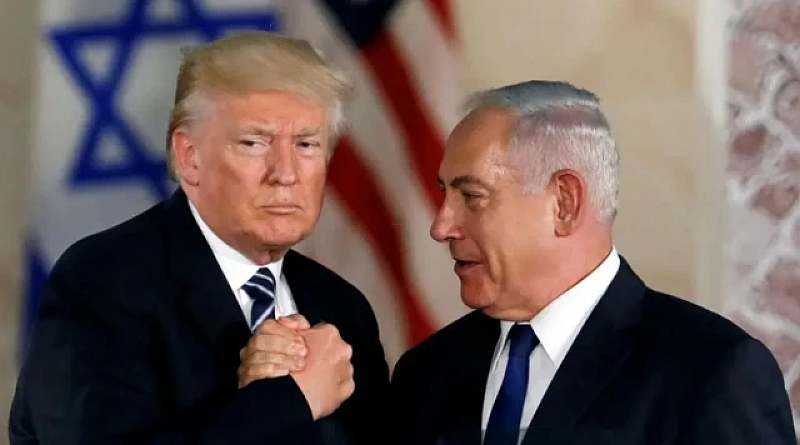
Throughout almost the entire 2024 US election campaign and the first year of Donald Trump’s new presidency, I literally had to fend off my American and Israeli acquaintances who were convinced that my criticism of the new American president was solely due to his stubborn unwillingness to help Ukraine and his rejection of the previous administration’s approach. Whereas for Israel, Trump’s presidency is the most advantageous political project in history, as Prime Minister Benjamin Netanyahu unambiguously stated.
In response, I tried to explain that I only believe in partnerships based on values, not benefits. If people share common values, if countries share common values, they will adhere to common approaches. If these shared values are absent, the approach can change at any moment and with regard to anyone.
I believed that the administration of Joseph Biden supported Ukraine not because it was interested in resources or strengthening America’s role in Europe, but because it wanted to uphold the priority of international law, the impossibility of annexing foreign territory, and a big state imposing its vision of the future on a neighboring country. This is the role of the United States as a leader of the democratic world: not to seek control over foreign oil or minerals but to promote the maintenance of a civilized world order. For only in such a civilized world can the United States feel secure.
I thought that the same approach should be applied in the case of Israel. The United States should support Israel based on its right to exist and protect it from those who deny it that right. It’s not about controlling Iranian oil and US influence in the region. It is primarily a matter of justice, a question of a peaceful Middle East where people do not fight but build a civilized common future.
And I would like to note that the previous president virtually sacrificed both his own chances and those of his associates for reelection when he refused to harshly condemn Israel during the Gaza war amidst the radicalization of sentiments in his own party and among his own voters. Because for the sake of values, one should not be afraid of defeats.
It seemed to me that this was a universal approach. That if it is not adhered to, political failure is inevitable. I was mistaken not in my understanding of this, but in counting on the same understanding among people engaged in politics, journalism, business. And it turned out that many of them, in the literal sense of the word, have lost their moral compass—and even business acumen.
The first alarming sign did not even sound when Donald Trump was reprimanding Ukrainian President Volodymyr Zelensky in the Oval Office. In fact, the point of no return was crossed when American paratroopers captured Venezuelan dictator Nicolas Maduro, yet no one in Washington even considered restoring Venezuelan democracy or transferring power to those who won the last elections in that country. When Trump became a partner of the Venezuelan authoritarian regime and demanded a Nobel laureate’s medal from opposition leader Maria Machado.
It seemed clear even then: anyone willing to negotiate with the Venezuelan regime could at any moment negotiate with the Iranian regime, if it proves capable of surviving and dictating its will. If the main interest is to prove one’s own power and secure Iranian oil, then political priorities can be reformatted.
After the Trump and Zelensky scandal and the reduction of intensive American support, Ukraine learned to survive without it. This happened not least thanks to the complex system of alliances that Kyiv began to form after the Russian attack. However, Ukraine could have behaved differently. Even during the Biden administration, they could have put all their eggs in the American basket—only to find themselves helpless and confused after Trump’s refusal. Now Ukrainian drones are bombing Russian cities, and American military personnel are trying to learn from their Ukrainian colleagues how to fight drones. This is what actually happened.
One might say that Ukraine has European allies, while Israel has nothing to rely on. Meanwhile, the whole history of the Jewish state is a living lesson in building complex systems of situational alliances and not being afraid to move from one agreement to another when an ally proves unreliable. How logical was the move that reduced Israel’s entire alliance commitments not even to relations with one country, but to relations with one person—who was old and capricious at that? Donald Trump’s defeat in the previous presidential elections should have convinced Benjamin Netanyahu and the Israeli elite of the danger of betting all their resources on zero. But Trump’s return to the Oval Office revived this approach to politics as a game of chance.
So what is the way out of the current situation?
Firstly, stop living in the illusion that Donald Trump will come to his senses, fall in love with Israel again, strike Iran, or do what Netanyahu or Smotrich expect of him. Yes, the international situation may evolve such that the United States re-enters into conflict with Iran. But in any conflict, Trump will pursue his own interests first, and then Israel’s interests.
Secondly, it is necessary to return to an approach that allows Israel to take its own actions to ensure its security without looking back at the United States. Israel is not an overseas territory of the United States. Those Jews who want their future to be determined by the President of the United States live in the United States. Those Jews who want to live in a national state live in Israel and should not depend on the whims of the White House or any other foreign administration. Any opposing approach essentially nullifies the very idea of Zionism. Israel, as Vladimir Jabotinsky put it, is a state, not a national home governed by foreigners.
Thirdly, it is essential for Israeli society to understand the importance of a partnership of values, rather than a marriage of convenience, or even a marriage of love, even if this marriage of love turns out to be a marriage to the president’s daughter. Without the reputation of being a democratic state in the Middle East—a state that wants to exist itself and does not deny others the right to exist—Israel simply has no chance of re-establishing situational alliances or ensuring safe existence in the future. And it seems to me that this is the main lesson of Donald Trump.
