
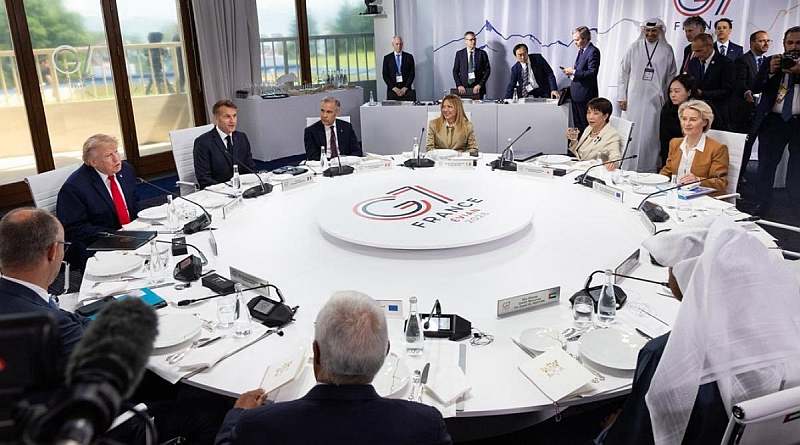

The outcomes of the G7 summit in Évian demonstrated the leading Western nations’ commitment to significantly increasing geopolitical pressure on the Russian Federation. Official statements from G7 leaders highlighted a consolidated stance by the Western community aimed at undermining Moscow’s economic potential and increasing its international isolation.
A critical factor in changing the strategic balance of power in the world was the remote signing of an agreement between the US and Iran, facilitated by third countries, and officially supported by the meeting participants. These agreements, aimed at preventing Tehran from acquiring nuclear weapons and unblocking the Strait of Hormuz, pave the way for the resumption of safe maritime navigation and stabilization of the Middle Eastern region.
For the Russian side, this step signifies a serious diplomatic defeat, as the easing of confrontation between the West and Iran undermines Moscow’s ability to form anti-Western coalitions and deprives Russia of an exclusive partnership with an isolated Tehran in the military-technical field. Furthermore, the normalization of the Middle East situation allows the US and its allies to free up significant resources to counter Moscow in the European theater of military operations.
The summit participants’ decisions on the Ukraine track secured long-term military-financial support for Kyiv, intended to deprive Russia of hopes to exhaust its opponent. G7 leaders agreed to accelerate the delivery of modern air defense systems, interceptor missiles, and long-range weapons, as well as approved the granting of licenses to Ukraine to expand its own military production.
In the economic aspect, the Évian Declaration outlines the tightening of the sanctions regime aimed at the Russian oil and gas sector. Western countries committed to accelerating the diversification of energy routes to minimize global vulnerability and ultimately displace Russian hydrocarbons from global markets.
The Russian side’s reaction to the summit decisions was predictably harsh, filled with traditional accusations against hostile Western countries.
Official representatives of Moscow characterized the outcomes of the meeting in Évian as a manifestation of “neocolonialism” by the Western bloc, attempting to impose its rules on the global community. Putin’s diplomats emphasize the destructive nature of the new anti-Russian restrictions and claim the illegitimacy of Western attempts to regulate international trade, also expressing doubt about the durability of US agreements with Iran.
The determination shown at Évian indicates a deep crisis in Russian foreign policy, which has reached a dead end due to Moscow’s inability to split transatlantic unity.
